 Skip to content
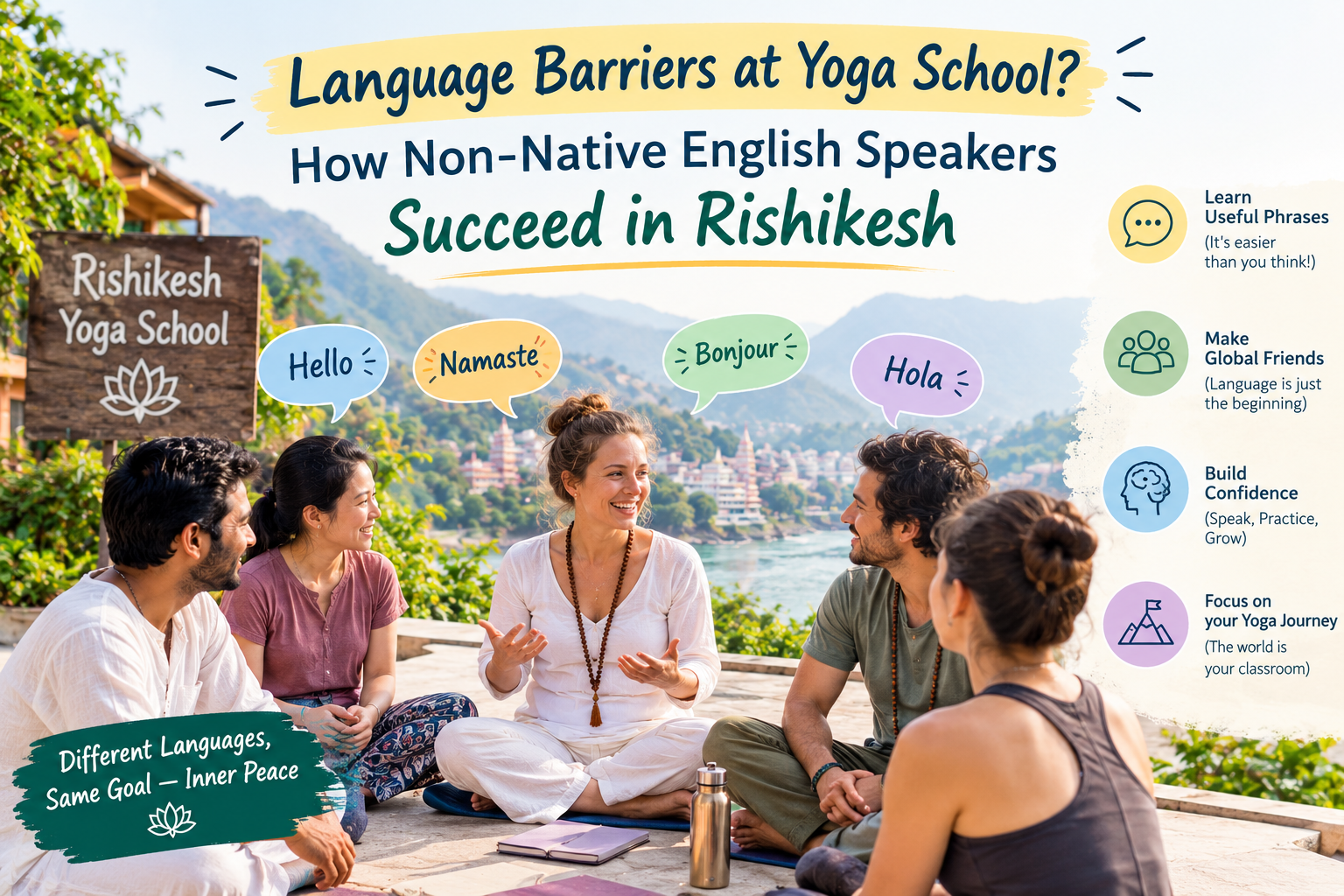
Quick answer: Non-native English speakers succeed in Rishikesh’s yoga programmes because the teaching method relies far more on demonstration, repetition, and physical cueing than on complex spoken English, and because most established schools actively structure their courses — smaller groups, visual learning aids, peer support, and instructors experienced with international students — to make language a minor factor rather than a barrier. Students with basic conversational English routinely complete full certification programmes successfully, provided they choose a school that’s genuinely set up for a multilingual classroom rather than one that simply assumes fluency.
Every year, thousands of students arrive in Rishikesh from Germany, France, Japan, South Korea, Latin America, and dozens of other countries where English isn’t the first language, worried that a language gap will hold them back in a yoga teacher training or retreat. It’s a reasonable worry — technical anatomy terms, Sanskrit vocabulary, and philosophy discussions can sound intimidating even to confident English speakers. But the reality on the ground is usually far more forgiving than students expect, largely because yoga itself is a physical, demonstrated practice, not a lecture-based subject.
This guide looks at where language barriers genuinely show up in a Rishikesh yoga programme, how well-run schools reduce that friction, and what non-native speakers can do before and during the course to make sure the language gap never becomes a learning gap.
Why the Language Concern Is Usually Overstated
Most people picture a yoga teacher training as rows of students taking notes while an instructor lectures in rapid English. In practice, the majority of contact hours in a Yoga Teacher Training in Rishikesh are physical: asana practice, alignment corrections, breathing techniques, and hands-on adjustments. These are taught by demonstration first and explanation second, which means a student can often follow correctly by watching and mirroring the instructor even before every word is understood.
This isn’t unique to one school — it reflects how yoga has historically been transmitted, long before English became the common teaching language in Rishikesh. Sanskrit terms, breath counts, and physical alignment cues translate across language barriers more easily than, say, a university lecture would, simply because the body is doing most of the learning.
Where the Language Barrier Actually Shows Up
That said, it would be misleading to claim language never matters. Three areas genuinely require a working level of English or committed extra effort:
Philosophy and theory sessions. Discussions of yogic philosophy, ethics, and history involve more abstract vocabulary than physical practice does. Concepts explored through Jnana & Karma Yoga in Rishikesh or a broader look at the Values of Yoga in Life, India can be conceptually dense, and following the nuance of a discussion is harder than following a physical sequence.
Anatomy and technical terminology. Understanding the physiological reasoning behind a posture, or how to explain a pose safely to future students, involves specific English vocabulary that doesn’t always have a direct equivalent in a student’s first language.
Written assessments and teaching practice. Most certified programmes, including standard 200 Hours YTTC Rishikesh India courses, require some written work and a supervised teaching segment where students lead a class in English. This is usually where non-native speakers feel the most pressure, even though instructors typically grade for competence in cueing and sequencing rather than for polished English.
How Established Schools Reduce the Barrier
The difference between a frustrating experience and a smooth one usually comes down to how deliberately a school has designed its programme for an international, multilingual classroom. A genuine Best Yoga School in Rishikesh will typically build in several specific supports:
- Smaller class sizes, so instructors can give one-on-one clarification rather than relying purely on group lecture pace
- Visual and physical demonstration as the primary teaching tool, with verbal explanation used to reinforce rather than replace it
- Simplified, deliberate English from instructors who are used to teaching international students, avoiding idiom and unnecessarily complex phrasing
- Peer support structures, pairing students so that someone more confident in English can help translate nuance for a classmate during philosophy sessions
- Written materials and manuals that use plain language and diagrams rather than dense academic prose
Schools that also run structured Yoga TTC India programmes across multiple certification levels tend to have refined this approach over years of teaching a genuinely international student body, which shows in how patiently and clearly instructors handle a mixed-language room.
Why the Physical Practice Itself Is the Great Equaliser
Whatever a student’s native language, most yoga styles are learned the same way: watch, attempt, get corrected, repeat. This is especially true in physically precise styles such as Iyengar Yoga in Rishikesh, India, where instructors rely heavily on hands-on alignment correction rather than verbal instruction alone, and in flow-based styles like Vinyasa Yoga in Rishikesh, India, where breath-to-movement counts are often communicated through rhythm and demonstration more than spoken cues.
Even more dynamic or energetically intense practices, such as Kundalini Yoga in Rishikesh, India or Ashtanga Yoga in Rishikesh, India, rely on fixed sequences that, once demonstrated a few times, become familiar regardless of the language they were first explained in. Students often report that by the second week of a programme, they’re following the physical sequencing entirely from memory and visual cues, independent of how much of the verbal instruction they’re catching in real time.
What EEAT-Aligned Schools Do Differently
Search engines and prospective students alike increasingly evaluate yoga schools on the same criteria Google applies to trustworthy information sources: genuine expertise, real experience, demonstrable authority, and trustworthiness. In practical terms for a non-native English speaker, this translates into concrete, checkable signals:
- Instructor bios with verifiable teaching credentials and years of experience with international, multilingual cohorts
- Transparent curricula that show exactly how much of the course is physical practice versus lecture-based theory
- Reviews or testimonials specifically from non-native English-speaking alumni describing their experience
- Clear policies on language support, rather than a vague assurance that “everyone manages fine”
Programmes that also offer Yoga for Mental Health in Rishikesh, India content or structured guidance tend to be more attentive generally to student wellbeing, including the stress that language uncertainty can add to an already intensive training schedule — which is a reasonable proxy for how seriously a school takes the non-native speaker experience overall.
A Realistic Week-by-Week Progression
Most non-native English speakers describe a similar arc over a standard month-long certification:
Week one. The hardest stretch. New vocabulary, an unfamiliar teaching rhythm, and the mental fatigue of processing a second language for six or more hours a day. Students often understand physical instruction well but struggle to keep pace with philosophy discussions.
Week two. Vocabulary specific to the course — pose names, anatomical terms, common instructor phrasing — becomes familiar through repetition. Following group instruction gets noticeably easier.
Week three. Most students report feeling comfortable participating in discussions, asking questions, and following technical explanations without needing translation help from classmates.
Week four. The teaching practicum, where students lead their own class segment in English. By this stage, most non-native speakers find they know the relevant vocabulary well because they’ve heard and used it daily for three weeks already.
This progression is one of the reasons why the full 100 Hours YTTC Rishikesh India or longer 300 Hours YTTC Rishikesh India formats tend to work better for non-native speakers than very short, intensive programmes — there’s simply more time for language comfort to catch up with physical skill.
Practical Steps Before You Arrive
A few weeks of preparation meaningfully reduces the adjustment period:
- Learn common yoga and anatomy vocabulary in English in advance — pose names, breath-related terms, and basic anatomical directions (flexion, extension, rotation) come up constantly
- Watch a few English-language yoga classes online beforehand to get used to typical instructor phrasing and pace
- Review the Things to Know Before Doing Yoga Teacher Training in India guide, which covers general preparation that also reduces first-week overwhelm
- If possible, contact the school beforehand and ask directly how they support non-native speakers — a school with a real answer, rather than a vague reassurance, is a good sign
What to Do During the Course
- Sit near instructors during lecture sessions rather than at the back, where quieter speech and side conversations make listening harder
- Don’t hesitate to ask an instructor to repeat or rephrase — experienced teachers in Rishikesh are used to this and rarely treat it as disruptive
- Keep a small notebook of new vocabulary as it comes up, rather than trying to absorb everything by ear alone
- Pair up with a classmate for philosophy sessions specifically, even if you’re comfortable with physical practice alone
- Review the day’s written material each evening rather than only during class, giving unfamiliar terms time to settle
Choosing a Course Level That Matches Language Comfort
Course length and intensity affect how much room there is to adjust. Shorter, faster-paced programmes leave less time to catch up if the first week feels overwhelming, while longer courses build in more repetition naturally. Students less confident in English sometimes find it worth starting with a shorter Yoga Retreat in Rishikesh first, to get comfortable with the teaching style and vocabulary in a lower-pressure setting, before committing to a full certification course.
Others prefer to go directly into a full 200 Hours YTTC Rishikesh India programme, reasoning that the immersive, repetitive daily structure accelerates language comfort faster than a shorter stay would. Both approaches work; the right choice depends on individual confidence level and how much time is available.
For students planning to eventually teach professionally, understanding the full Yoga Instructor Certification Guide in India in advance helps set realistic expectations about how much English proficiency different certification levels actually require, since requirements do increase somewhat at more advanced levels such as an Advanced Yoga Practices in Rishikesh India course.
Common Mistakes Non-Native Speakers Make
- Choosing the cheapest available course without checking whether it has any real experience teaching international, multilingual cohorts
- Assuming fluency is required to start, and delaying enrolment for years while “improving English” first
- Skipping preparation entirely and arriving with zero exposure to yoga-specific vocabulary
- Staying isolated within a group of same-language speakers throughout the course, which reduces English exposure and slows adjustment
- Underestimating how much the physical practice itself will carry understanding, and over-worrying about lecture-based sessions specifically
A Practical Checklist Before You Enrol
- Ask the school directly how they support students with limited English confidence
- Check whether class sizes are small enough for individual clarification during lectures
- Confirm whether written materials use plain language and visual diagrams rather than dense text
- Look for reviews from alumni who identify as non-native English speakers
- Consider a slightly longer course format if language confidence is a genuine concern, rather than the shortest available option
Frequently Asked Questions (FAQs)
1. Do I need fluent English to complete a yoga teacher training in Rishikesh?
No. Basic conversational English is generally sufficient, since most learning happens through physical demonstration. Fluency helps with philosophy discussions and the teaching practicum, but isn’t a strict requirement at most schools.
2. Will I fall behind the class if my English is weaker than other students’?
Not typically. Physical practice progresses at a similar pace for everyone regardless of language, and most instructors give individual attention during hands-on correction sessions rather than relying purely on group verbal instruction.
3. Is the written exam difficult for non-native speakers?
It can require more preparation time, but most schools grade for understanding and correct application rather than polished writing style, and allow extra time or clarification where genuinely needed.
4. Are there yoga schools in Rishikesh that teach in other languages?
A small number cater to specific language groups, but most established schools teach primarily in English, since that’s the common language across an international student body. This is usually an advantage, not a drawback, since it exposes students to a wider peer group.
5. How can I practise yoga vocabulary before arriving?
Watching English-language yoga classes online, reviewing basic anatomical terms, and learning common Sanskrit pose names in advance all meaningfully reduce first-week overwhelm.
6. Does a longer course make the language adjustment easier?
Generally yes. Programmes like a 200-hour or 300-hour course give more time for vocabulary and teaching-style familiarity to build gradually, compared to very short, intensive formats.
Final Thoughts
A language barrier can feel like a serious obstacle before arriving in Rishikesh, but in practice, the physical, demonstration-based nature of yoga instruction carries most non-native English speakers through successfully, especially at schools genuinely structured around an international student body. The students who struggle most aren’t usually the ones with the weakest English — they’re the ones who chose a course without checking how well it actually supports a multilingual classroom. Doing that homework beforehand, and putting in a little vocabulary preparation, is usually all it takes to turn a language concern into a non-issue by the second week of training.
