 Skip to content
Introduction: When the Body Needs Rest, Not Another Workout
There’s a particular kind of tired that no amount of sleep seems to fix — the kind that shows up after weeks of overtraining, chronic stress, illness, or simply pushing through life without ever fully stopping. For a lot of people, the instinctive response is to try harder: another intense class, another early wake-up, another attempt to power through fatigue with effort. Restorative yoga works from the opposite assumption entirely, treating rest itself as the active ingredient rather than something to be earned after enough exertion.
It is, without exaggeration, one of the gentlest forms of yoga practiced anywhere, built almost entirely around supported stillness rather than strength or stretch. Even a well-rounded Yoga Teacher Training in Rishikesh program treats restorative practice as a serious subject in its own right, since knowing how to genuinely help a nervous system downshift is a skill many more dynamic styles simply don’t teach.
What Is Restorative Yoga, Exactly?
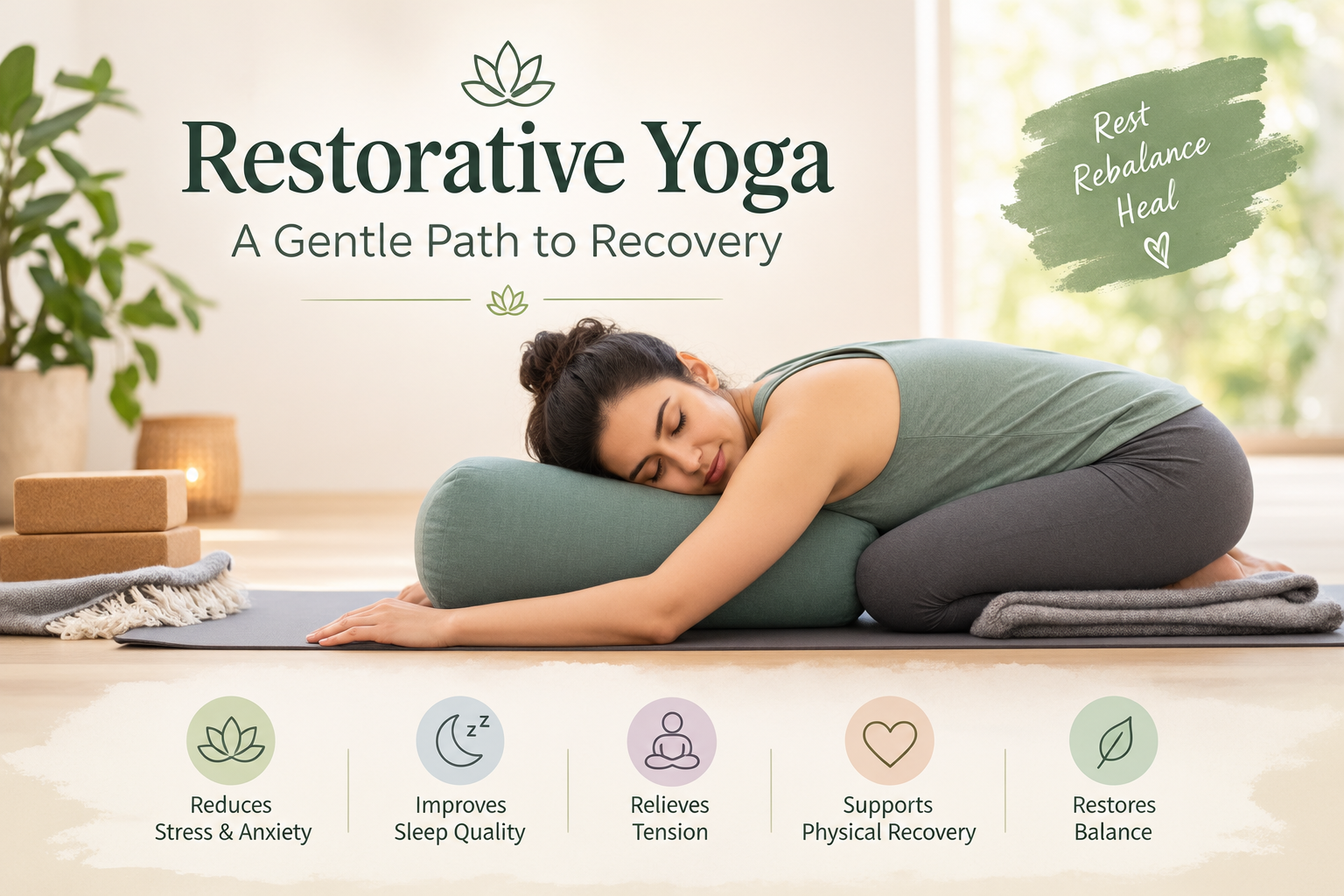
Restorative yoga uses props — bolsters, blankets, blocks, and straps — to fully support the body in a small number of passive postures, each held for five to twenty minutes or more. The goal isn’t to stretch, strengthen, or build heat; it’s to remove every unnecessary effort from the body so the nervous system can settle as completely as possible.
A typical class might include only four or five postures across an entire hour, compared to twenty or more in a flowing class. Every prop placement is intentional, designed to eliminate strain so that not a single muscle needs to work to hold the shape. That absence of effort is exactly the point, and it’s also why restorative yoga can feel strangely unfamiliar to people used to associating yoga with sweat or exertion.
The practice traces back to therapeutic adaptations of Hatha yoga developed for people who couldn’t safely manage a standard class, and it has since grown into a recognized style in its own right, taught in hospitals, cancer centers, and stress clinics as often as in yoga studios. That clinical lineage is part of why restorative yoga is increasingly discussed alongside evidence-based approaches to stress management rather than treated as a purely spiritual or fitness-oriented practice.
Restorative Yoga vs. Yin Yoga vs. Gentle Hatha
These three styles are often lumped together, but they aren’t interchangeable. Yin Yoga intentionally introduces a mild, sustained stretch into connective tissue, which means there’s still some sensation to work with. Restorative yoga removes that sensation almost entirely — props support the body so fully that no stretch is meant to be felt at all, only comfort and release.
Gentle Hatha sits somewhere in between, since postures are still held actively enough to engage muscles, even if the pace is slow. A more alignment-focused approach such as Iyengar Yoga in Rishikesh India also uses props extensively, but typically toward building precise alignment rather than toward total passive rest, which is the clearest line separating it from a true restorative class.
The Core Benefits of Restorative Yoga
1. It Activates Deep Nervous System Recovery
Long, fully supported holds signal safety to the nervous system in a way that active movement simply can’t replicate. This shifts the body out of a sympathetic, fight-or-flight-leaning state and into a parasympathetic one, where digestion, immune function, and tissue repair are naturally prioritized.
2. It Supports Recovery From Burnout and Overtraining
Athletes and dedicated practitioners of more demanding styles often reach a point where the body simply needs less, not more. Restorative sessions layered into a heavy training week, even alongside a rigorous Vinyasa Yoga in Rishikesh India schedule, give overworked muscles and an overtaxed nervous system genuine time to recover rather than accumulating fatigue session after session.
3. It Reduces Chronic Stress and Anxiety Symptoms
Because restorative practice so directly targets the nervous system, it’s frequently used as a complementary tool for people managing chronic stress or anxiety. The combination of full physical support and slow, unhurried breathing creates conditions that are difficult to replicate through willpower alone.
4. It Aids Recovery From Illness, Injury, and Fatigue
For people recovering from illness, surgery, or a long period of physical depletion, restorative yoga offers a way to stay connected to movement and breath without demanding anything the body isn’t ready to give. It’s often one of the only styles of yoga appropriate during active recovery periods, when even gentle Hatha might ask for more than the body can comfortably provide.
5. It Improves Sleep Quality
An evening restorative practice, particularly one that closes with an extended relaxation period, can meaningfully ease the transition into sleep. Many teachers pair the final posture of a restorative class with techniques drawn from Yoga Nidra in Rishikesh, since both practices share the same underlying goal of guiding the body into a state of deep, conscious rest.
6. It Builds Body Awareness Without Physical Demand
Because there’s nothing to actively perform, restorative yoga creates unusual space to simply notice what’s happening in the body — where tension sits, how breath moves, what sensations arise once effort is removed. Over time, this awareness tends to carry over into daily life, making it easier to notice stress accumulating before it becomes overwhelming.
Who Should Try Restorative Yoga?
- Anyone recovering from burnout, overtraining, illness, surgery, or prolonged physical depletion
- People managing chronic stress, anxiety, or a nervous system that rarely feels fully at ease
- Pregnant practitioners or those in postpartum recovery, with appropriate modifications
- Older adults or anyone with limited mobility seeking a genuinely low-impact practice
- Dedicated practitioners of intense styles who need a structured way to recover between sessions
It’s a style that essentially anyone can benefit from trying at least occasionally, regardless of fitness level or prior yoga experience, since there’s no physical prerequisite to lying supported on a bolster.
What a Typical Restorative Yoga Class Involves
Classes usually open with a short period of settling in, followed by a small sequence of supported postures such as Supported Child’s Pose, Reclined Bound Angle, Legs-Up-the-Wall, and Supported Fish, each built almost entirely around props. Bolsters go under the spine or knees, blankets pad the floor or support the head, and straps or blocks fine-tune each shape so nothing requires muscular effort to maintain.
Instruction tends to be quiet and minimal once a posture is set up, often accompanied by dimmed lighting and very little verbal guidance beyond occasional breath cues. The final posture is frequently an extended relaxation period, sometimes stretching past fifteen minutes, allowing the deepest part of the nervous system reset to unfold undisturbed.
Common Mistakes People Make With Restorative Yoga
- Under-propping a posture, leaving the body doing subtle work it’s meant to be relieved of
- Treating it as “not real yoga” and skipping it in favor of more active styles
- Rushing transitions between postures instead of allowing time to fully settle
- Practicing with a racing mind and expecting the body to relax without addressing mental noise
- Choosing restorative yoga only during a crisis, rather than as a preventative, regular practice
Most of these mistakes come from underestimating how much intention restorative practice actually requires, even though it looks effortless from the outside.
Pairing Restorative Yoga With a Broader Practice and Lifestyle
Restorative yoga rarely needs to stand entirely alone. Many practitioners fold it into a broader rhythm that includes more active styles during the week, with one or two restorative sessions serving as a deliberate counterbalance. The reflective, self-inquiry-oriented approach found in Jnana & Karma Yoga in Rishikesh pairs especially well with restorative practice, since both traditions place far more emphasis on inner stillness than on physical output.
For anyone whose fatigue or stress is tied closely to mental health, structured guidance such as that explored in Yoga for Mental Health in Rishikesh India can help contextualize why a slow, supported practice like this often produces benefits that more vigorous styles simply aren’t designed to offer.
Learning to Teach or Deepen a Restorative Practice
Because prop placement and sequencing genuinely matter for safety and effectiveness, learning restorative yoga properly is worth taking seriously rather than improvising from memory. Studying at a recognized Best Yoga School in Rishikesh gives students direct access to instructors trained in exactly this kind of supported, prop-heavy sequencing, rather than a generic approach borrowed from more active styles.
For those considering a deeper commitment, a recognized Yoga TTC India program typically dedicates real curriculum time to restorative technique, alongside more dynamic styles. A clear Yoga Instructor Certification Guide in India and the broader How to Get Yoga Certified in Rishikesh India roadmap both outline how this kind of specialized training fits into a fuller teaching path, useful even for students who simply want to understand the practice more deeply without any intention of teaching it.
Frequently Asked Questions
1. Is restorative yoga good for complete beginners?
Yes, it’s one of the most accessible styles available, since it requires no strength, flexibility, or prior yoga experience. The only real skill involved is a willingness to stay still and let props do the supporting work.
2. How is restorative yoga different from simply resting or napping?
Unlike passive rest, restorative yoga uses intentional postures, breath awareness, and structured prop support to actively guide the nervous system into a parasympathetic state. It’s a more deliberate, guided process than simply lying down, even though the physical effort involved is minimal in both cases.
3. How often should someone practice restorative yoga?
Once or twice a week is a common and sustainable frequency for most people, particularly when it’s used to balance out more demanding activity during the rest of the week. During periods of illness, burnout, or acute stress, more frequent practice can be genuinely beneficial.
4. Can restorative yoga replace more active forms of exercise?
No, restorative yoga isn’t designed to build strength, cardiovascular fitness, or muscular endurance, and it shouldn’t be relied on as a sole form of physical activity long term. It works best as a deliberate complement to more active movement rather than a replacement for it.
5. What props are essential for a home restorative practice?
A bolster, two or three thick blankets, and a couple of blocks cover most common postures. Household substitutes like firm pillows and rolled towels can work reasonably well for beginners before investing in dedicated props.
6. Do you need any special training to teach restorative yoga safely?
Yes — prop placement, timing, and knowing how to modify postures for different bodies all require dedicated instruction rather than intuition alone, which is why most reputable teacher trainings treat restorative technique as its own module rather than an afterthought tacked onto a more active curriculum.
Final Thoughts: Rest as a Practice, Not Just a Pause
Restorative yoga makes an unusual promise for a physical practice: that doing almost nothing, done with enough intention and support, can be genuinely transformative. For anyone caught in a cycle of pushing through fatigue rather than addressing it, that shift in approach alone can be significant, offering a structured, repeatable way to actually rest rather than simply collapsing at the end of an exhausting day.
For anyone wanting to experience this kind of deep, supported practice within a broader, well-guided setting, joining a dedicated Yoga Retreat in Rishikesh offers the structure, environment, and experienced instruction needed to let restorative practice do what it does best — without the distractions that so often make true rest difficult to find at home.
