 Skip to content
A practical, honest guide for Canadians who train in India and want to know which credentials studios, insurers and students in Canada will actually recognise.
Many Canadians travel to the foothills of the Himalayas to complete their first teacher training. They come home with a certificate, a notebook full of philosophy and anatomy notes, and one practical question: what do I register with, and will anyone in Canada care?
The answer depends on which registry you choose, what your school offers and what your future employer expects. Yoga teaching in Canada is generally not a government-regulated profession, so credibility comes from training hours, teacher experience and voluntary membership in a recognised body. This guide explains how the Canadian Yoga Alliance (CYA) compares with Yoga Alliance (US) and other international registries, and how to plan your training in Rishikesh with registration in mind. Standards, fees and recognition rules change, so treat this as a starting point and confirm the details directly with each organisation before you enrol.
1. Why Registration Matters After Rishikesh
A certificate from your school proves you completed a course. A registration, on the other hand, places you on a public list maintained by an independent body. Studios, gyms, corporate wellness programmes and insurance providers often use that list as a quick trust signal.
In Canada, most employers ask for a minimum of 200 hours of training and some form of registration or proof of insurance. Registration is rarely a legal requirement, but it makes hiring, insuring and marketing yourself far easier. It also shows students that you follow a professional code of ethics.
2. Certification vs. Registration: Clearing Up the Terms
These words are often used interchangeably, but they mean different things. Your school issues a training certificate after you complete its programme. A registry, by contrast, lists teachers who meet its stated requirements.
Yoga Alliance (US), for example, describes its credential as a registry and not a certification programme. It lists teachers who meet its experience requirements and completed training at a Registered Yoga School. Understanding this distinction helps you avoid marketing claims such as “internationally certified” that sound official but mean little without the name of the body behind them. Wikipedia
3. How Yoga Alliance (US) Works
Yoga Alliance is the largest international registry and is US-based. Its RYT credentials are tied to training at a Registered Yoga School (RYS). A teacher earns the RYT 200 by completing a 200-hour programme at an RYS 200, and separate trainings cannot be combined to meet the 200-hour requirement. yogaalliance
For the 500-hour level, you complete either a single 500-hour programme or a 200-hour training followed by a 300-hour training. This matters for Rishikesh graduates because the school itself must be registered. Always search the official Yoga Alliance school directory before you pay a deposit, since the registration follows the school and not your certificate alone.
4. How the Canadian Yoga Alliance Works
The Canadian Yoga Alliance is a Canada-specific registry with its own membership levels. According to its published information, its individual registration options include a 200-hour level, and the training does not have to come from a CYA-registered school, although a teacher certificate is required. canadianyogicalliance
This is a significant difference from the US model. It can make CYA registration more approachable for graduates of overseas programmes, provided you keep your paperwork in order. CYA also lists intermediate levels, such as 250 and 300 hours, and combinations of separate trainings. Because membership categories, fees and renewal rules are updated over time, review the CYA membership page on the day you apply.
5. Other International Registries Worth Knowing
Beyond the two main names, several other registries exist. Yoga Alliance Professionals in the UK and the British Wheel of Yoga set standards across Europe. Yoga Alliance Australia and Yoga Alliance New Zealand serve their own regions. Syllabuses are often more tightly constrained when a programme is designed for registration with Yoga Alliance or the British Wheel of Yoga. Wikipedia
India also has a government-backed route. The Ministry of AYUSH supports a Yoga Certification Board with its own evaluation process, which is aimed mainly at teachers working within India’s wellness sector. Recognition of this route outside India varies, so do not assume Canadian employers will treat it as equivalent to a Western registry.
6. Key Differences at a Glance
The differences that matter most in practice are these:
- School dependence: Yoga Alliance (US) ties your RYT credential to a registered school. CYA is more flexible about where you trained, as long as your certificate and hours are documented.
- Recognition: Yoga Alliance is widely recognised internationally, while CYA tends to carry the most weight inside Canada.
- Levels: Both use hour-based tiers, but they differ in their intermediate levels and in how separate trainings can be combined.
- Experience tiers: Experienced designations, such as E-RYT, require post-training teaching hours, and the requirements differ between registries.
- Cost and renewal: Annual fees, insurance offers and continuing education rules differ, so compare current details.
7. What the Hour Levels Actually Mean
Most teachers begin with a 200-hour foundation course. A typical syllabus covers asana, pranayama, philosophy, anatomy, teaching methodology and ethics. If you want to see how a foundation course is structured at a school in the region, review this outline of a 200 Hours YTTC Rishikesh India programme.
The 300-hour level is designed as advanced study after your foundation year, and the 500-hour level combines both. More hours do not automatically mean better teaching, but they do open doors to senior roles, mentoring and running your own trainings. Be cautious of any school that promises an unrealistic number of hours in a very short time.
8. What Canadian Studios and Employers Actually Ask For
In practice, hiring managers look at several things at once: your training hours, your teaching style in an audition class, your insurance and any registration you hold. A registry name on your résumé helps, but it rarely replaces a good sample class.
Independent studios often care most about fit, while larger chains and community centres may specify registration in their job postings. Before you choose a registry, look at three or four job listings in your city and note which credentials appear. That simple research tells you more about local expectations than any general article can.
9. Choosing a Rishikesh School With Registration in Mind
Ask each school which registries recognise its programmes and request proof. Verify the claim on the registry’s own website rather than relying on a logo. A well-run Yoga Teacher Training in Rishikesh course should be transparent about its lead teachers, syllabus, contact hours, class sizes and cancellation policy.
Also check whether the programme meets the contact-hour and non-contact-hour split that your target registry expects. If a school is vague about any of this, ask again in writing. Reputable schools are usually happy to answer these questions before you book.
10. Documents to Keep Before You Fly Home
Registration applications are much smoother when you carry the right paperwork. Before you leave India, make sure you have:
- Your signed certificate showing your name, dates, total hours and the school’s details
- A detailed syllabus or curriculum outline
- The lead teachers’ names and their own credentials
- Receipts and proof of attendance
- Digital copies of everything, stored in more than one place
If a registry asks for verification later, a school that has lost your records can cause weeks of delay. Requesting these documents at the end of your course is a simple step that protects your investment.
11. A Step-by-Step Path From Training to Registration
Start by deciding where you plan to teach. Then compare registries against local job listings and choose your school accordingly. After graduation, submit your application with the required documents, pay the fee and, if needed, arrange liability insurance.
If you want a clearer overview of the stages from beginner to professional, read this guide on how to get yoga certified in Rishikesh India. For a broader look at credentials and what they involve, the Yoga Instructor Certification Guide in India is a useful companion. Allow extra time for processing, particularly if you plan to begin teaching soon after you return.
12. Insurance, Continuing Education and Staying Current
Registration is not a one-time event. Most registries require annual renewal, and many ask for continuing education hours. Liability insurance is a separate matter and is strongly recommended for anyone teaching in Canada, whether in a studio or independently.
Keep learning after your first course. Short specialist trainings in areas such as restorative yoga, prenatal yoga or trauma-informed teaching can strengthen your practice and, in some cases, count toward renewal. Because every registry updates its rules from time to time, set a yearly reminder to review your credentials and standards.
Frequently Asked Questions (FAQs)
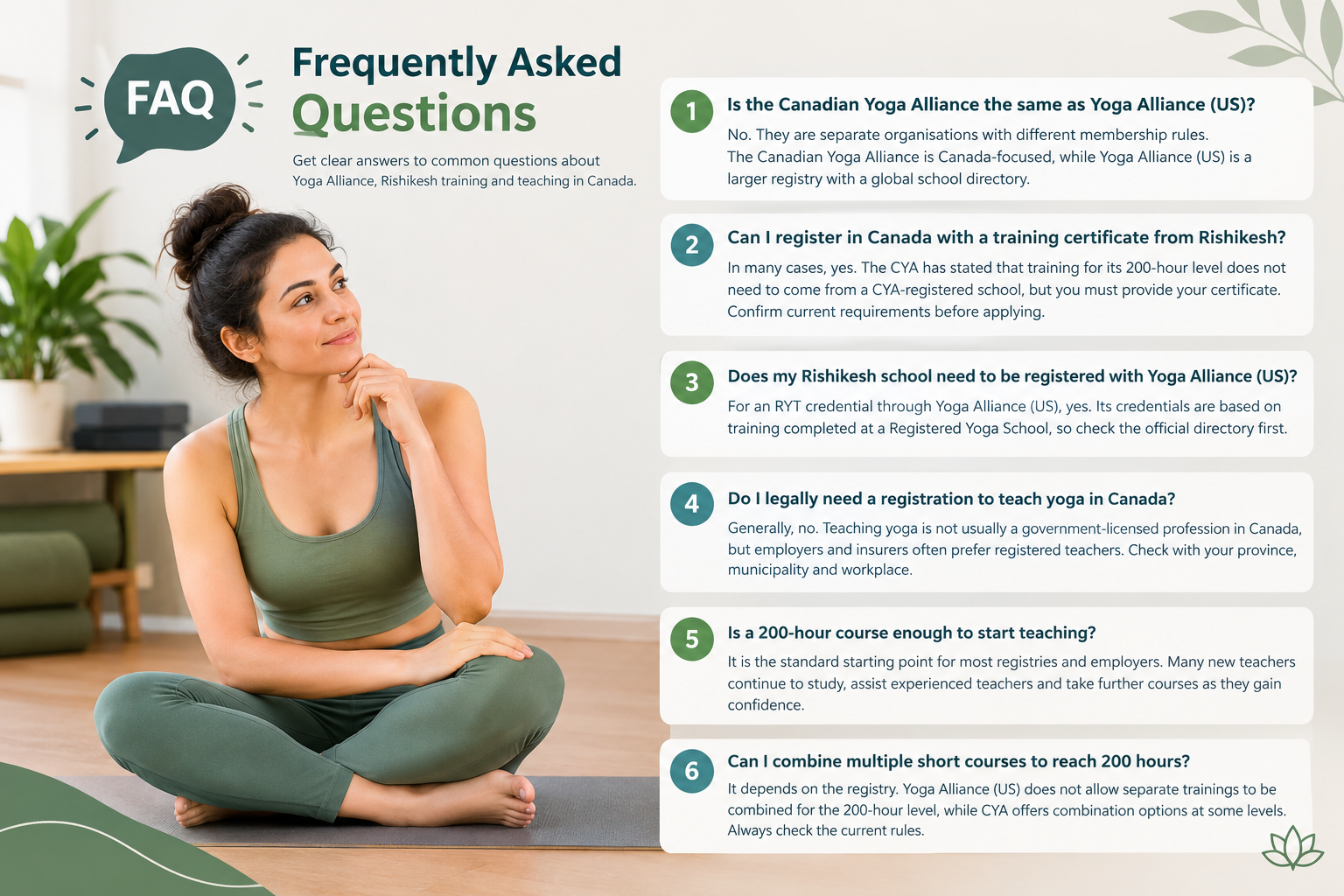
Q1. Is the Canadian Yoga Alliance the same as Yoga Alliance (US)?
No. They are separate organisations with different membership rules. The Canadian Yoga Alliance is Canada-focused, while Yoga Alliance (US) is a larger registry with a global school directory.
Q2. Can I register in Canada with a training certificate from Rishikesh?
In many cases, yes. The CYA has stated that training for its 200-hour level does not need to come from a CYA-registered school, but you must provide your certificate. Confirm current requirements before applying.
Q3. Does my Rishikesh school need to be registered with Yoga Alliance (US)?
For an RYT credential through Yoga Alliance (US), yes. Its credentials are based on training completed at a Registered Yoga School, so check the official directory first.
Q4. Do I legally need a registration to teach yoga in Canada?
Generally, no. Teaching yoga is not usually a government-licensed profession in Canada, but employers and insurers often prefer registered teachers. Check with your province, municipality and workplace.
Q5. Is a 200-hour course enough to start teaching?
It is the standard starting point for most registries and employers. Many new teachers continue to study, assist experienced teachers and take further courses as they gain confidence.
Q6. Can I combine multiple short courses to reach 200 hours?
It depends on the registry. Yoga Alliance (US) does not allow separate trainings to be combined for the 200-hour level, while CYA offers combination options at some levels. Always check the current rules.
Final Thoughts
Choosing between the Canadian Yoga Alliance and an international registry is not about finding a single “best” option. It is about matching your credentials to the place you plan to teach and the kind of students you hope to serve. For many Canadians, that means registering with the CYA, while others add a second registry to widen their reach.
Research first, ask direct questions, keep every document and expect standards to keep evolving. A thoughtfully chosen Rishikesh programme, paired with the right registration, gives you a credible foundation for a lasting teaching career.
