
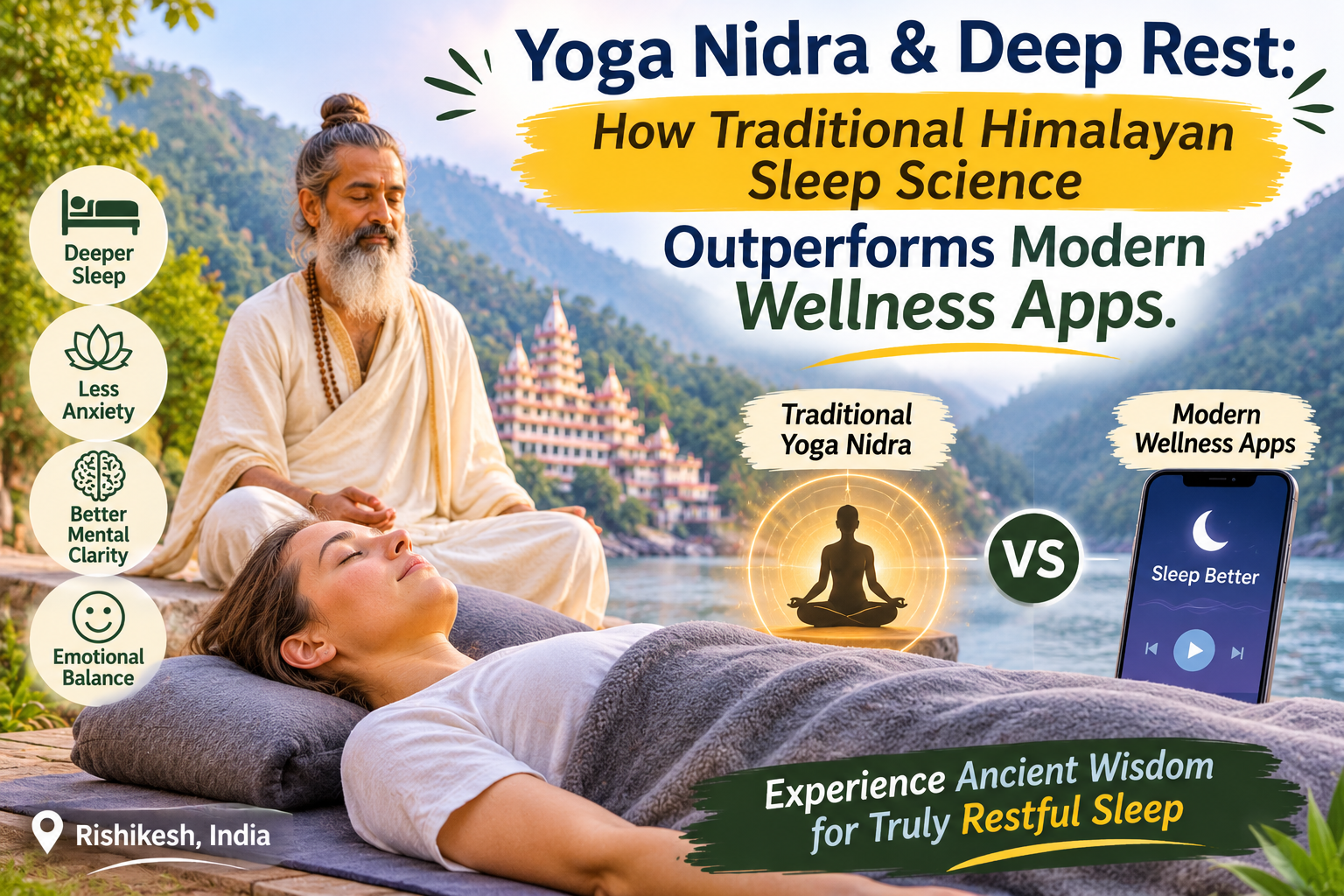
Introduction: We Track Our Sleep, Yet We Are More Tired Than Ever
Many of us now sleep with a small laboratory beside the bed. Wearables score our rest, apps play rain sounds, and algorithms promise a perfect night. And yet tiredness remains one of the most common complaints in modern life.
The Sleep Health Foundation in Australia has long reported that a large share of adults regularly struggle to get enough good-quality sleep, and the Healthdirect service lists insomnia and poor sleep among the most common reasons people seek health advice. The more we measure sleep, the more anxious some of us become about it.
This is where an old Himalayan practice offers a different answer. Instead of tracking rest, Yoga Nidra teaches you to enter it. In this guide, we look at what Yoga Nidra is, how it works, what research honestly says, and why, for many people, it can feel more restorative than a screen-based wellness routine. A quick note on the headline: apps can be useful tools, and “outperforms” here means the depth and lasting skill many practitioners report, not a proven head-to-head victory. We will be clear about that evidence as we go.
What Is Yoga Nidra?
Nidra means sleep, so Yoga Nidra is often called “yogic sleep.” That label is slightly misleading. In Yoga Nidra you lie down and are guided through body awareness, breath and imagery while remaining aware, in a state between waking and sleeping. The body rests deeply while the mind stays quietly alert.
The roots lie in the tantric and yogic traditions of India, and the contemplative maps of consciousness found in texts such as the Mandukya Upanishad, which describes waking, dreaming, deep sleep and a fourth state of pure awareness. In the twentieth century, teachers such as Swami Satyananda Saraswati of the Bihar School of Yoga organised the practice into the systematic, step-by-step form widely taught today.
If you want to experience it in its home setting, you can explore Yoga Nidra in Rishikesh, where it is taught as both a rest practice and a doorway to meditation.
The Himalayan View of Sleep: Rest as a Skill
Traditional yoga does not treat sleep as something that simply happens to you. It treats rest as a skill that can be trained, much like concentration or flexibility.
In this view, poor sleep is rarely about the bed. It is about a nervous system stuck in activation: a busy mind, tense muscles, shallow breath and a body that has forgotten how to let go. Rather than adding more stimulation, even calming stimulation, the Himalayan approach removes effort. You learn to:
- Withdraw the senses (pratyahara): turn attention inward, away from external noise.
- Release holding patterns: move awareness systematically through the body.
- Observe without controlling: notice thoughts and sensations without chasing or resisting them.
- Rest in awareness: remain present while the body softens.
These ideas sit at the heart of the Values of Yoga in Life India, where inner stillness is seen as the foundation of health, not a luxury.
How a Yoga Nidra Session Works
A classical session typically lasts 20 to 45 minutes and follows a clear structure:
- Settling: You lie in savasana, comfortable and warm, and set an intention (sankalpa), a short positive resolve phrased in the present tense.
- Rotation of consciousness: The teacher guides your attention through body parts in a set order, such as right hand, fingers, wrist, and so on, without movement.
- Breath awareness: You follow the natural breath, sometimes counting backwards.
- Opposites and sensation: You feel heaviness and lightness, warmth and coolness, allowing the nervous system to balance.
- Visualisation: Simple images are offered, such as a still lake or a night sky.
- Return: The sankalpa is repeated, and you gently reorient to the room.
The sequence is deliberate. It gives the thinking mind a gentle task, which makes it easier to let go of rumination, and then loosens even that task.
What Happens in the Body and Brain?
Research into Yoga Nidra is still developing, but several findings are worth knowing.
- Autonomic nervous system: Studies on relaxation-based practices, including Yoga Nidra, report reductions in heart rate and self-reported stress, consistent with a shift toward the parasympathetic “rest and digest” state.
- Brain activity: A small number of EEG studies suggest increased alpha and theta activity during practice, patterns associated with relaxed wakefulness and drowsiness.
- Sleep quality: Small trials and reviews, including some indexed on PubMed, have found improvements in insomnia symptoms and perceived sleep quality among people who practise regularly.
- Mood and anxiety: Participants in several studies report lower anxiety and improved emotional regulation.
The honest caveat is that many of these studies are small, short and sometimes lack strong control groups. Yoga Nidra is promising and low-risk for most people, but it is not a proven treatment for clinical insomnia or sleep disorders. If you snore heavily, wake gasping, or feel exhausted despite long nights, please see your GP, as these can signal conditions such as sleep apnoea.
For the broader picture of how traditional practice supports emotional wellbeing, see our guide to Yoga for Mental Health in Rishikesh India.
Yoga Nidra vs Wellness Apps: An Honest Comparison
So does the ancient method really outperform modern apps? Here is a fair look at how they differ.
Where apps shine
- Convenience, with a session in your pocket anywhere, anytime.
- Variety, from sleep stories to guided meditations to soundscapes.
- Data, since tracking can help some people spot patterns.
- Low cost, with many free or inexpensive options.
Where Yoga Nidra tends to go deeper
- It builds a skill, not a habit of dependence. Many people find they need the app every night. With Yoga Nidra, the aim is to internalise the process so you can rest without a device.
- It removes the screen and the score. Sleep tracking can create “orthosomnia,” a term used by sleep researchers for anxiety about achieving perfect sleep data. Yoga Nidra has no score to chase.
- It addresses the body, breath and mind together. Many apps focus on sound or thought. Yoga Nidra moves systematically through physical tension, breath and attention.
- It works in the daytime too. A 20-minute session can restore energy after lunch, something sleep soundscapes are not designed to do.
- It sits within a philosophy. Practices like self-inquiry, explored in Jnana & Karma Yoga in Rishikesh, give context and meaning that a ten-minute app track rarely offers.
The fair verdict
There is no solid evidence that Yoga Nidra beats every app for every person. The strongest case is that it is a complementary, skill-based practice that many people find more sustaining. A sensible approach is to use whichever tool helps you actually rest, and to use apps as a doorway into practice rather than a permanent crutch. Even better, learn Yoga Nidra from a trained teacher, then use a recording when you need it.
Preparing the Body: Gentle Practices Before Deep Rest
Yoga Nidra works best when the body is not buzzing with leftover tension. A few preparatory practices make a noticeable difference:
- Slow, supported postures: Props-based work, as taught in Iyengar Yoga in Rishikesh India, uses blocks, bolsters and straps to help the body release without strain.
- Forward folds and legs-up-the-wall: These calm the nervous system and ease tired legs.
- Extended exhale breathing: Breathe in for four counts and out for six to eight to cue the relaxation response.
- Warm, simple evening habits: Dim lights, a warm drink and a regular bedtime support the practice.
In Ayurveda, India’s traditional system of health, evening self-care such as warm oil massage (abhyanga) is also used to calm vata, the quality linked to restlessness and light, interrupted sleep. Students curious about this can learn more through an Ayurvedic Massage Course in Rishikesh India.
A 20-Minute Yoga Nidra Practice to Try Tonight
You can try this at home. Read it through first, or record yourself reading it slowly, then follow along.
- Prepare (3 minutes): Lie on your back with a pillow under your head and knees if needed. Cover yourself with a blanket. Close your eyes.
- Set an intention (1 minute): Choose a short, positive phrase such as “I am calm and rested.” Repeat it three times silently.
- Body scan (8 minutes): Move attention slowly from your right hand, to right arm, shoulder, then through the left side, legs, back, belly, chest, neck, face and the crown of your head. Simply notice each area without trying to change it.
- Breath awareness (4 minutes): Feel the natural breath. Count backwards from 20 with each exhale. If you lose count, simply begin again.
- Rest in stillness (3 minutes): Imagine a calm place, such as a quiet beach at dawn. Let the image dissolve.
- Return (1 minute): Repeat your intention, wiggle fingers and toes, roll to one side, and sit up slowly.
It is normal to drift into sleep the first few times. With practice, you may stay in that half-aware state longer. If lying still brings up uncomfortable emotions or memories, open your eyes, move your body, or stop and seek support from a qualified professional.
Choosing the Right Practice for Your Energy
Not all evenings call for the same approach. As a general guide:
- Wired and overstimulated: Yoga Nidra, long exhales and gentle forward folds.
- Heavy and sluggish by day: Morning movement such as Vinyasa Yoga in Rishikesh India can help regulate your energy so that your body is ready for rest at night.
- Drawn to inner exploration: Breath-centred traditions such as Kundalini Yoga in Rishikesh India can be taught earlier in the day, with calming practices saved for the evening.
If you are unsure, a qualified teacher can adapt the practice to your needs.
Deep Rest at the Source: Why People Travel to Rishikesh
Rishikesh, set on the banks of the Ganges at the foot of the Himalayas, has been a place of retreat for generations. Away from screens and schedules, the natural rhythm of early rising, simple food and quiet evenings helps many people reset sleep patterns that daily life has disrupted.
A Yoga Retreat in Rishikesh offers time to practise Yoga Nidra daily with experienced teachers, rather than squeezing it between tasks. When choosing a school, look for qualified, registered teachers, a clear daily timetable, transparent communication and a calm, supportive environment. If you are comparing options, learn what to expect from the Best Yoga School in Rishikesh in terms of teaching quality and student care.
Practical tips:
- Best time to visit: Spring (February to April) and autumn (October to November) offer comfortable weather.
- Travel: Fly to Delhi, then continue by road, train, or a short flight to Dehradun.
- Health and safety: Check current entry requirements, consult your GP about vaccinations and travel insurance, and keep your medications with you.
Teaching Others the Gift of Rest
For some practitioners, personal benefit turns into a desire to teach. A structured Yoga Teacher Training in Rishikesh programme covers anatomy, philosophy, pranayama, meditation and teaching methodology, including how to lead relaxation practices safely and clearly.
If you are exploring the pathway, the Yoga Instructor Certification Guide in India explains the steps, and those wanting advanced depth can look at the 500-hour yoga teacher training in Rishikesh. Always ask about lead teachers’ experience, syllabus, class size and course policies before booking.
Frequently Asked Questions
Is Yoga Nidra the same as sleeping? No. In Yoga Nidra you stay aware while the body rests deeply, although many beginners fall asleep, which is perfectly fine.
How often should I practise? Five to seven times a week for several weeks is a common suggestion, though even two or three sessions can help.
Can Yoga Nidra replace medical treatment for insomnia? No. It can support better rest, but persistent sleep problems deserve a medical check.
Do I need to go to India to learn it? Not at all. Reputable local classes and recordings work well, while travel offers deeper immersion.
Is it safe for everyone? It is gentle for most people, but anyone with trauma history, severe anxiety or a mental health condition should practise with a qualified teacher and speak with their health provider.
Final Thoughts: Return to the Original Technology of Rest
Modern wellness apps have their place, but sleep cannot be downloaded. Yoga Nidra offers something different: a way to train your nervous system to let go, using nothing but attention, breath and a quiet place to lie down. Whether you try it for twenty minutes tonight or commit to a retreat at the foot of the Himalayas, you are returning to a practice refined over centuries.
Start small, be patient, and let rest become a skill that belongs to you.