
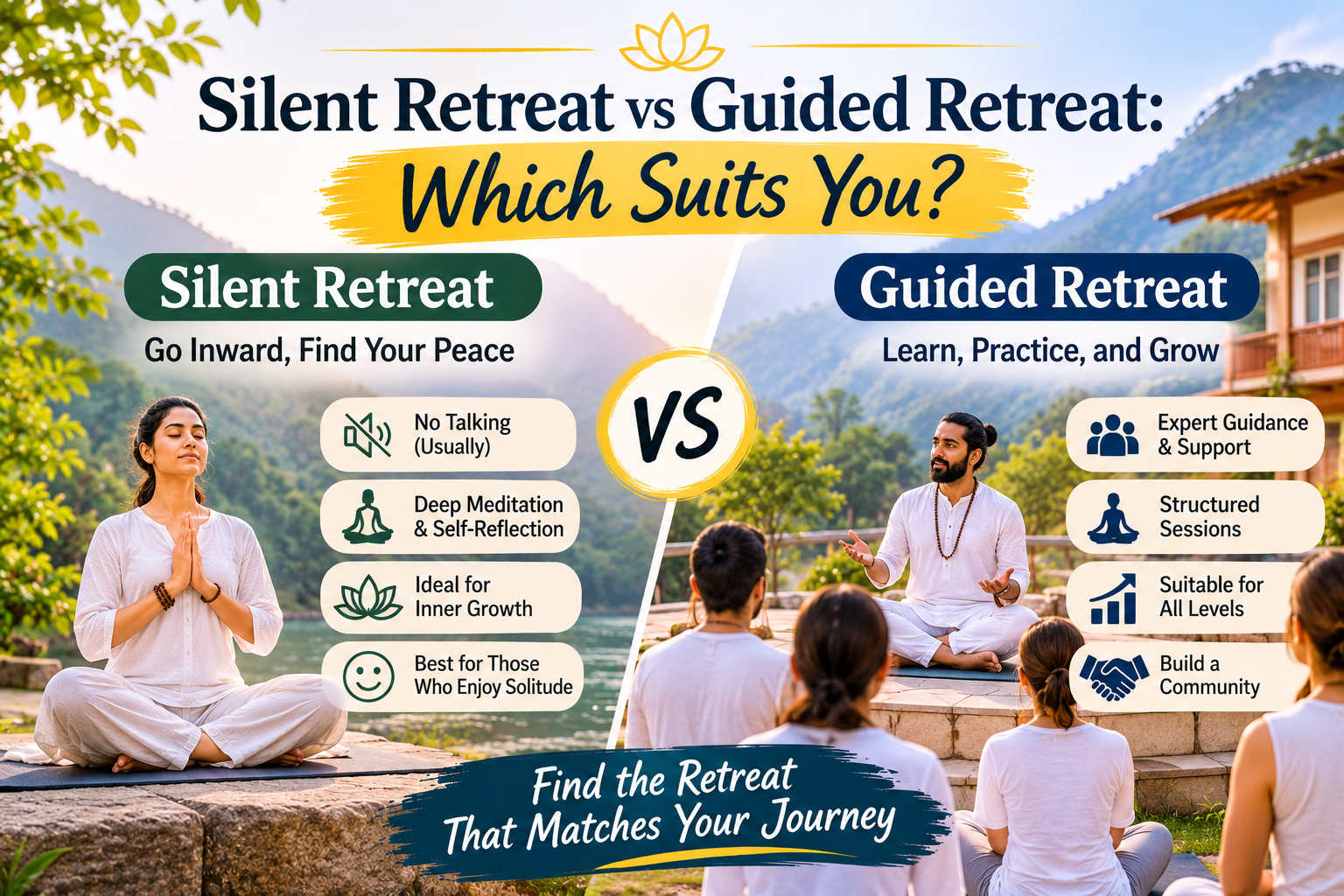
Choosing a retreat sounds simple until you realise how different two options can be. One asks you to stop talking, reading, and often even making eye contact for days. The other fills your day with classes, teachers, discussions, and group activities. Both can be life-changing, and both can be a poor fit if you pick the wrong one.
This guide compares silent and guided retreats in plain terms: what each involves, who tends to benefit, what the risks are, and how to decide. Examples draw on the traditions you will find in Rishikesh, where both formats are widely offered.
What Is a Silent Retreat?
A silent retreat is a period, usually from three days to several weeks, in which participants refrain from speaking to one another. Many traditions extend this to reduced eye contact, no phones, and no reading or writing, so that attention can turn inward. Well-known examples include Vipassana-style courses, where participants observe what is often called “noble silence” while practising meditation for many hours a day.
Silence does not mean there is no structure. Most silent retreats still have a daily timetable, meditation sittings, meals, and often a short check-in with a teacher. What changes is the absence of social conversation, which removes a major source of distraction and self-presentation.
What Is a Guided Retreat?
A guided retreat is led by one or more teachers who instruct, explain, and respond to your questions throughout the programme. A typical day might include asana classes, breathwork, philosophy sessions, meditation, group discussion, and time for rest. Guidance is the defining feature: you are taught techniques, corrected when needed, and supported if difficulties arise.
In Rishikesh, a Yoga Retreat in Rishikesh is commonly of this type, mixing practice with teaching and gentle community. Guided formats suit people who want to learn as well as rest.
The Core Differences at a Glance
| Silent Retreat | Guided Retreat | |
|---|---|---|
| Focus | Inner observation | Learning and practice |
| Talking | Minimal or none | Encouraged in sessions |
| Teacher role | Brief instruction, occasional check-ins | Active, ongoing teaching |
| Social contact | Very limited | Central to the experience |
| Intensity | Mentally demanding | Varied, usually more balanced |
| Best for | Experienced or self-motivated practitioners | Beginners and those wanting structure |
Benefits of a Silent Retreat
Deep rest from stimulation. Constant conversation, notifications, and social roles keep the mind busy. Silence gives the nervous system a break from that demand.
Clearer self-observation. Without conversation to fill gaps, you notice habitual thoughts, moods, and reactions more directly. Many people describe this as the main value of the format.
Strengthened concentration. Long periods of sitting and walking meditation train attention in a way that short classes rarely do.
Simplicity. With fewer decisions and no need to socialise, many people find the days surprisingly restful.
Benefits of a Guided Retreat
Learning technique safely. A teacher can correct posture, adjust practice to your body, and explain the reasoning behind each method. That matters for physical styles such as Vinyasa Yoga in Rishikesh India, which involve continuous movement and require good form, or Iyengar Yoga in Rishikesh India, where detailed alignment guidance is essential.
Community and support. Shared meals, group practice, and conversation help many people feel connected, especially those travelling alone.
Variety. Mixing movement, breathwork, philosophy, and rest keeps energy balanced and prevents boredom.
Direct answers. Questions about practice, philosophy, or personal struggles can be addressed in real time rather than carried silently for days.
The Risks and Limits You Should Know
Both formats have limits, and an honest comparison should include them.
Silent retreats can be emotionally intense. Without distractions, difficult memories or feelings can surface. For most people this passes, and for many it is valuable, but research on meditation has documented that some participants experience distress, anxiety, or disorientation during intensive practice. If you have a history of trauma, severe anxiety, depression, or psychosis, speak with a qualified mental health professional before attempting a long silent retreat, and choose a programme that offers teacher support.
Guided retreats can be overly packed. Some programmes schedule so many activities that participants feel busier than at home. Rest and free time should be part of the design.
Quality varies in both. Credentials, group size, and teacher experience matter. For a general overview of how to evaluate options, see our guide to the Best Yoga School in Rishikesh.
If you are interested in the relationship between practice and emotional wellbeing, our article on Yoga for Mental Health in Rishikesh India explains how breathwork, meditation, and movement can support, but not replace, professional care.
Who Suits a Silent Retreat?
A silent retreat is often a good fit if you:
- Already have some meditation or yoga experience.
- Feel emotionally stable and have healthy support at home.
- Find constant social interaction draining.
- Want to examine your habits and thought patterns directly.
- Are comfortable with long periods of stillness and little stimulation.
It tends to be less suitable for complete beginners, people currently in acute emotional distress, or anyone who relies heavily on conversation to process feelings.
Who Suits a Guided Retreat?
A guided retreat is usually the better choice if you:
- Are new to yoga or travelling alone for the first time.
- Want to learn postures, breathing, and meditation properly.
- Enjoy group energy and discussion.
- Have injuries or health considerations that need adaptation.
- Are considering further training and want a taste of structured study.
If you fall into the last group, it helps to understand what comes next. The Yoga Instructor Certification Guide in India and the roadmap on how to get yoga certified in Rishikesh India outline the stages from beginner to professional. You can also compare formats within Yoga TTC India and Yoga Teacher Training in Rishikesh, which are far more structured than a short retreat.
Can You Combine Both?
Yes, and many people do. Some programmes include periods of silence, such as a silent morning, a silent day, or a final silent weekend, inside a guided framework. This hybrid approach gives you the benefits of inward focus while keeping teacher support close.
Practices like Yoga Nidra in Rishikesh also sit comfortably between the two worlds. They are guided by a teacher’s voice yet deeply inward, which makes them a gentle introduction to quiet practice for beginners.
Another option is to start guided and progress to silence over time. A first retreat of five to seven days with teaching and optional quiet periods can show you how you respond to stillness before you commit to a longer silent course.
The Role of Philosophy in Both Formats
Whatever format you choose, understanding why you practise makes the experience richer. Silent retreats often leave you alone with big questions: Who am I without my roles? What do I actually want? Guided retreats give you language and frameworks for those questions.
Traditional teachings such as Jnana & Karma Yoga in Rishikesh explore self-inquiry and selfless action, ideas that fit naturally into both formats. Likewise, the values of yoga in life, including non-harming, truthfulness, and contentment, give practical guidance for how to live once the retreat ends.
How to Decide: Five Questions to Ask Yourself
- What is my main goal? Rest, learning, reflection, or a mix?
- How experienced am I? Beginners usually benefit from guidance.
- How do I handle solitude? If you enjoy quiet but feel anxious when alone with your thoughts, ease in gradually.
- What is my current emotional state? If you are going through a crisis, choose supported, guided settings and consider professional advice first.
- How long do I have? Longer silent retreats require more commitment, while shorter guided ones are easier to fit into a schedule.
Practical Tips for Either Choice
- Ask about the schedule. Know how many hours per day are practice, teaching, and rest.
- Check teacher support. Even in silent retreats, find out how you can reach a teacher if you struggle.
- Disclose health conditions to the organisers before booking.
- Start shorter than you think you need to.
- Plan your return. Allow a quiet day or two afterwards instead of jumping straight back into work.
- Prepare for the logistics. Read things to know before doing yoga teacher training in India if it is your first visit to the country, and review the daily routine during yoga teacher training in Rishikesh to get a feel for a structured day.
Frequently Asked Questions
Is a silent retreat better than a guided one? Neither is universally better. They serve different goals and different people.
Can beginners attend a silent retreat? Some can, particularly shorter ones with teacher support, but many beginners find a guided programme more comfortable first.
Will I be completely alone in a silent retreat? Usually not. You are with a group, but conversation is restricted. Teachers are typically available for guidance.
What if I want to leave early? Ask about the policy before booking. Reputable organisers explain how they handle early departures and difficult experiences.
Is silence the same as meditation? No. Silence removes talking; meditation is a specific practice. Silent retreats usually include both.
Final Thoughts
The question is not which retreat is better, but which is right for you now. A silent retreat offers depth and solitude; a guided retreat offers learning, structure, and connection. If you are unsure, start with guidance, notice how your mind responds to quiet, and move toward more silence as your confidence grows. Whatever you choose, go with realistic expectations, honest self-awareness, and a reputable teacher, and the retreat will have the best chance of giving you what you came for.