 Skip to content
A deep dive into the ancient city where the Himalayas, the Ganges, and thousands of years of yogic wisdom converge – and why practitioners from every corner of the globe keep returning.
In this article
There are cities built for commerce, cities built for history, and a handful of rare places on Earth built — or rather, grown — for spiritual inquiry. Rishikesh, nestled in the foothills of the Himalayas along the banks of the sacred Ganges River, belongs entirely to the third category. While the title “Yoga Capital of the World” carries obvious marketing weight today, it is not a modern invention. It is a recognition, repeated across centuries, of something that practitioners feel the moment they arrive.
If you have been considering Yoga Teacher Training in Rishikesh, or simply want to understand why this city carries such a profound reputation in the global yoga community, this guide will take you through the history, the geography, the living tradition, and the practical reality of studying yoga in Rishikesh.
The ancient roots that set Rishikesh apart
The story of yoga in Rishikesh does not begin with a wellness trend. It begins in an era long before the words “retreat” or “certification” existed. Ancient texts reference this region — where the hills compress the Ganges into a fast, cold torrent before it opens onto the plains — as a preferred site of tapasya, meaning disciplined spiritual practice. Sages like Vashistha Rishi and scholars who traced the origin of the practice to Hiranyagarbha Rishi understood this landscape as one that accelerates inner work.
The city’s name itself offers a clue. “Hrishikesha” is one of the names of Lord Vishnu, meaning “lord of the senses.” The philosophy embedded in that name — that mastery of the senses is the doorway to liberation — is the same philosophy at the heart of classical yoga. Rishikesh did not adopt yoga as part of its identity; yoga grew here, in the same way that wine culture belongs to a particular valley and cannot fully be replicated elsewhere.
Texts like the Yoga Vashistha and the philosophical frameworks of Sankhya — explored by Kapila Muni — were not merely studied here. They were lived, debated, and refined over generations of rishis who chose this landscape as their ashram.
The Himalayan energy: why geography matters in yoga
It might sound mystical to speak of Himalayan energy, but experienced practitioners are quick to point out that the concept has grounded, observable dimensions. The altitude of Rishikesh — sitting at roughly 1,250 feet above sea level at the point where the Himalayan foothills begin — means the air is noticeably cleaner than in most Indian cities. The river water, flowing directly from Gangotri Glacier hundreds of miles north, is cool, oxygenated, and carries a mineral clarity that practitioners often describe as heightening mental alertness.
Forest cover in the surrounding Rajaji National Park creates an acoustic buffer from urban noise. Early morning practices conducted outside — whether pranayama on a ghats-side platform or asana in an ashram courtyard — unfold in a soundscape of birdsong, flowing water, and distant temple bells rather than traffic. This is not incidental. The science of environment and cognitive performance consistently shows that natural settings lower cortisol, ease nervous-system arousal, and support the kind of sustained inward attention that yoga demands.
Many students who come to study Kundalini Yoga in Rishikesh or Ashtanga Yoga in Rishikesh report that within three to five days, their sleep deepens, their breath lengthens, and concentration sharpens in ways that surprise even longtime practitioners.
This is why yogis have always preferred the Himalayas. The mountain environment does not add decoration to practice — it strips away distraction, leaving the practitioner with fewer excuses and more clarity.
The living lineage of yogic teachers
One of the least appreciated aspects of Rishikesh’s status is the continuity of its teaching lineages. Yoga is, at its core, a transmitted knowledge — not just information to be read in a book, but a direct, experiential transmission from teacher to student. The Nath tradition, traced through figures like Matsyendranath and later Guru Gorakhnath, the lineage preserved at Sivananda Ashram, the classical Hatha traditions passed down through schools like the Nath Sampradaya — these are not museum exhibits in Rishikesh. They are active, taught curricula.
When you study at a serious school in Rishikesh, you are not simply learning postures. You are connecting to a system that has been continuously practiced and debated for centuries. This lineage matters for teachers especially: students who go on to teach carry not just technical knowledge but a philosophical context for that knowledge.
This is also why programs like Jnana and Karma Yoga in Rishikesh and Iyengar Yoga in Rishikesh attract serious practitioners rather than tourists looking for a two-week spa experience. The depth of available study is simply not replicated in most other locations worldwide.
How the West discovered Rishikesh
While Rishikesh was already well-established as a center of yogic learning within India, its international reputation crystallized in the late 1960s when the Beatles famously visited Maharishi Mahesh Yogi’s ashram on the banks of the Ganges. The cultural moment was enormous. Western practitioners who had been cautiously circling the edges of Indian philosophy suddenly had a familiar reference point, and a wave of serious international students followed.
What is often overlooked in the retelling of that story is that Rishikesh was already full of genuine masters before the celebrity visits, and it remained so after the cameras left. The sustained, decades-long reputation of the city as a place of authentic practice rests on far more than a single pop-cultural moment. It rests on the consistent experience of practitioners — from every background and belief system — who arrived as curious seekers and left as changed people.
Today, students from the United States, Europe, Australia, and Southeast Asia account for a significant share of enrollments in 200-hour yoga teacher training programs and more advanced certifications. The international classroom itself becomes part of the education: studying alongside practitioners from thirty different countries, each bringing their own somatic experience and cultural context to the mat, accelerates learning in ways that a domestic training rarely can.
What makes a yoga education in Rishikesh different
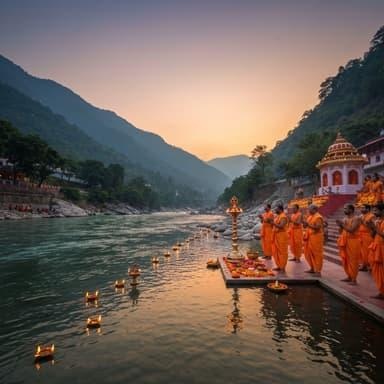
A yoga teacher training in any city will give you a curriculum. A yoga teacher training in Rishikesh gives you a curriculum inside a living context. The evening aarti ceremony at the Triveni Ghat — where hundreds of lamps are floated on the river at dusk — is not a tourist show. It is a daily devotional practice that has been carried out for generations, and witnessing it as a student of yoga changes how you understand the subject you are studying.
The food and lifestyle during training also reflects the yogic philosophy you are learning. Most quality schools observe a sattvic diet — fresh, lightly spiced, vegetarian — which is not merely a preference but an extension of the practice itself. Students frequently report that the clarity of digestion and the absence of stimulants produces a physical receptivity to the practices that feels qualitatively different from their experience at home.
UJ
A note from the mentors at Rishikesh Yog Darshan: Lead instructors Uttam Ji and Anshika regularly remind students that the city itself is a teacher. “Walk by the Ganga before your first class each morning,” Uttam Ji says. “Let the river remind you that the practice is not about performance — it is about flow.”
At Rishikesh Yog Darshan, courses ranging from 100-hour foundations to 500-hour advanced teacher training are designed around this principle: that knowledge of the tradition and embodied practice must develop in parallel, and that the environment of Rishikesh is not a backdrop but an active part of the curriculum.
If you are exploring how to get yoga certified in Rishikesh or assessing the difference between various program lengths, the yoga instructor certification guide available through Rishikesh Yog Darshan is an excellent starting point for US-based students navigating the Yoga Alliance recognition process.
Spiritual and cultural landmarks every yogi should know
The geography of the city is itself a curriculum. The suspension bridges — Laxman Jhula and Ram Jhula — connect the two banks of the Ganges and frame the skyline of ashrams, temples, and ghats that has defined Rishikesh for a century. Walking these bridges at dawn or dusk, with the sound of bells from dozens of temples and the cold river air rising from below, is an experience that stays with practitioners long after they have returned home.
The spiritual places to visit in Rishikesh during your yoga training extend well beyond the famous sites. Neelkanth Mahadev Temple, perched in the forest above the city, is a pilgrimage site for serious practitioners. The caves along the Ganges where historical yogis undertook extended retreats are still accessible. Spending time in these places — not as a tourist, but as a student — deepens the philosophical understanding that no classroom instruction alone can provide.
For students interested in the broader healing tradition, the Ayurvedic massage course and related therapies available in Rishikesh offer a complementary lens on the body that integrates naturally with the yogic framework. Ayurveda and yoga share the same philosophical root in Sankhya philosophy and Vedic cosmology — studying them together in Rishikesh, rather than in isolation, reveals connections that enrich both disciplines.
This is, ultimately, what preserving the soul of classical yoga means in practice: not freezing the tradition in the past, but ensuring that the depth of its philosophy and the rigour of its embodied methods remain available to every generation of practitioners, wherever in the world they may come from.
Frequently asked questions
Is Rishikesh suitable for complete beginners or only for experienced practitioners?−
Rishikesh is genuinely welcoming to all levels. Schools like Rishikesh Yog Darshan offer programs specifically structured for beginners, and the city’s ecosystem of ashrams, drop-in classes, and community practice means that students at every level can find appropriate instruction. Many of the most transformative student experiences in Rishikesh belong to people who arrived with no prior practice at all.
How does a Yoga Alliance certification from Rishikesh affect my ability to teach in the United States?−
Yoga Alliance certification is recognized globally, including in the United States. Completing a Yoga Alliance-registered 200-hour or 300-hour program at a recognized school in Rishikesh qualifies you to register as an RYT (Registered Yoga Teacher) and teach professionally in the US, Canada, Australia, and most other countries that recognize the standard. Always verify that the specific school is currently registered with Yoga Alliance before enrolling.
What is the best time of year for Americans to travel to Rishikesh for yoga training?−
The most comfortable windows for international students are October through February and March through May. The October-to-February period offers cool, clear weather — ideal for both outdoor practice and indoor study. Summer months (June-September) bring the monsoon and significant heat in the lower foothills, though some practitioners find the rainy season’s quieter atmosphere particularly conducive to contemplative practice.
How is studying yoga in Rishikesh different from studying in Bali or other popular destinations?−
Bali offers beautiful natural settings and a thriving yoga community, but its tradition is primarily one of adaptation — drawing on a blend of international influences. Rishikesh is the source. The teaching lineages here trace directly to the ancient traditions from which all modern yoga styles developed. For students who want philosophical depth, historical grounding, and direct connection to the classical tradition alongside practical certification, Rishikesh consistently offers something that newer yoga hubs cannot fully replicate.
