 Skip to content
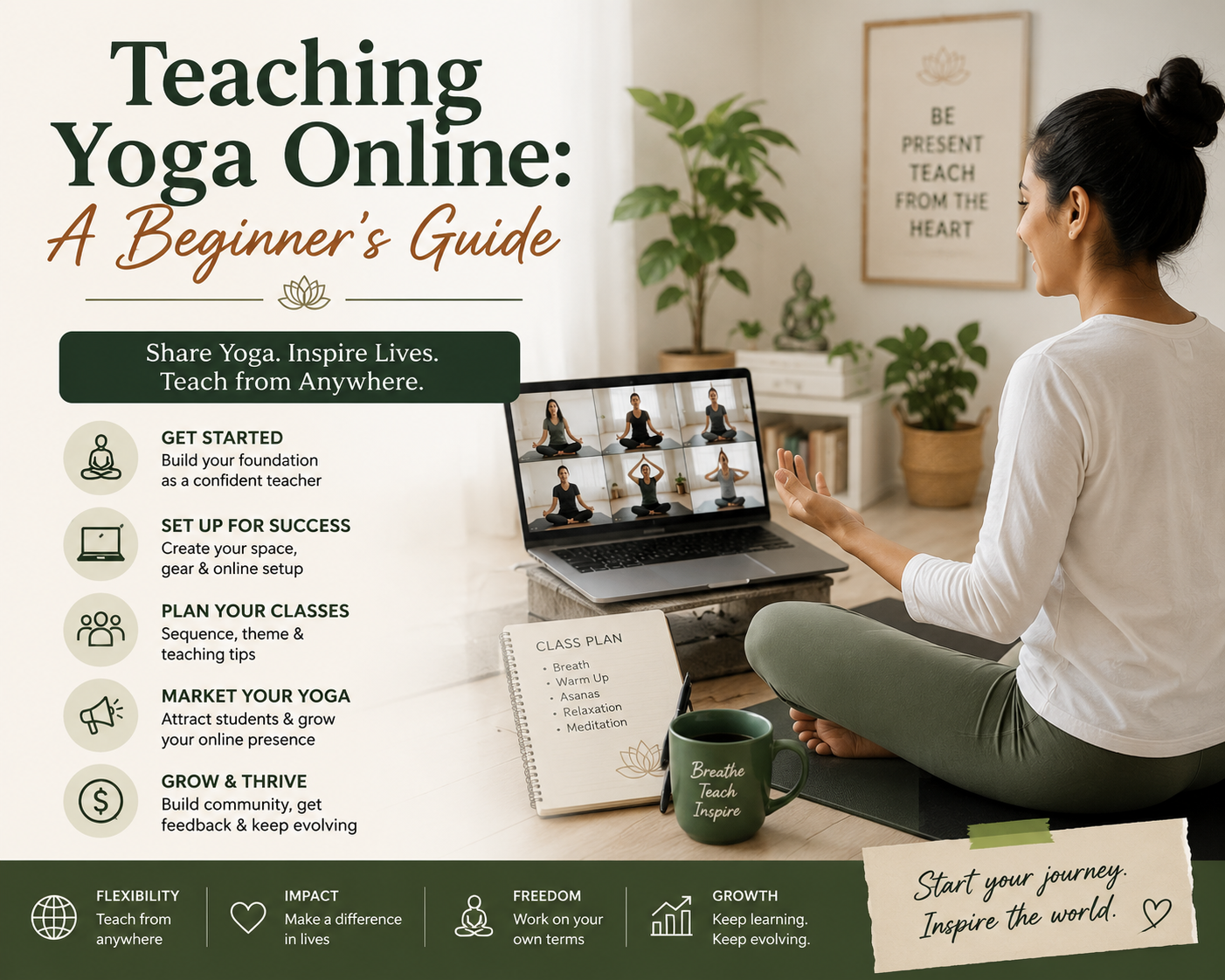
A few years ago, “teaching yoga online” mostly meant uploading the occasional video to YouTube or running an awkward Skype call for a single distant client. Today, it’s an entirely legitimate path — one that thousands of teachers use as a primary income source, a supplement to in-person work, or simply a way to reach students who’d never otherwise have access to their teaching.
For new teachers, though, the idea of teaching online can feel intimidating in a different way than in-person teaching. There’s technology to figure out, an unfamiliar format to adapt to, and the strange experience of teaching to a screen rather than a room full of breathing, moving bodies. This guide breaks down the essentials of getting started with online yoga teaching, from technical basics to teaching adaptations that make virtual classes genuinely effective.
Why Consider Online Teaching as a New Teacher
For those just starting their teaching journey after completing Yoga Teacher Training in Rishikesh, online teaching offers several distinct advantages worth considering even if it’s not your primary focus.
It removes geographic limitations — your potential students aren’t limited to people who can physically attend a class at a specific location and time. It allows for flexible scheduling, particularly valuable if you’re balancing teaching with other commitments. It provides a low-pressure environment to build confidence, since many online formats (especially pre-recorded content) allow for retakes and editing in ways live in-person teaching doesn’t. And it creates a portfolio — recorded classes or consistent online content become a body of work that demonstrates your teaching style to potential students or employers.
Live vs. Pre-Recorded: Understanding the Formats
Live Online Classes
Live classes, typically conducted via video conferencing platforms, most closely resemble in-person teaching — you’re guiding students in real time, can offer (verbal) cues based on what you observe, and there’s an element of community and connection, even through a screen.
Live classes work well for building a regular following, since they create a sense of appointment and routine for students. They also allow for more responsive teaching — adjusting pace, offering modifications, or addressing questions in real time.
The downside is that live classes require students to be available at a specific time, which can limit your potential audience, particularly if you’re hoping to reach students in different time zones.
Pre-Recorded Classes
Pre-recorded content — whether individual class videos, structured course series, or content uploaded to platforms like YouTube — offers flexibility for both you and your students. Students can practice whenever suits their schedule, and you can build a library of content that continues to provide value (and potentially income, depending on your model) long after it’s created.
Pre-recorded content requires more upfront effort (filming, editing) but less ongoing time commitment compared to live teaching. It’s often a good complement to live teaching rather than a complete replacement, especially early on.
Essential Equipment: Keep It Simple
One of the biggest misconceptions new online teachers have is that they need professional-grade equipment to get started. While quality matters, the barrier to entry is lower than many assume.
A smartphone with a reasonably good camera is sufficient for most beginners — many successful online teachers started this way and only upgraded equipment once they’d established a consistent practice and audience. Good, natural lighting (filming near a window, facing the light source) makes a significant difference in video quality without requiring expensive lighting equipment. Stable audio matters more than many people realize — even a basic external microphone significantly improves sound quality compared to built-in device microphones, especially important for cueing and instructions.
A simple tripod or phone stand ensures consistent framing without someone needing to hold the camera, and a clean, uncluttered space — doesn’t need to be elaborate, just tidy and well-lit — provides a professional backdrop without requiring a dedicated studio.
Adapting Your Teaching for the Online Format
Teaching online requires some genuine adaptations beyond simply pointing a camera at yourself doing a class you’d normally teach in person.
Verbal Cues Become Everything
In an in-person class, you can physically demonstrate, walk around and offer hands-on adjustments, and read the room to gauge how students are doing. Online, especially with pre-recorded content or larger live classes, verbal cueing becomes your primary tool. This means being more descriptive and precise with instructions than you might be in person — describing not just what to do, but how it should feel, common misalignments to watch for, and modifications for different needs, all verbally.
Camera Awareness
Unlike teaching in a room where you can move freely, online teaching requires awareness of your camera frame. Students need to be able to see the poses clearly, which sometimes means adjusting your usual positioning — facing the camera for certain poses rather than facing away as you might naturally in person, or using camera angles that show the full body for standing poses.
Building Connection Without Physical Presence
One of the biggest challenges of online teaching is creating the sense of connection and presence that comes naturally in a shared physical space. This might involve more verbal check-ins during live classes (“notice how your breath feels right now”), using names when possible in smaller live classes, or simply being more expressive and warm in your delivery than might feel natural at first.
For teachers whose training emphasized the more subtle, energetic aspects of practice — such as those who’ve studied Kundalini Yoga in Rishikesh India or other practices with strong meditative components — translating that quality of presence through a screen takes practice, but many teachers find that focusing on their own embodiment and presence (rather than worrying about how it’s being received) helps this translate naturally over time.
Choosing Platforms
There’s no single “best” platform for online yoga teaching — the right choice depends on your goals, technical comfort, and audience.
For live classes, video conferencing platforms (originally designed for business meetings) have become widely used for yoga classes due to their accessibility and familiarity for most students. For pre-recorded content, platforms like YouTube offer free hosting with potential for organic discovery, while dedicated course platforms allow for paid content with more control over access and presentation.
Many teachers start with free or low-cost options (a basic video conferencing platform for live classes, YouTube for recorded content) before investing in more specialized platforms as their online teaching grows and they have a clearer sense of what their students actually want and how they prefer to engage.
Pricing and Monetization
Online teaching offers several monetization approaches, and many teachers combine multiple models. Donation-based or pay-what-you-can models work well for building an initial following, particularly for new teachers still developing their online presence — lower barriers to entry mean more people are willing to try a class.
Subscription models (monthly access to a library of content or regular live classes) provide more predictable income once you’ve built a following, though they require consistent content creation to maintain value for subscribers. Individual class or course purchases work well for more specialized content — a workshop on a specific topic, for example — where students are seeking something particular rather than ongoing general practice.
Free content with optional paid offerings (a common YouTube model) builds audience and trust, with monetization coming through other channels — perhaps eventually leading students toward live classes, retreats, or other paid offerings.
Common Challenges and How to Navigate Them
Technical Difficulties
Technology will inevitably fail at some point — connection issues, audio problems, or platform glitches are a near-universal experience for online teachers. Having a calm, flexible approach to these moments (rather than letting them derail the entire class) matters more than preventing them entirely, since they’re often outside your control.
Feeling Disconnected from “Real” Teaching
Some new teachers feel that online teaching is somehow less legitimate than in-person teaching — a lesser version of “real” teaching. This perspective often shifts with experience, as teachers realize that online students experience genuine benefit from their classes, and that the skills developed teaching online (clear verbal cueing, adapting to different needs without physical adjustment, maintaining presence without direct feedback) are valuable in their own right, not just substitutes for in-person skills.
Inconsistent Engagement
Particularly for free or low-commitment content, engagement can feel inconsistent — strong turnout one week, minimal the next. This is normal, especially early on, and tends to stabilize as you build a more consistent following over time. Consistency on your end (regular posting, reliable scheduling for live classes) tends to matter more than any individual class’s turnout.
Combining Online and In-Person Teaching
For many teachers, online teaching works best as part of a broader teaching practice rather than as a complete replacement for in-person work. The flexibility and reach of online teaching can complement the community and physical presence of in-person classes, creating a more diverse and resilient teaching practice overall.
This combination also allows teachers to experiment — testing new sequences or class formats online before bringing them to in-person settings, or vice versa, using in-person teaching experience to refine approaches that then translate to online content.
Frequently Asked Questions
Do I need a large following to start teaching online?
No. Many successful online teachers started with very small audiences — sometimes just a handful of people from their existing network. Growth tends to happen gradually through consistency, word-of-mouth, and gradually expanding reach, rather than requiring a large audience from the outset.
How is online teaching different from filming a class for social media?
While there’s overlap, teaching an online class (whether live or structured pre-recorded content) typically involves a complete practice with intentional sequencing, pacing, and instruction — more akin to a full class experience than short social media clips, which often serve more as promotional or educational snippets rather than complete practices.
What if I’m not comfortable being on camera?
This is extremely common initially and tends to improve significantly with practice. Starting with smaller, lower-pressure formats (perhaps just audio-guided practices, or very small live classes with people you know) can help build comfort gradually before moving to larger or more public formats.
Can online teaching alone provide RYT-required practicum hours?
This depends on your specific certifying body’s requirements — some accept online teaching toward practicum hours, while others require in-person teaching experience. It’s worth checking specific requirements with your training program or Yoga Alliance directly if this is relevant to your certification path.
Is online teaching suitable for all yoga styles?
Most styles can be adapted for online teaching, though some translate more naturally than others. Styles with significant emphasis on verbal instruction and self-guided awareness — such as restorative practices or Yoga Nidra in Rishikesh — often translate particularly well online, since they rely less on physical adjustment and more on guided internal experience, which works naturally through audio and video formats.
How do I get started without feeling overwhelmed by all the technical aspects?
Start small and simple — a basic smartphone recording, a single platform, and one consistent offering (whether a weekly live class or a single recorded practice shared with your existing network). Resist the urge to set up everything perfectly before starting; most systems and preferences become clearer once you’re actually teaching and can identify what genuinely needs improvement versus what was just anxiety about getting started.
Final Thoughts
Teaching yoga online isn’t a lesser substitute for “real” teaching — it’s a legitimate and increasingly valuable skill set in its own right, one that opens opportunities simply unavailable through in-person teaching alone. For new teachers, starting with simple, low-pressure online offerings can build both confidence and a foundation that complements whatever else your teaching career eventually includes — whether that’s studio classes, private clients, retreats, or a combination that continues to evolve as your practice and teaching deepen over time.
