
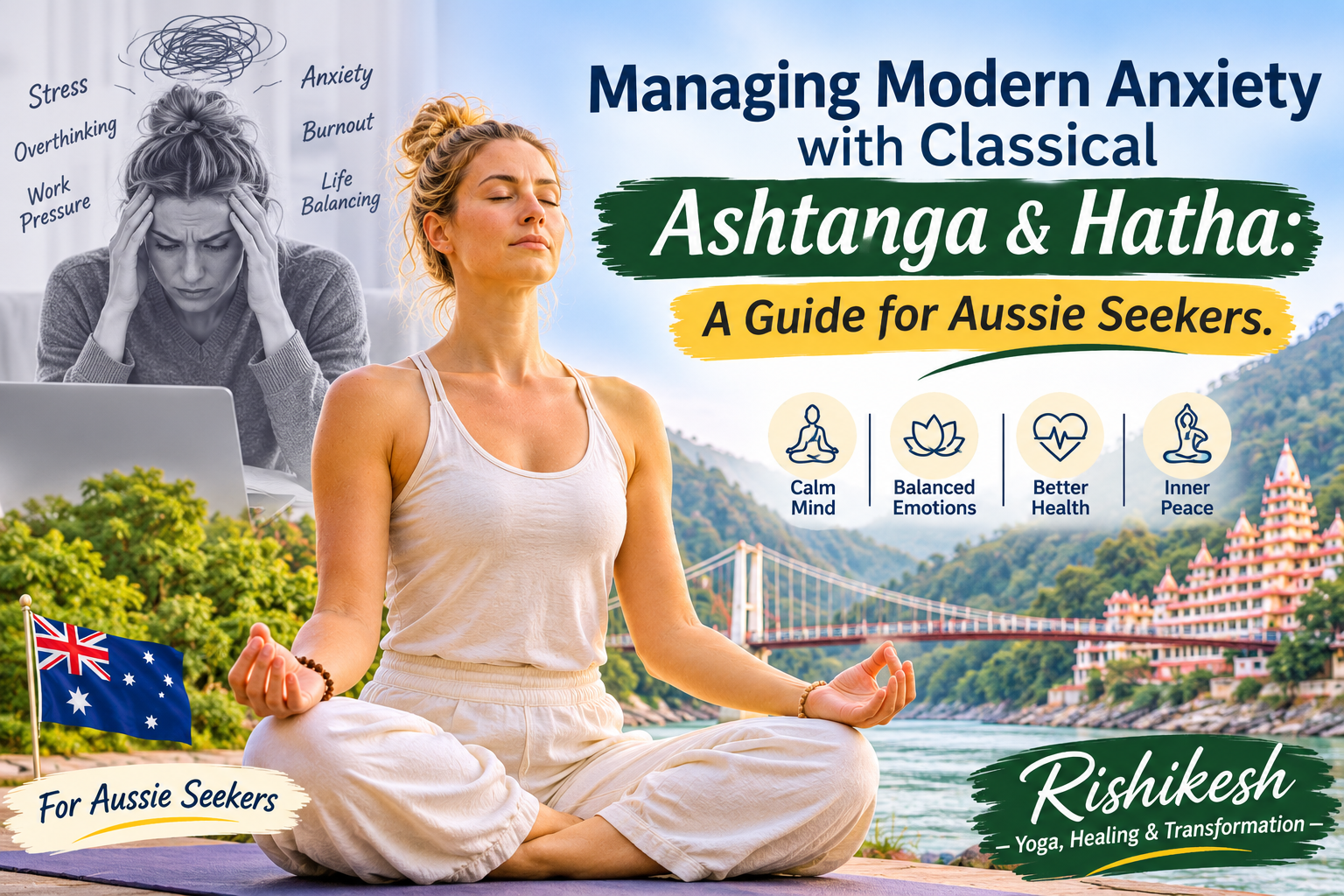
If you live in Sydney, Melbourne, Brisbane or Perth, you know the rhythm: early commutes, rising rent, endless notifications, and a culture that prizes being “flat out.” The beach lifestyle looks relaxed from the outside, yet many Aussies carry a quiet hum of worry that never fully switches off.
The numbers back this up. According to the Australian Bureau of Statistics, anxiety disorders are the most common mental health condition in the country, affecting roughly one in six adults in any given year. Organisations such as Beyond Blue report ever-growing demand for support, especially among younger Australians.
Medication and therapy help many people, and they should always be your first port of call when anxiety is severe. But a growing number of seekers are adding something older and slower to their toolkit: the classical yoga practices of India. In this guide, we explore how traditional Ashtanga and Hatha yoga can help you manage modern anxiety, how to start at home, and how a trip to the source can deepen your practice.
Understanding Modern Anxiety: What Is Really Happening in the Body?
Anxiety is not simply “overthinking.” It is a whole-body experience. When your brain perceives a threat, whether a real danger or an overflowing inbox, the sympathetic nervous system releases adrenaline and cortisol. Your heart rate rises, breathing becomes shallow, muscles tighten, and your mind scans for what might go wrong.
This fight-or-flight response is useful in an emergency. The trouble is that modern stressors rarely end. Chronic activation leads to common symptoms:
- Racing thoughts and difficulty concentrating
- Tight shoulders, jaw and chest
- Shallow, rapid breathing
- Poor sleep and restlessness
- Digestive discomfort
Classical yoga approaches these symptoms from the body upward. Instead of arguing with anxious thoughts, it changes the physical state that feeds them: posture, breath and attention. This is why many people find yoga for stress and anxiety relief more accessible than purely cognitive methods when their mind feels too loud to think straight.
What Makes Ashtanga and Hatha “Classical”?
The words “Hatha” and “Ashtanga” are used loosely in studios today, so it helps to know the roots.
Hatha yoga is the broad tradition of physical practice described in texts such as the Hatha Yoga Pradipika. It combines asanas (postures), pranayama (breath control), mudras, bandhas and cleansing practices to prepare the body and mind for meditation. The name is often explained as the union of ha (sun) and tha (moon), balancing opposing energies.
Ashtanga yoga comes from two layers. The first is the eight-limbed path of Patanjali’s Yoga Sutras: ethical restraints (yama), personal observances (niyama), posture (asana), breath regulation (pranayama), sense withdrawal (pratyahara), concentration (dharana), meditation (dhyana) and absorption (samadhi). The second is the dynamic, set-sequence style popularised by K. Pattabhi Jois in Mysore. If you want to see how this method is taught at its source, explore Ashtanga Yoga in Rishikesh India.
Together, Hatha provides the foundation and Ashtanga provides the structure and discipline. For an anxious mind, that combination is powerful: Hatha teaches you to slow down, while Ashtanga teaches you to stay steady.
How Ashtanga Calms an Anxious Mind
At first glance, a vigorous, sweaty Ashtanga class may seem the opposite of relaxing. Yet its design is precisely what many anxious people need.
1. A predictable sequence
Anxiety thrives on uncertainty. Ashtanga’s fixed sequence means you always know what comes next. Over weeks, this predictability becomes a container for the mind, and you stop spending energy deciding and start simply doing.
2. Breath-led movement
Every movement is linked to an inhale or exhale using ujjayi breathing, a gentle constriction at the back of the throat that creates an audible, ocean-like sound. This slow, rhythmic breath stimulates the parasympathetic nervous system, the body’s rest-and-digest mode.
3. Drishti, or focused gaze
Each posture has a specific gaze point. Fixing your eyes on one spot trains attention and interrupts the habit of mental scanning for threats.
4. Physical release
Vigorous practice burns off excess adrenaline. Many students describe feeling “clean” and quiet after a morning session, as though the static had been cleared from the line.
A note of caution: a very intense practice can overstimulate some people, especially those with panic attacks or poor sleep. If that sounds like you, begin with a shorter, gentler version of the sequence and build slowly under a qualified teacher.
How Hatha Soothes the Nervous System
Where Ashtanga builds discipline, Hatha offers softness. A traditional Hatha class holds postures longer, pays close attention to alignment, and weaves in breathwork and relaxation.
- Longer holds teach you to stay with discomfort without reacting, a skill that transfers directly to anxious moments in daily life.
- Pranayama such as alternate nostril breathing (nadi shodhana) and extended exhale breathing helps shift the body into a calmer state.
- Final relaxation (savasana) gives the nervous system a chance to integrate the practice.
For deeper rest, many seekers pair Hatha with guided relaxation such as Yoga Nidra in Rishikesh, a systematic practice of lying down while being led through body awareness, breath and imagery. It is especially helpful when anxiety shows up as insomnia.
The Science: What Research Says
It is important to be honest about what yoga can and cannot do. Studies and systematic reviews, including those indexed on PubMed, suggest that regular yoga practice can reduce self-reported stress and anxiety symptoms, improve sleep quality and lower markers of physiological arousal such as heart rate. Slow breathing practices in particular are linked with improved heart rate variability, a marker of a flexible, resilient nervous system.
However, yoga is best understood as a complementary approach. Research quality varies, and results differ between individuals. If you experience persistent panic, intrusive thoughts or depression, please speak with your GP or a psychologist. In Australia, Beyond Blue (1300 22 4636) and Lifeline (13 11 14) offer free support at any hour.
For a deeper look at the mind-body connection, our article on Yoga for Mental Health in Rishikesh India explains how traditional practices support emotional balance.
Beyond the Mat: The Philosophy That Quiets Worry
Classical yoga was never meant to be only exercise. Patanjali defined yoga as the stilling of the fluctuations of the mind, and the philosophy offers practical tools for modern worry.
- Santosha (contentment): noticing what is already enough, instead of chasing the next goal.
- Aparigraha (non-grasping): loosening the grip on outcomes you cannot control.
- Pratyahara (sense withdrawal): deliberately stepping back from screens and stimulation.
These ideas sit at the heart of the Values of Yoga in Life India, and they are just as relevant on a Bondi morning as in a Himalayan ashram. Those drawn to the intellectual and service-based paths can also explore Jnana & Karma Yoga in Rishikesh, which teach self-inquiry and selfless action as antidotes to rumination.
A Simple 20-Minute Routine for Anxious Days
You do not need an hour or a perfect studio. Try this gentle blend of Hatha and Ashtanga principles at home, ideally in the morning or early evening.
- Arrive (2 minutes): Sit comfortably and take ten slow breaths, making the exhale longer than the inhale.
- Cat-cow (2 minutes): Move with your breath to warm the spine and release tension.
- Sun Salutation A, three to five rounds (6 minutes): Link each movement to one breath. Keep your gaze soft.
- Standing postures (4 minutes): Hold Warrior II and Triangle for five breaths each side.
- Forward fold and seated twist (2 minutes): Fold forward to calm the mind, then twist gently to release the spine.
- Alternate nostril breathing (2 minutes): Breathe slowly through one nostril at a time.
- Savasana (2 minutes): Lie still and let the breath return to its natural rhythm.
Practise four to five days a week for a month and note changes in your sleep, mood and reactions. Consistency matters far more than intensity. If a posture or breathing technique increases your anxiety, ease off or stop.
Choosing the Right Style for Your Temperament
Not every nervous system responds to the same practice. A quick guide:
- Feeling restless, wired, overstimulated? Start with slower Hatha and Yoga Nidra.
- Feeling stuck, heavy, low-energy? A more dynamic style such as Ashtanga, or a flowing Vinyasa Yoga in Rishikesh India class, can lift energy.
- Need precision and support for tight or injured areas? Alignment-focused approaches can help.
A good teacher will adapt the practice to you. This is where lineage, experience and training standards matter, a point we return to below.
Why Many Australians Travel to Rishikesh
Rishikesh, nestled in the foothills of the Himalayas along the Ganges, is widely known as the “Yoga Capital of the World.” For Australians, it offers something that is hard to find at home: complete immersion. There are no work emails, no traffic, just sunrise practice, simple meals, river air and teachers who have lived the tradition.
A Yoga Retreat in Rishikesh gives you time to settle into the practices described above, away from the triggers of daily life. Many seekers describe that first week as the moment their nervous system finally exhales.
When choosing where to study, look for a school with experienced, registered teachers, small class sizes, a clear daily schedule that includes philosophy and meditation, and honest, transparent communication. If you are comparing options, you may want to learn what makes the Best Yoga School in Rishikesh stand out in teaching quality and student care.
Practical tips for Australian travellers:
- Best time to go: October to November and February to April offer comfortable weather. The monsoon (July to September) brings heavy rain.
- Travel route: Fly into Delhi, then travel to Rishikesh by road or train, or take a short domestic flight to Dehradun.
- Visas and health: Check current entry requirements on the Australian Government’s Smartraveller website and consult your GP about vaccinations.
- Pack light: Comfortable clothing, a sturdy mat if you prefer your own, and an open mind.
From Personal Practice to Teaching: Is It Right for You?
For many, a healing journey becomes a calling. Students who experience the benefits of yoga firsthand often want to share them. A structured Yoga Teacher Training in Rishikesh programme can deepen your understanding of anatomy, philosophy, sequencing and teaching methodology, whether or not you plan to teach professionally.
If you are new to formal training, the 200-hour yoga teacher training in Rishikesh is the standard foundation course, covering Hatha and Ashtanga basics, pranayama, meditation and anatomy. Aussie students often value that the certification can support teaching back home, particularly when the school is registered with Yoga Alliance, which is recognised by many Australian studios.
As always, do your homework: ask about lead teachers’ qualifications, course syllabus, accommodation, class size and refund policies before you book.
Frequently Asked Questions
Can yoga cure anxiety? No. Yoga can help manage symptoms and build resilience, but it is not a cure and should not replace professional care when anxiety is significant.
Is Ashtanga too intense for beginners with anxiety? It can be if you jump in too fast. Start with a short, modified sequence and focus on breath before effort.
How long until I notice a difference? Some people feel calmer after a single session. For lasting change, aim for consistent practice over four to eight weeks.
Do I need to travel to India to benefit? Not at all. Home and local studio practice are valuable. Travel simply offers deeper immersion and access to traditional teachers.
Final Thoughts: Come Home to Yourself
Modern anxiety is a sign of a nervous system working overtime in a world that rarely lets it rest. Classical Ashtanga and Hatha yoga offer a time-tested way to slow down, breathe deeply and reconnect with steadiness that already exists within you. Begin with twenty minutes on your lounge-room floor. Be patient, be kind to yourself, and seek professional help whenever you need it.
And if the call to go deeper grows louder, the foothills of the Himalayas are waiting.