
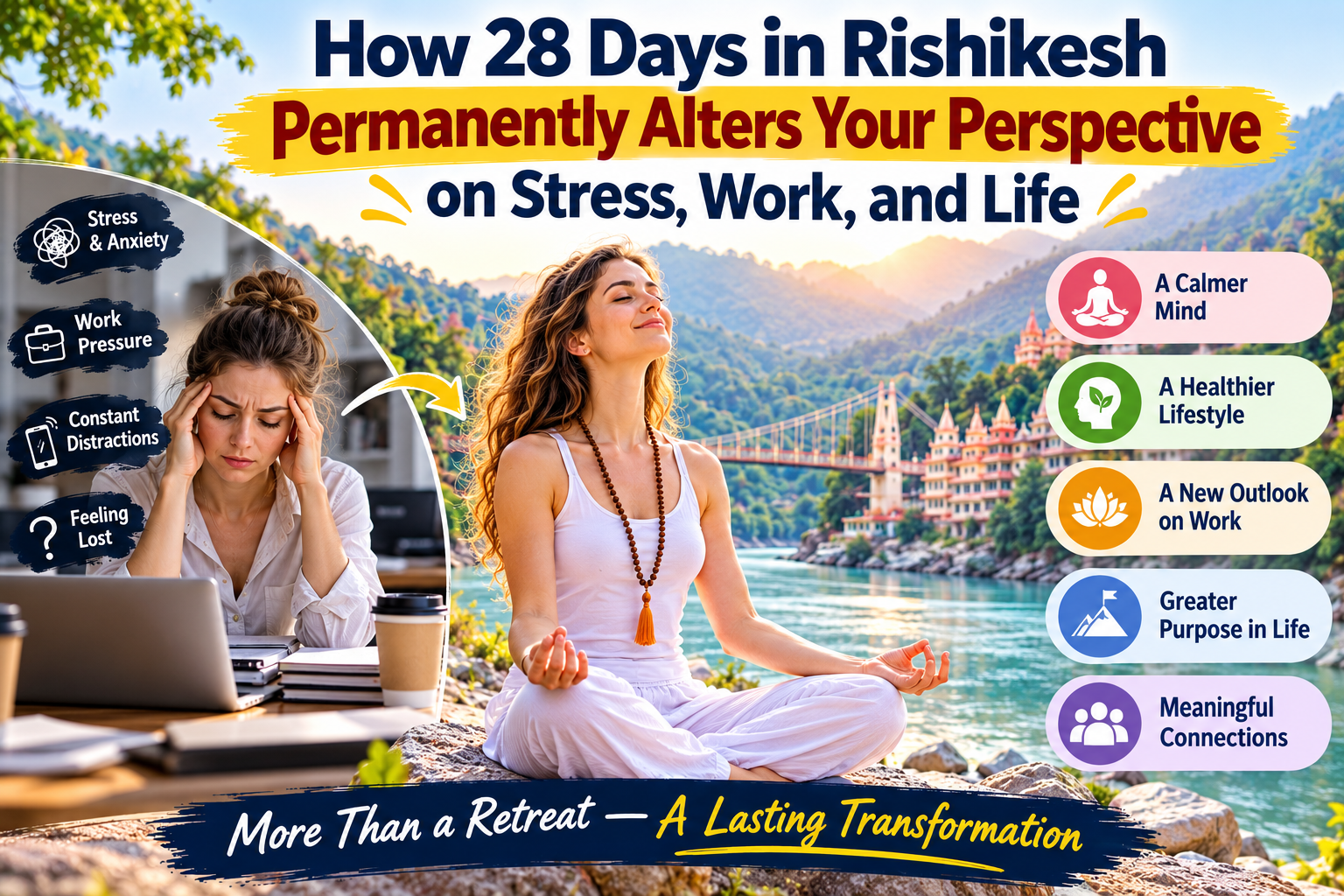
Most of us don’t realise how much stress we carry until we stop for a few days. The inbox goes quiet, the commute disappears, and suddenly the body shows what it has been holding: tight shoulders, shallow breathing, a mind that cannot settle. Now imagine stepping away for 28 days, not for a holiday, but for structured immersion in yoga, breathwork, meditation, and philosophy on the banks of the Ganga.
That is what thousands of people from around the world do every year in Rishikesh. Many arrive tired and sceptical. Many leave with something harder to name than “relaxation”: a different way of relating to pressure, ambition, and time. This article explains why 28 days is long enough to create lasting change, what happens week by week, and how those shifts carry into ordinary life.
Why 28 Days Is a Meaningful Turning Point
A weekend retreat feels lovely, but it rarely outlasts the flight home. Four weeks is different. It is long enough for your sleep cycle to reset, for new habits to become automatic, and for the “performing” version of you to relax. Research on habit formation suggests that new routines take weeks, not days, to become stable, and a month of daily practice gives the nervous system repeated, consistent evidence that calm is possible.
That is also why many people choose a 28-day format when they enrol in Yoga Teacher Training in Rishikesh. The programme structure matters as much as the destination: early mornings, a predictable rhythm, simple food, and fewer decisions to make. Rishikesh itself supports this. If you are curious about the town’s pull, see what makes Rishikesh the Yoga Capital of the World for the history behind its reputation.
Week 1: The Body Lets Go Before the Mind Does
The first week is rarely glamorous. You wake before sunrise, your hamstrings protest, and your mind loudly argues for your phone. Many students report restless sleep for the first few nights as the body adjusts to a new rhythm.
This is useful information. Stress is not only a mental state; it lives in posture, breath, and muscle tension. Slow, deliberate asana and pranayama start to interrupt that pattern. You notice, perhaps for the first time in years, how often you hold your breath at a desk or clench your jaw when thinking.
If you want a realistic picture of how a day is structured, this daily routine during yoga teacher training in Rishikesh breakdown walks through it hour by hour. The takeaway: the schedule does the heavy lifting so you do not have to rely on willpower.
Week 2: Learning to Work With Attention, Not Against It
By the second week, the body starts to cooperate and the mind becomes the main subject of study. Styles such as Vinyasa Yoga in Rishikesh India link breath to movement, which trains sustained attention in a way that is surprisingly practical. When you must match each inhale to a movement for ninety minutes, distraction becomes visible, and so does your ability to return from it.
Traditions with a more structured approach, like Ashtanga Yoga in Rishikesh India and Iyengar Yoga in Rishikesh India, teach another lesson relevant to modern work: precision and patience. Ashtanga rewards consistency; Iyengar rewards careful alignment and the willingness to stay with discomfort without forcing results.
Compare that to a typical workday of context switching and constant notifications. Many people discover that what they called “poor focus” was really a trained habit of fragmented attention, and habits can be retrained.
Week 3: Meeting Stress at Its Source
Around the third week, something shifts. The physical practice is no longer the challenge, and quieter questions emerge. Why do I feel guilty when I rest? What am I chasing? Who decided that busy equals valuable?
This is where the less visible parts of yoga become central. Practices like Yoga Nidra in Rishikesh offer guided deep relaxation, a structured way to rest while remaining aware. For people whose “rest” usually means scrolling, it can feel unfamiliar at first, then deeply restorative.
If your main motivation is emotional balance, it is worth exploring Yoga for Mental Health in Rishikesh India. Yoga is not a replacement for professional care, and anyone living with anxiety, depression, or trauma should consult a qualified healthcare provider. But as a complement, breathwork and meditation give you tools to notice a stress response and choose a different reaction.
The Shift From “Reacting” to “Responding”
The most commonly reported change at this stage is a gap: a small pause between a trigger and a reaction. A difficult message arrives, and instead of an instant spike of anger or worry, there is a breath first. It sounds minor. In practice, it changes conversations, decisions, and relationships.
Week 4: Rethinking Work Through Karma and Jnana
The final week often brings the biggest shift in perspective, particularly around work. Classical teachings such as Jnana & Karma Yoga in Rishikesh explore two ideas that quietly transform how professionals think.
Karma yoga is the practice of acting with full effort while releasing attachment to the outcome. It does not mean being careless about results. It means doing excellent work without letting your self-worth rise and fall with every approval or setback.
Jnana yoga is the path of inquiry: examining who you are beyond job titles, achievements, and roles. For people whose identity is tightly bound to their career, this reflection can be unsettling and freeing in equal measure.
Together they suggest a healthier relationship with ambition. You can still work hard, build things, and pursue growth, but from steadiness rather than fear. Many students describe this as the moment work stopped feeling like a constant emergency.
What Actually Changes: Stress, Work, and Life
After 28 days, people typically describe changes in three areas.
Stress. Stress does not vanish, because life continues to be unpredictable. What changes is your relationship with it. You recognise early signals such as shallow breath, tight shoulders, or racing thoughts, and you have practical tools to respond. The values of yoga in life (non-harming, truthfulness, contentment, self-discipline) become less like abstract ideas and more like daily decision filters.
Work. Many people return with clearer boundaries. They protect sleep, take real breaks, and single-task. Some decide to change careers; others stay but work differently. Neither outcome is “better.” The point is that the choice becomes conscious rather than automatic.
Life. Simplicity becomes appealing. After a month of eating simple meals, sleeping early, and spending time in nature, you notice how little you actually need to feel well. That clarity is often the most lasting souvenir.
Is the Change Really “Permanent”?
An honest answer: the experience is permanent, but the benefits depend on practice. A month in Rishikesh gives you a lived reference point, proof that you can feel calm, focused, and clear. Whether that holds depends on whether you keep a daily routine of even 20 to 30 minutes of asana, pranayama, or meditation.
People who sustain the change usually do three things: they keep a short daily practice, they stay connected to a community or teacher, and they make one or two concrete lifestyle changes (such as a consistent sleep schedule) rather than attempting to overhaul everything.
Choosing the Right Programme
Not every programme is the same, so do your homework. Look for registered schools, experienced faculty, clear syllabi, small group sizes, and honest communication about what is and is not included. If you are comparing options, a guide on the Best Yoga School in Rishikesh should cover lineage, teacher credentials, curriculum, accommodation, and food.
Common programme lengths include the 100 Hours YTTC Rishikesh India, the foundational 200 Hours YTTC Rishikesh India, and advanced options such as the 300 Hours YTTC Rishikesh India and 500 Hours YTTC Rishikesh India. If you plan to teach professionally, the Yoga Instructor Certification Guide in India and the roadmap on how to get yoga certified in Rishikesh India explain the path from beginner to professional. Those wanting broader international options can also read about Yoga TTC India.
Not everyone wants to teach. If your goal is personal renewal, a Yoga Retreat in Rishikesh may suit you better, offering the same immersive environment with less academic pressure. For deeper study, consider Advanced Yoga Practices in Rishikesh India, Kundalini Yoga in Rishikesh India, or an Ayurvedic Massage Course in Rishikesh India to complement your training.
Practical Preparation Tips
Preparation makes the experience smoother. Read things to know before doing yoga teacher training in India so expectations match reality. Understand what the food and lifestyle during yoga teacher training in Rishikesh looks like: typically simple, vegetarian, freshly cooked meals and an early-to-bed rhythm. A packing checklist for yoga teacher training in Rishikesh saves last-minute stress. And on rest days, the spiritual places to visit in Rishikesh during yoga TTC offer quiet time at the river, temples, and ashrams.
A few extra tips: start a gentle daily stretch and breathing routine a few weeks before you travel, tell your teachers about any injuries or health conditions on day one, and keep your expectations flexible. The people who benefit most are usually those who stay curious rather than competitive.
Frequently Asked Questions
Do I need prior yoga experience? Not necessarily. Many beginner-friendly programmes exist, though a basic familiarity with postures helps. Always confirm the prerequisites with the school.
Will 28 days really change how I handle stress? Most students report noticeable shifts in sleep, focus, and emotional reactivity. Individual results vary, and long-term change depends on continued practice.
Is yoga a substitute for medical or mental health treatment? No. Yoga can support wellbeing, but it should complement, not replace, professional medical or psychological care.
What if I am worried about returning to a busy job? Plan your re-entry. Keep a short morning practice, protect your sleep, and introduce changes gradually rather than all at once.
Final Thoughts
Twenty-eight days will not erase every worry or solve every career question. What it offers is perspective: the lived discovery that calm is trainable, that work does not have to consume you, and that a meaningful life is built from small, repeated choices. Rishikesh simply provides the space, structure, and teachers to make that discovery possible. What you do with it afterwards is yours.