
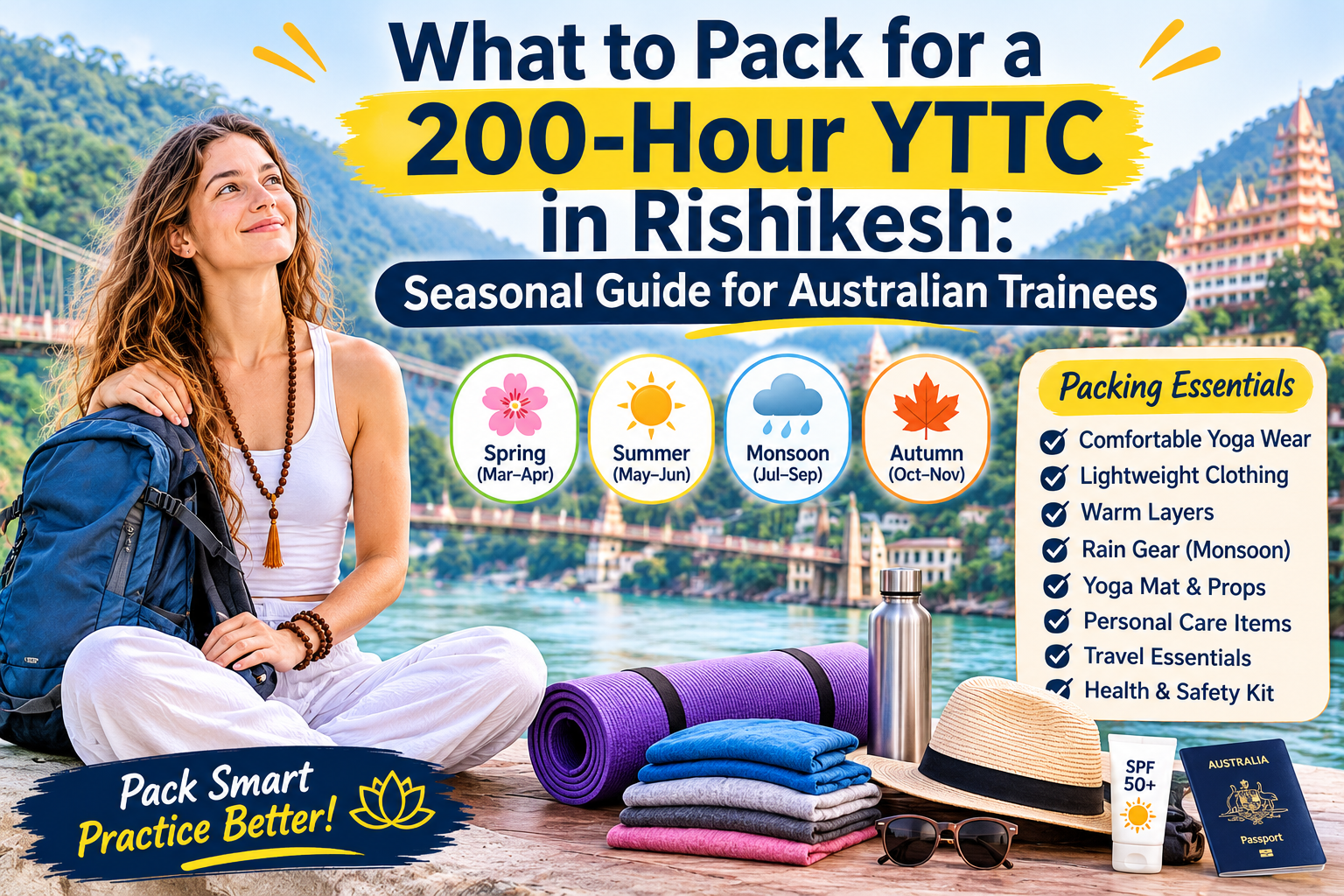
Introduction: Why Packing Right Matters for Your Yoga Journey
If you’re an Aussie preparing for a month-long immersion on the banks of the Ganga, your suitcase deserves as much thought as your practice. A 200-hour course is demanding. You’ll wake before sunrise, practise asana and pranayama for hours, sit through philosophy and anatomy lectures, and live simply. Packing well means you spend your energy on learning, not on hunting for a warm jumper in a foggy January or a dry change of clothes in a July downpour.
There’s a twist for Australians: Rishikesh’s seasons run opposite to yours. Your summer is Rishikesh’s winter, and a trainee flying out of a Sydney heatwave in December can land to single-digit mornings. This guide breaks down what to pack by season, plus the year-round essentials, so you arrive comfortable and focused.
If you’re still choosing a programme, start with an overview of Yoga Teacher Training in Rishikesh and the details of the 200 Hours YTTC Rishikesh India course, then come back here to build your list.
Understanding Rishikesh’s Seasons (Through an Australian Lens)
Rishikesh sits in the foothills of the Himalayas in Uttarakhand, so it has a humid subtropical climate with a real winter. Here is a general guide. Conditions vary year to year, so check a current forecast a week before departure.
| Season | Months | Typical feel | Aussie equivalent |
| Spring | Mid-Feb to Mar | Mild, pleasant, warming up | Late Aussie summer into autumn |
| Summer | Apr to Jun | Hot and dry, often 35°C+ by day | A Darwin or inland NSW summer |
| Monsoon | Jul to Sep | Warm, humid, heavy rain | Brisbane in a wet February |
| Autumn | Oct to Nov | Clear skies, comfortable days, cool nights | Perfect Melbourne autumn |
| Winter | Dec to mid-Feb | Chilly mornings and evenings, fog, mild days | Canberra winter mornings, minus the frost |
Many schools run intakes through autumn and spring because the weather suits long practice days. That said, you can train comfortably in any season with the right kit.
Year-Round Essentials: The Non-Negotiables
Before we get seasonal, these items belong in every bag.
Travel Documents and Money
- Passport valid for at least six months beyond your arrival, with spare blank pages.
- Indian e-Visa or visa approval. Australians generally apply online, but rules and eligible categories change, so confirm on the official Indian government visa portal and with your school before booking flights.
- Printed copies of your passport, visa, flight itinerary, course confirmation and travel insurance. Keep digital copies in cloud storage as well.
- Travel insurance that covers medical care, evacuation and trip interruption. Check the policy covers yoga and any adventure activities you plan on weekends.
- Cash and cards. Carry some Indian rupees on arrival, but use ATMs in town for the rest. Tell your bank you’re travelling, and bring a backup card.
The Australian Government’s Smartraveller service publishes current advice for India, and it’s worth subscribing before you go.
Yoga Gear
- A lightweight travel yoga mat (around 1.5 to 3 mm) or a mat towel. Most schools provide mats, so ask first. If you’re particular about grip, a travel mat packs flat and saves a heavy carry.
- Yoga clothing: 5 to 6 sets of breathable, modest tops and leggings or loose trousers. Cotton and bamboo blends handle humidity better than synthetics.
- A small meditation shawl or blanket for pranayama, Yoga Nidra and long seated sessions.
- Notebook and pens. Many schools provide a manual, but you’ll still want your own notes on alignment cues, Sanskrit terms and teaching methodology.
Modest, Culture-Aware Clothing
Rishikesh is a spiritual town, and the ashrams, ghats and temples expect respectful dress. Cover shoulders and knees when you’re out and about. Pack:
- 2 to 3 loose long skirts or lightweight trousers
- 3 to 4 T-shirts or kurtas with sleeves
- A light scarf or dupatta, handy as sun cover, temple cover and pillow in a pinch
Local tailors can make kurtas and cotton pants cheaply, so you can leave room in your bag and shop on arrival.
Health and Hygiene
Speak to your GP or a travel clinic at least six to eight weeks before departure about vaccinations, malaria advice and any personal medical needs. Beyond that, pack:
- Prescription medications in original packaging with a doctor’s letter, plus a little extra
- Basic first aid: plasters, antiseptic, rehydration salts, pain relief, antihistamines, motion-sickness tablets
- Digestive support: probiotics and electrolyte sachets for the first week while your gut adjusts
- Insect repellent (DEET or picaridin) and after-bite cream
- Hand sanitiser, wet wipes and travel tissue packs. Toilet paper and soap aren’t always supplied.
- Sunscreen SPF 50+ and a lip balm with SPF. Australians are used to strong UV, but Himalayan foothill sun at altitude is still intense.
- Reusable water bottle with a filter or purification tablets. This also helps keep plastic out of the Ganga.
Many students find that Yoga for Mental Health in Rishikesh India becomes a meaningful part of their journey, so bring along anything that supports your sleep and wellbeing too, such as an eye mask and earplugs.
Tech and Power
- Plug adapter. India uses Type C, D and M plugs on 230V, while Australia uses Type I. An Australian three-pin plug won’t fit, so pack a universal adapter.
- Power bank. Power cuts do happen, especially in monsoon.
- Unlocked phone so you can buy a local SIM or eSIM. Check your Australian carrier’s roaming rates first.
- Headlamp or small torch for early-morning walks and power outages.
- Offline downloads: maps, music, meditation tracks and any pre-course reading.
What to Pack for Rishikesh in Summer (April to June)
Summer is hot and dry. Aussies from Perth or Adelaide will feel at home, but you’ll be practising for hours, so choose airy fabrics.
- Lightweight cotton, linen or bamboo yoga clothes, in light colours
- A wide-brim hat or cap, UV sunglasses and a cooling scarf
- Quick-dry towels (one for the mat, one for the body)
- Sandals and flip-flops (you’ll remove shoes constantly)
- Electrolyte powders and a larger water bottle
- Heat rash powder or a light, non-greasy moisturiser
Avoid heavy dark clothing, and don’t bring a thick sleeping bag. One thin sheet or a travel liner will do. Ask your school whether rooms have air conditioning or fans. Expect daily rhythms to start early, as laid out in this daily routine during yoga teacher training in Rishikesh breakdown, which helps you plan clothing for dawn through to evening sessions.
What to Pack for Rishikesh in Monsoon (July to September)
The monsoon turns the hills vividly green, and the Ganga swells and roars. It’s also wet and humid. Mould, slippery steps and damp laundry are the main challenges.
- A lightweight rain jacket or poncho and a compact umbrella
- Quick-dry clothing, since cotton can take days to dry in humid weather
- Waterproof sandals with good grip, such as Teva-style or rubber-soled styles
- Dry bags or zip-lock bags to protect passports, phones and electronics
- A silica gel pack or two for your suitcase
- Extra insect repellent and long, light sleeves for mosquito protection in the evenings
- A spare towel and a small travel clothesline
Roads and trekking routes can be affected by landslides and heavy rain, and rafting is typically restricted in this period, so keep weekend plans flexible. Trainees who value a calm, reflective atmosphere often enjoy this season, as the quieter town suits an inward focus.
What to Pack for Rishikesh in Autumn (October to November)
Autumn is widely considered the sweet spot. Days are clear and comfortable, and evenings cool off.
- Breathable layers: short and long-sleeved tops
- A light cardigan, fleece or hoodie for dawn and dusk
- One pair of full-length yoga pants for cooler mornings
- Closed shoes or sneakers for walks and temple visits
- A light scarf or shawl
This is also a popular time for exploring. Pack a small daypack for sightseeing, and if you plan to visit temples and ghats, the guide on spiritual places to visit in Rishikesh during yoga TTC will help you plan outfits and timing.
What to Pack for Rishikesh in Winter (December to Mid-February)
Here is where Australians get caught out. You may leave a humid 35°C summer day and land in a place where mornings can feel close to single digits, with fog and damp chill. Many rooms and yoga halls are not heated, and stone or tiled floors are cold on bare feet.
- Thermal base layers (top and leggings) for early sessions
- A warm fleece, wool jumper or down vest, plus a windproof jacket
- Beanie, gloves and warm socks. Grippy yoga socks are a bonus for cold-floor practice.
- A warm shawl or blanket for meditation and lectures
- A travel sleeping bag liner or extra layer for bedding
- Moisturiser, lip balm and hand cream, because dry cold air cracks skin
- Closed shoes for cooler days and a hot water bottle if you feel the cold
Mid-days are often sunny and mild, so layering works better than one heavy coat. Pack items you can shed easily between sessions.
What to Pack for Rishikesh in Spring (Mid-February to March)
Spring is gentle and pleasant, with warming days and cool mornings. Combine autumn and light winter layers:
- A light jacket or cardigan for early mornings
- Breathable yoga wear for daytime heat
- A hat and sunscreen as the sun strengthens
- Light rain protection, since occasional showers can appear
It’s an excellent time for balanced practice, and many trainees mention feeling energised as the days lengthen.
Clothing and Style by Practice: Match Your Kit to Your Course
Your 200-hour curriculum will likely blend several traditions, so think about what each asks of your body and wardrobe.
- Dynamic styles: For flowing practice such as Vinyasa Yoga in Rishikesh India, choose sweat-wicking, stretchy yet secure clothing. Test it in a full sun salutation sequence at home first.
- Strong, traditional sequences: Ashtanga Yoga in Rishikesh India is heating, so bring a mat towel for grip.
- Alignment-focused work: Iyengar Yoga in Rishikesh India uses props. Schools usually supply blocks and straps, but ask in advance.
- Stillness and deep rest: For Yoga Nidra in Rishikesh, bring a warm layer even in warm months, because your body temperature drops as you relax.
Note: Because of the four-link limit for this post, treat the above as plain-text suggestions if you prefer to keep only the four primary links. Anchors for these can be added later if you’d like extra internal linking.
What to Leave at Home
Packing light is a skill in itself. You’ll accumulate scarves, books and incense along the way.
- Excessive jewellery and valuables
- Revealing or very tight clothing
- A full-size hairdryer (voltage and plug differences, plus power-hungry)
- Too many pairs of shoes
- Disposable plastic where you can avoid it
- Heavy yoga props, which most schools provide
A good rule: if you can’t lift your bag easily up a flight of stairs, it’s too heavy. Many trainees aim for a 15 to 20 kg check-in bag plus a cabin backpack. Check your airline’s limits, including domestic connections from Delhi.
Food, Water and Lifestyle Considerations
Most schools serve simple, vegetarian, sattvic meals, and alcohol and caffeine are often discouraged on campus. Pack a few favourite comfort items, such as herbal teas, a small jar of Vegemite if that keeps you grounded, muesli bars or trail mix for snack gaps. Also consider supplements recommended by your GP.
For a fuller picture of what daily life looks like, read about food and lifestyle during yoga teacher training in Rishikesh. It will help you decide what to bring and what to buy locally.
Travel Logistics for Australians
- Flights: Most Australians fly into Delhi (DEL) with a connection, or sometimes into Dehradun’s Jolly Grant Airport (DED), the closest airport to Rishikesh. Many schools can arrange a pick-up. Confirm this in advance.
- Time difference: India Standard Time is 4.5 to 5.5 hours behind eastern Australia depending on daylight saving, so jet lag is mild. Arrive a day or two early if you can.
- Arrival kit: Pack a change of clothes, medications, chargers and a light layer in your carry-on in case checked baggage is delayed.
- Weekend trips: If you’d like to visit the Beatles Ashram, Neelkanth Mahadev or Haridwar, bring a daypack, a sturdy pair of walking shoes and a modest outfit.
A Simple Packing Checklist
Documents: passport, visa, insurance, printed itinerary, course confirmation, emergency contacts
Clothing: 5 to 6 yoga outfits, 3 to 4 modest everyday outfits, underwear and socks, sleepwear, one warm layer (more in winter), rain gear (monsoon), hat and sunglasses (summer)
Footwear: sandals, closed shoes, waterproof sandals (monsoon), warm socks (winter)
Health: prescriptions, first aid, rehydration salts, probiotics, repellent, sunscreen, sanitiser, wet wipes
Tech: adapter, power bank, phone, headphones, torch, offline downloads
Other: water bottle, towel, notebook, small padlock, dry bags, ear plugs, eye mask
Frequently Asked Questions
Do I need to bring my own yoga mat to a 200-hour YTTC in Rishikesh?
Not necessarily. Many schools provide mats and props, but a personal mat suits trainees who prefer their own grip and hygiene. Ask your school before you pack.
What clothes are appropriate in Rishikesh?
Choose modest, breathable clothing. Cover shoulders and knees in public, particularly near temples and ghats. Loose cotton pieces are the most comfortable across seasons.
Is it cold in Rishikesh during Australian summer?
Yes, mornings and evenings in December and January can be cold, even though days can be sunny. Layers, thermals and warm socks are strongly advised.
Can I buy things in Rishikesh instead of packing them?
Yes. Yoga clothes, shawls, kurtas, toiletries and basic medication are widely available and inexpensive. Items like specific prescriptions, sunscreen brands you trust and your preferred technical gear are better brought from home.
How much money should I bring?
Budget depends on your lifestyle and what’s included in your course fees. Withdraw rupees from local ATMs as needed and keep a small cash reserve for emergencies.
Final Thoughts: Pack Light, Stay Open
The best packing advice for any yoga teacher training in India is also a lesson from the mat: carry less, notice more. A few quality, adaptable pieces, the right health basics and respect for local culture will carry you through the full month, whatever the season.
If you’re still weighing up when to go, review things to know before doing yoga teacher training in India so your expectations match reality. Then choose your intake, check the forecast, and pack with intention.
Safe travels, and enjoy every sunrise on the Ganga.
Disclaimer: Climate, visa and travel requirements change. Verify current conditions with official government sources, your travel clinic and your chosen school before departure.