 Skip to content
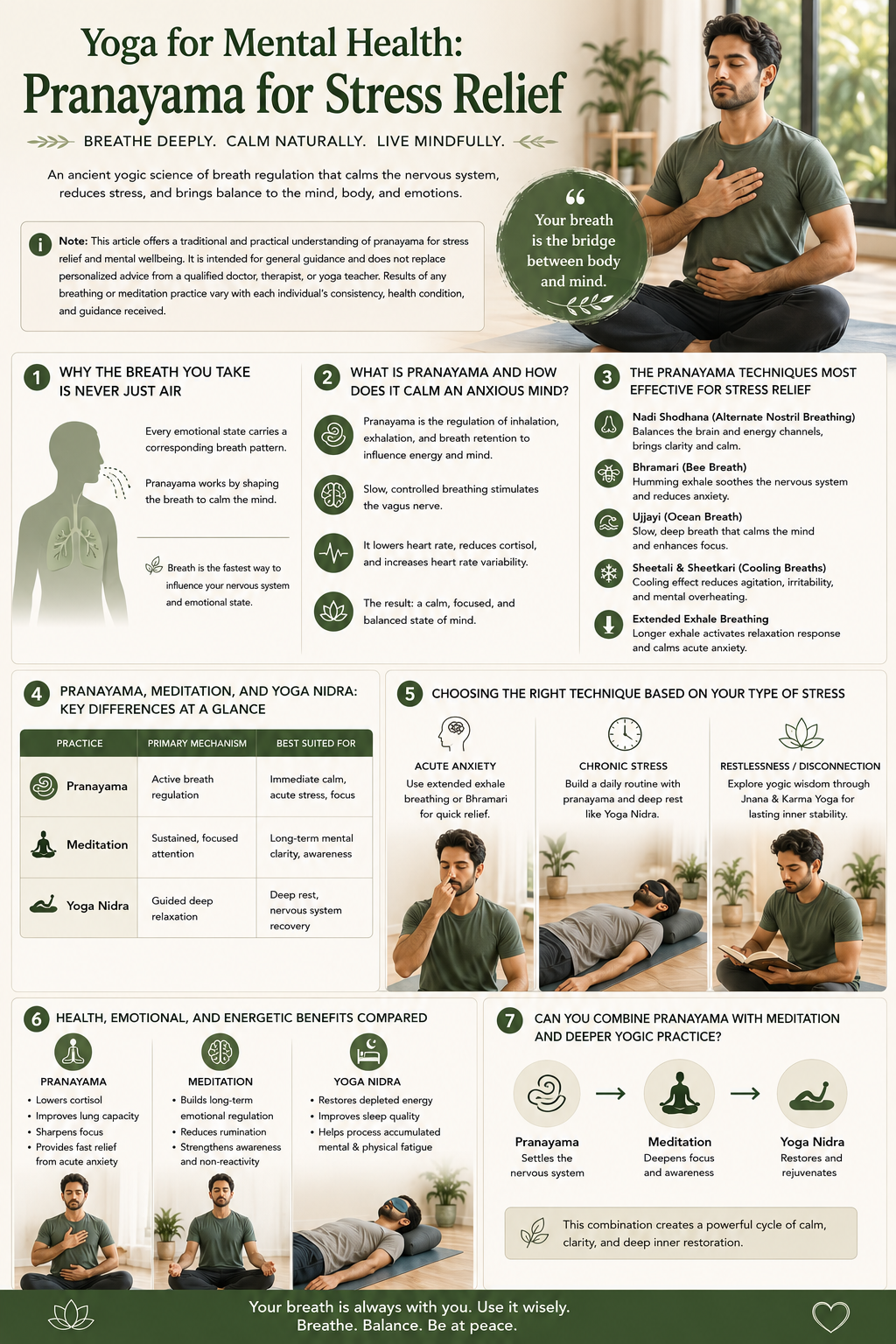
Note: This article offers a traditional and practical understanding of pranayama for stress relief and mental wellbeing. It is intended for general guidance and does not replace personalized advice from a qualified doctor, therapist, or yoga teacher. Results of any breathing or meditation practice vary with each individual’s consistency, health condition, and guidance received.
Stress has quietly become one of the defining health challenges of modern life. Between demanding work schedules, constant digital stimulation, and the pressures of daily responsibilities, our nervous systems rarely get a genuine chance to rest. While yoga is often associated with physical postures, one of its most powerful, and most overlooked, tools for mental wellbeing is far simpler than any asana: the breath.
Pranayama, the yogic science of breath regulation, has been practiced for thousands of years as a bridge between body and mind. Long before modern neuroscience confirmed the link between breathing patterns and nervous system regulation, yogic sages understood that controlling the breath was one of the most direct ways to influence the mind. Today, as anxiety and burnout affect millions worldwide, this ancient practice is proving remarkably relevant to modern mental health.
This guide breaks down what pranayama is, how it works on the nervous system, which techniques are most effective for stress relief, and how you can build a sustainable daily practice, whether you are a complete beginner or someone deepening an existing yoga journey.
1. Why the Breath You Take Is Never Just Air
Every emotional state carries a corresponding breath pattern. Fear and anxiety produce shallow, rapid breathing high in the chest, while calm and contentment produce slow, deep, abdominal breathing. Pranayama works by reversing this relationship: instead of waiting for the mind to calm the breath, you deliberately shape the breath to calm the mind.
This is one of the reasons breathwork occupies such a central place in Yoga for Mental Health in Rishikesh India, where pranayama is taught not as an isolated exercise but as part of a complete framework for emotional regulation, alongside asana, meditation, and philosophy.
2. What Is Pranayama and How Does It Calm an Anxious Mind?
The word pranayama comes from two Sanskrit roots: prana (life force or breath) and ayama (extension or control). At its core, pranayama is the deliberate regulation of inhalation, exhalation, and breath retention to influence both the flow of energy in the body and the state of the mind.
From a physiological standpoint, slow and controlled breathing stimulates the vagus nerve, a key regulator of the parasympathetic nervous system, the branch responsible for rest and recovery. This activation lowers heart rate, reduces blood pressure, decreases cortisol, and increases heart rate variability, a marker closely associated with better emotional regulation and resilience under stress.
3. The Pranayama Techniques Most Effective for Stress Relief
Nadi Shodhana (Alternate Nostril Breathing): Balances the two hemispheres of the brain and the body’s energy channels, producing an almost immediate sense of mental clarity and calm.
Bhramari (Bee Breath): A gentle humming exhale whose vibration soothes the nervous system, particularly effective for racing thoughts and pre-sleep anxiety.
Ujjayi (Ocean Breath): A slow, deep breath with a soft throat constriction, widely used throughout Vinyasa Yoga in Rishikesh India to maintain focus during movement, while also calming the mind in stillness.
Sheetali and Sheetkari (Cooling Breaths): Inhaling through a curled tongue or clenched teeth produces a cooling sensation that reduces agitation, irritability, and mental overheating.
Extended Exhale Breathing: Making the exhale longer than the inhale directly stimulates the parasympathetic response and is one of the fastest ways to calm acute anxiety.
4. Pranayama, Meditation, and Yoga Nidra: Key Differences at a Glance
| Practice | Primary Mechanism | Best Suited For |
| Pranayama | Active breath regulation | Immediate calm, acute stress, focus |
| Meditation | Sustained, focused attention | Long-term mental clarity, awareness |
| Yoga Nidra | Guided deep relaxation | Deep rest, nervous system recovery |
5. Choosing the Right Technique Based on Your Type of Stress
Not every kind of stress calls for the same response. Acute anxiety, such as a racing heart before a difficult conversation, responds best to extended exhale breathing or Bhramari, both of which act quickly on the nervous system. Chronic, low-grade stress that builds up over weeks benefits more from a consistent daily pranayama routine combined with deeper restorative practice, such as Yoga Nidra in Rishikesh, which allows the body to reach a state of rest that occasional breathing exercises alone cannot achieve.
For those whose stress is tied to a deeper sense of restlessness or disconnection rather than a single triggering event, exploring the philosophical roots of practice through Jnana & Karma Yoga in Rishikesh, the paths of wisdom and selfless action, often provides a more lasting sense of stability than technique alone.
6. Health, Emotional, and Energetic Benefits Compared
- Pranayama: Lowers cortisol, improves lung capacity, sharpens focus, and provides fast relief from acute anxiety symptoms.
- Meditation: Builds long-term emotional regulation, reduces rumination, and strengthens the ability to observe thoughts without reacting to them.
- Yoga Nidra: Restores depleted energy, improves sleep quality, and helps process accumulated mental and physical fatigue.
7. Can You Combine Pranayama With Meditation and Deeper Yogic Practice?
Yes, and most experienced practitioners do. A short pranayama session is often used to settle the nervous system before meditation, allowing the mind to reach stillness far more easily than if meditation is attempted straight away. This layered approach, breath first, then stillness, is one of the oldest sequencing principles in yogic tradition.
Beyond technique, understanding the broader Values of Yoga in Life India helps practitioners see why breathwork alone is only one piece of a complete approach to mental wellbeing. Yogic philosophy has always treated the breath, the mind, and one’s daily conduct as deeply interconnected, rather than as separate compartments of practice.
8. Common Mistakes to Avoid When Practicing Pranayama
- Forcing the breath rather than allowing it to flow naturally, which creates tension instead of relaxation.
- Attempting advanced breath retention techniques without proper guidance, risking dizziness or discomfort.
- Practicing inconsistently and expecting long-term results from occasional sessions.
- Ignoring posture, which restricts the diaphragm and reduces the effectiveness of the practice.
- Practicing immediately after a heavy meal, when the diaphragm has less room to move freely.
9. A Simple Framework for Building Your Daily Practice
If you are unsure where to begin, ask yourself these three questions honestly:
- Is my stress acute and immediate, or a slow, ongoing background tension?
- Do I have five quiet minutes a day, or closer to fifteen?
- Am I looking for fast relief in the moment, or a long-term shift in how I respond to stress?
There are no wrong answers here, only the starting point that is honest for where you are right now. A simple ten-minute daily routine of breath observation, one calming technique, and a minute of stillness is enough to begin noticing real change within a few weeks.
10. Learning Pranayama the Right Way: Why Guided Training Matters
While many pranayama techniques are safe for self-guided practice, learning directly from an experienced teacher meaningfully improves both safety and effectiveness, particularly for techniques involving breath retention or rapid breathing, which require correct guidance to avoid overexertion.
This is one of the many reasons practitioners from around the world travel to study Yoga Teacher Training in Rishikesh, widely regarded as the spiritual home of yoga. Structured programs at the Best Yoga School in Rishikesh typically include dedicated pranayama modules taught by experienced instructors, ensuring students learn correct technique, sequencing, and safety precautions rather than relying solely on self-taught methods from videos or books.
For those considering a deeper dive into yogic breathwork as part of a full teaching qualification, our Yoga Instructor Certification Guide in India outlines how pranayama fits into a broader Yoga TTC India curriculum, and a structured 200 Hours YTTC Rishikesh India program remains one of the most complete ways to learn these techniques safely, under real supervision, rather than piecing them together alone.
Frequently Asked Questions (FAQs)
Q1. What is pranayama and how is it different from normal breathing?
Pranayama is a structured, intentional practice of breath control involving specific techniques, ratios, and timing, unlike normal breathing, which is automatic and unregulated.
Q2. Can pranayama really help with anxiety?
Yes. Slow, controlled breathing techniques activate the parasympathetic nervous system, which reduces heart rate, lowers cortisol, and counteracts the physiological symptoms of anxiety.
Q3. How long does it take to see benefits from pranayama?
Many people notice a calming effect within a single session, particularly with extended exhale breathing. Longer-term benefits, such as improved emotional regulation, typically develop over several weeks of consistent practice.
Q4. Which pranayama technique is best for beginners?
Nadi Shodhana and extended exhale breathing are excellent starting points due to their simplicity and immediate calming effect.
Q5. Is it safe to practice pranayama without a teacher?
Basic techniques are generally safe for self-practice, but techniques involving breath retention or rapid breathing are best learned under qualified guidance.
Q6. How often should I practice pranayama for stress relief?
Daily practice of ten to fifteen minutes is generally more effective for stress management than longer, infrequent sessions.
Q7. Can pranayama replace medication for anxiety or depression?
Pranayama can be a valuable complementary practice for stress and mild anxiety, but it should not replace professional medical or psychological treatment for diagnosed conditions.
Q8. What is the best time of day to practice pranayama?
Morning practice sets a calm tone for the day, while evening practice with calming techniques supports better sleep. The right time ultimately depends on individual routine and goals.
Q9. Does pranayama have physical health benefits beyond stress relief?
Yes. Regular practice is associated with improved lung capacity, better cardiovascular function, and enhanced focus and concentration.
Q10. Where can I learn pranayama properly as part of a full yoga curriculum?
Structured yoga teacher training programs, particularly those offered in Rishikesh, India, typically include dedicated pranayama instruction alongside asana, meditation, and philosophy.
Final Thoughts
Pranayama is not a quick fix, but a long-term relationship with your own breath. Like any skill, its benefits compound with consistent practice. Over weeks and months, many practitioners notice not just reduced anxiety in the moment, but a broader shift in how they respond to stress, a greater ability to pause, breathe, and choose their response rather than react automatically.
Whichever technique you feel drawn to, what matters most is consistency and, where possible, learning from a qualified teacher. The breath is always with you; the practice simply teaches you how to use it.
