 Skip to content
Note: This article offers a traditional and practical understanding of yoga as a supportive practice for recovering from burnout and chronic stress. It is intended for general guidance and does not replace personalized advice from a qualified doctor or therapist. Burnout has many contributing factors, and results of any yoga or mindfulness practice vary with each individual’s consistency, circumstances, and guidance received.
Burnout is often described in purely psychological terms — as a sense of exhaustion, cynicism, or feeling less effective in a job that once felt meaningful. But long before burnout announces itself as a mood or an attitude, it is a physiological state: months, sometimes years, of a nervous system running on stress hormones with too little genuine recovery in between, until the body’s own regulation systems begin to wear down instead of resetting.
Modern work culture rarely leaves room to notice this shift while it is happening. Long hours, constant connectivity, and a steady pressure to do more with less keep the body’s stress response switched on well past the point where it should stand down. By the time exhaustion becomes impossible to ignore, the pattern is usually already deeply grooved into the body, not just the mind.
Yoga does not treat burnout as a willpower problem or something to push through with more effort. Instead, it approaches recovery as a process of retraining the nervous system, rebuilding the capacity to rest, and slowly restoring the energy and clarity that chronic overextension erodes.
This guide looks at what burnout means from a yogic perspective, which practices genuinely support recovery, and how to build a sustainable routine that helps you come back from depletion without repeating the same cycle.
1. What Burnout Actually Looks Like From a Yogic Perspective
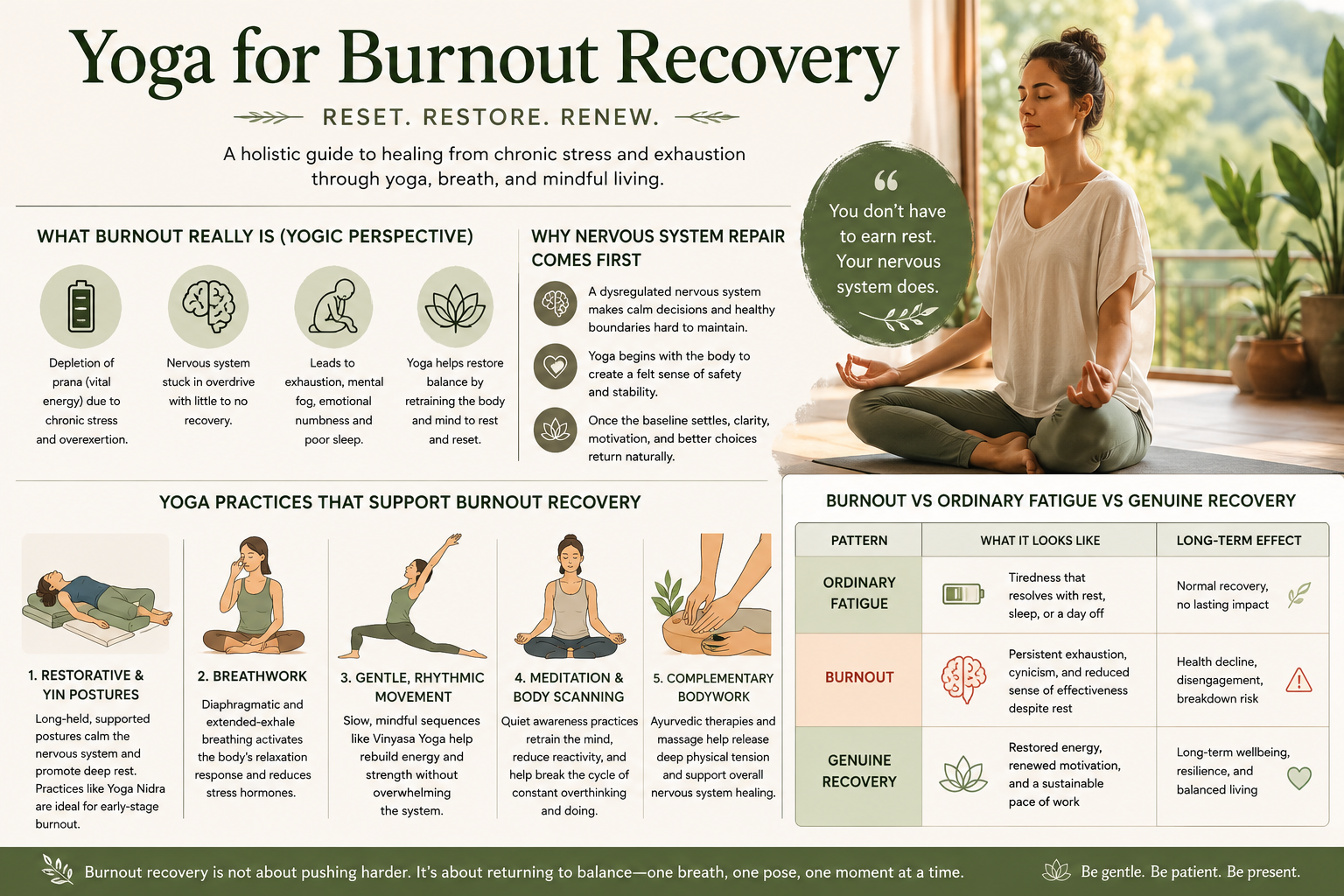
Yogic tradition does not use the word burnout, but it describes the underlying state clearly. Prana, the body’s vital energy, is meant to move in a natural rhythm of expenditure and renewal. Burnout occurs when that rhythm collapses — when output continues long after the reserves needed to sustain it have run dry, and the nervous system is left operating in a near-constant state of depletion and low-grade alarm.
This is different from ordinary tiredness, which resolves with a good night’s sleep or a restful weekend. Burnout sits deeper, in the tissues and the breath itself, often accompanied by a flattened emotional range, disrupted sleep, and a persistent sense of being unable to properly switch off even during downtime.
This pattern, and how yoga addresses it, is explored in more depth in our broader guide to Yoga for Mental Health in Rishikesh India, which looks at how various yogic tools work together to support the nervous system through periods of prolonged stress, not just in isolated sessions, but as an ongoing way of living.
2. Why Nervous System Repair Has to Come Before Motivation
Most advice aimed at burned-out professionals focuses on mindset — set better boundaries, prioritize differently, learn to say no. These are useful skills, but they are difficult to apply consistently when the nervous system itself is still stuck in a sympathetic, fight-or-flight-adjacent state. A dysregulated nervous system makes calm decision-making harder, not easier, regardless of how much someone intellectually understands what they should be doing.
This is why yoga’s approach to burnout recovery starts with the body rather than the to-do list. Slow, supported movement gives the nervous system direct, felt evidence of safety, which gradually allows the stress response to stand down. Only once that baseline settles does the mental clarity needed for better boundaries and decisions tend to return on its own.
Alignment-focused practices such as Iyengar Yoga in Rishikesh India are particularly well suited to this early stage of recovery, since the use of props and precise, supported postures allows even a depleted body to build strength and stability without adding further strain, giving the nervous system a genuine experience of steadiness rather than additional effort to manage.
3. Yoga Practices That Support Burnout Recovery
Recovery from burnout tends to unfold in stages, and different practices support the body at each point along the way.
- Restorative and Yin-Style Postures: Long-held, supported shapes allow the body to fully release muscular guarding and settle into genuine rest, something active exercise rarely achieves. Extended sessions modeled on Yoga Nidra in Rishikesh are often one of the most effective single practices for early-stage burnout.
- Diaphragmatic and Extended-Exhale Breathing: Slow breath work with a longer exhale directly signals the nervous system to downshift, reducing circulating stress hormones over time.
- Gentle, Rhythmic Movement: Once basic rest returns, slow-paced, flowing sequences such as Vinyasa Yoga in Rishikesh India help rebuild physical energy without tipping the body back into overexertion.
- Meditation and Body Scanning: Quiet, non-striving awareness practices retrain the mind’s relationship to rest, countering the compulsive productivity patterns that often drive burnout in the first place.
- Complementary Bodywork: Practices such as an Ayurvedic Massage Course in Rishikesh India introduce touch-based therapies that many practitioners find valuable alongside asana and breathwork, particularly for releasing tension held deep in the muscles.
4. Burnout vs Ordinary Fatigue vs Genuine Recovery: Key Differences at a Glance
| Pattern | What It Looks Like | Long-Term Effect |
| Ordinary Fatigue | Tiredness that resolves with rest, sleep, or a day off | Normal recovery, no lasting impact |
| Burnout | Persistent exhaustion, cynicism, and reduced sense of effectiveness despite rest | Health decline, disengagement, breakdown risk |
| Genuine Recovery | Restored energy, renewed motivation, and a sustainable pace of work | Resilience, clearer boundaries, long-term wellbeing |
5. Matching Practice to Your Stage of Burnout
Not everyone experiencing burnout is in the same place, and applying the wrong intensity of practice can slow recovery rather than support it.
Those in the earliest, most depleted stage — where even simple tasks feel exhausting — usually need almost entirely restorative work: extended relaxation, gentle Yoga Nidra in Rishikesh sessions, and breathwork, with minimal physical exertion until baseline energy begins to return.
As energy stabilizes, a structured, moderate practice becomes appropriate. This is often where styles like Kundalini Yoga in Rishikesh India, with its emphasis on breath, chanting, and gradual energetic build-up, can help restore a sense of vitality without the intensity of a purely physical workout.
Only once genuine energy has returned, typically after weeks rather than days, does more demanding practice make sense. At this later stage, some practitioners find a disciplined style such as Ashtanga Yoga in Rishikesh India helpful for rebuilding physical resilience and structure, though this should never be rushed into during active burnout, when it risks reinforcing the same overexertion pattern that caused the depletion in the first place.
6. Physical, Emotional, and Professional Benefits Compared
- Physical: Improved sleep quality, reduced muscular tension, and a nervous system that returns to baseline more easily after stress.
- Emotional: Greater emotional range returning after the flatness burnout often produces, along with reduced irritability and improved patience.
- Professional: Clearer decision-making, better boundary-setting, and a more sustainable pace of output once genuine energy is restored rather than borrowed from reserves.
7. The Deeper Shift That Makes Recovery Last
Burnout often stems not only from workload but from a deeper relationship to effort, worth, and rest — a belief, rarely stated outright, that constant output is what makes a person valuable. Recovery that addresses only the schedule while leaving this underlying belief untouched tends to be temporary.
Traditional teachings on Jnana & Karma Yoga in Rishikesh, the paths of wisdom and selfless action performed without attachment to outcome, offer a genuinely different framework for thinking about effort itself, one where dedicated work and personal worth are no longer fused together in a way that makes rest feel like failure.
Reflecting more broadly on the Values of Yoga in Life India can help practitioners see burnout recovery not as an isolated fix, but as part of a wider shift toward living with greater balance, patience, and self-respect, long after the immediate exhaustion has passed.
8. Common Mistakes People Make When Recovering From Burnout
- Treating rest as a reward to be earned only after everything else is done, rather than a genuine requirement.
- Jumping straight into vigorous practice as soon as energy slightly improves, before the nervous system has properly stabilized.
- Expecting a single retreat or a few sessions to reverse months or years of accumulated depletion.
- Continuing to measure progress by output and productivity, the very metric that contributed to the burnout in the first place.
- Returning to old work patterns unchanged the moment energy returns, without adjusting the underlying habits that led to depletion.
9. A Simple Framework for Sustainable Recovery
If you are building your own recovery approach, three honest questions are worth sitting with:
- What specifically depleted me — workload, lack of boundaries, an unclear sense of purpose, or some combination of all three?
- Am I resting in a way that actually restores me, or in a way that simply distracts me until the next demand arrives?
- What would a genuinely sustainable pace look like, not just for the next few weeks, but for the next few years?
There are no universally right answers here, only an honest starting point. A short daily practice of breath, restorative movement, and stillness, protected consistently, tends to rebuild depleted reserves more reliably than occasional, intense effort squeezed in around an unchanged schedule.
10. Deepening Recovery Through Structured Training
For some, a personal home practice is enough to rebuild balance. Others, particularly after prolonged or severe burnout, find that stepping away entirely is what genuine recovery requires. This is one of the reasons so many people choose a dedicated Yoga Retreat in Rishikesh, immersing themselves fully in rest, practice, and a slower rhythm of life, away from the demands that contributed to their depletion in the first place.
For those who want to go further and build a lasting personal practice out of their recovery, structured Yoga Teacher Training in Rishikesh programs combine asana, breathwork, meditation, and philosophy into a single curriculum, offering both the technique and the understanding needed to sustain balance well after the training itself ends.
Programs at the Best Yoga School in Rishikesh are typically available across several formats, and our Yoga Instructor Certification Guide in India outlines how Yoga TTC India options such as a 100 Hours YTTC Rishikesh India, a 200 Hours YTTC Rishikesh India, a 300 Hours YTTC Rishikesh India, and a 500 Hours YTTC Rishikesh India each build on the last for those wanting to go deeper.
For a closer look at what daily life in one of these programs actually involves, our guide on the Daily Routine During Yoga Teacher Training in Rishikesh walks through a typical day from morning practice to evening reflection, and our broader overview on How to Get Yoga Certified in Rishikesh India maps out the complete path for anyone considering Yoga Teacher Training in Rishikesh India as part of their own recovery.
Frequently Asked Questions (FAQs)
Q1. What does burnout recovery mean from a yogic perspective?
In yogic terms, burnout recovery means restoring the natural rhythm between exertion and renewal, allowing the nervous system to move out of chronic alarm and back into a state where genuine rest and steady energy are possible again.
Q2. Can yoga really help with workplace burnout?
Yes. Practices that combine restorative postures, breathwork, and meditation help regulate the nervous system, often improving sleep, reducing reactivity, and gradually restoring the energy and clarity that chronic stress erodes.
Q3. How long does recovery from burnout typically take with yoga?
Some relief, such as calmer sleep, can appear within days, while deeper recovery of energy and motivation usually develops over several weeks to a few months of consistent, appropriately paced practice.
Q4. Is vigorous yoga a good idea during burnout?
Generally not in the early stages. Restorative and gentle practices are more appropriate until baseline energy returns; introducing vigorous styles too early can reinforce the same overexertion pattern that led to burnout.
Q5. What is the single most useful yoga practice for burnout?
There is no single answer, but many practitioners find extended restorative sessions and slow, extended-exhale breathing especially effective in the early stages, since both directly signal safety to an overstressed nervous system.
Q6. Can yoga replace professional support for severe burnout?
No. Yoga can meaningfully support recovery, but it is not a substitute for medical or psychological care when burnout is severe or accompanied by significant physical or mental health symptoms.
Q7. How often should I practice during burnout recovery?
A short, gentle daily practice, even ten to fifteen minutes, tends to support recovery more reliably than longer, infrequent sessions, particularly in the early stages when consistency matters more than intensity.
Q8. Can a retreat help with burnout recovery?
For many people, yes. Stepping fully away from ordinary demands, even for a short period, can accelerate the initial stages of nervous system recovery in a way that’s difficult to achieve at home.
Q9. Will burnout come back after recovery?
It can, particularly if the underlying habits and beliefs that caused it remain unchanged. Lasting recovery usually involves adjusting pace and boundaries alongside the physical practice, not just resting and returning to the same pattern.
Q10. Where can I learn a complete approach to yoga for burnout recovery?
Structured yoga teacher training programs, particularly in Rishikesh, India, typically include dedicated modules on restorative practice, breathwork, and philosophy that together support sustainable recovery well beyond a single course.
Final Thoughts
Burnout recovery is not a single event but an ongoing return to balance, one that asks you to keep listening to what your body and energy actually need, rather than what the calendar demands. Yoga does not remove the pressures of modern life; it builds the inner capacity to meet them without being worn down by them again.
If burnout feels severe, prolonged, or accompanied by significant physical or mental health symptoms, consider speaking with a qualified doctor or therapist alongside any yoga practice you take up. Professional support and a steady personal practice tend to work best together, each reinforcing the other.
