 Skip to content
Note: This article offers a traditional and practical understanding of yoga as a supportive practice for emotional balance and inner steadiness. It is intended for general guidance and does not replace personalized advice from a qualified doctor or therapist. Emotional patterns are shaped by many factors, and results of any yoga or mindfulness practice vary with each individual’s consistency, circumstances, and guidance received.
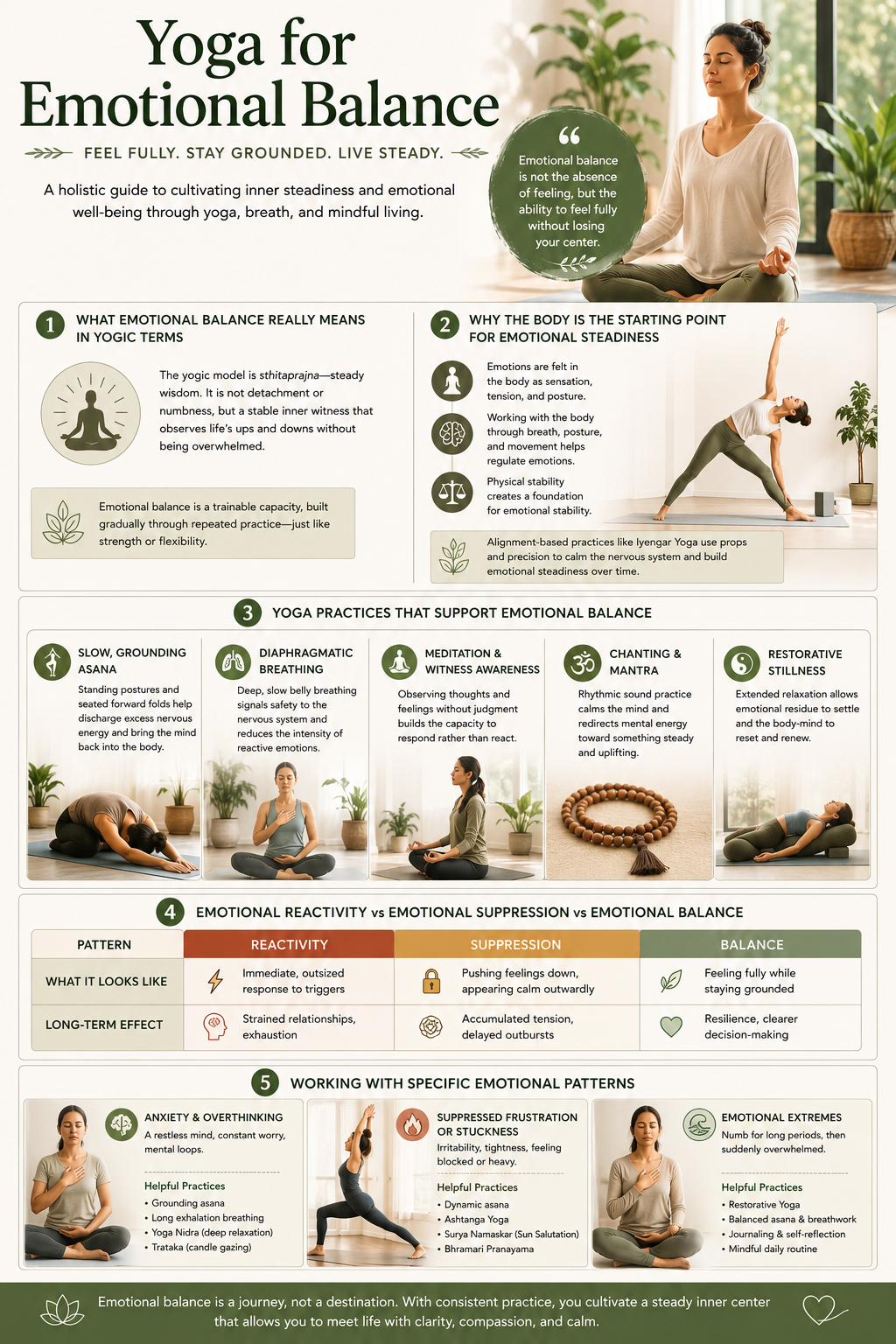
Emotional balance is often misunderstood as the absence of strong feeling, a permanently calm, unbothered state that few people ever seem to reach. In yogic tradition, however, balance means something different: not the elimination of emotion, but the ability to feel fully without being swept away, to experience joy, frustration, grief, or excitement while still remaining rooted in a steady inner center.
Modern life makes this kind of steadiness difficult to cultivate. Constant notifications, shifting responsibilities, and an ongoing stream of information keep the nervous system in a state of low-grade reactivity, where small triggers produce outsized emotional responses. Yoga offers a structured path back to equilibrium, not by suppressing emotion, but by strengthening the body and mind’s capacity to hold it steadily.
This guide explores what emotional balance actually means from a yogic perspective, how specific practices support it, and how you can build a sustainable routine that helps you meet life’s ups and downs with greater steadiness.
It is worth noting from the outset that emotional balance is not a fixed personality trait some people are simply born with and others are not. It is a trainable capacity, built gradually through repeated practice, much like flexibility or strength. Just as the body adapts to consistent physical training, the nervous system adapts to consistent emotional regulation practice, becoming progressively less reactive and more resilient over time.
1. What Emotional Balance Really Means in Yogic Terms
The Sanskrit term sthitaprajna, found in the Bhagavad Gita, describes a person of steady wisdom, someone who remains equanimous in both pleasure and pain, success and failure. This is the yogic model of emotional balance: not detachment or numbness, but a stable inner witness that can observe emotional weather without being blown over by it.
This concept is explored in more depth in our broader guide to Yoga for Mental Health in Rishikesh India, which looks at how various yogic tools work together to support psychological steadiness, not just in isolated moments, but as an ongoing way of relating to one’s inner life.
2. Why the Body Is the Starting Point for Emotional Steadiness
Emotions are not purely mental events; they are felt in the body as sensation, tension, and posture. Anxiety tightens the chest and shoulders, sadness collapses the spine, anger clenches the jaw and fists. Because of this deep connection, working with the body directly, through breath, posture, and movement, is often a faster route to emotional regulation than trying to think your way into calm.
This is part of why talk-based approaches alone sometimes fall short for people who feel emotionally stuck. The body holds patterns that the mind has already tried, and failed, to reason with. A slow, attentive asana practice offers a different entry point, working from sensation back toward thought, rather than the other way around.
Alignment-focused practices such as Iyengar Yoga in Rishikesh India are particularly useful here, since the precise, supported nature of each posture gives the nervous system a strong sense of physical stability, which often translates into a corresponding sense of emotional stability over time. The use of props and careful sequencing in this style also makes it accessible to people who feel too fatigued or overwhelmed for a more vigorous practice.
3. Yoga Practices That Support Emotional Balance
Slow, Grounding Asana: Standing postures and seated forward folds help discharge excess nervous energy and bring the mind back into the present body.
Diaphragmatic Breathing: Deep, slow belly breathing signals safety to the nervous system, reducing the intensity of reactive emotional states.
Meditation and Witness Awareness: Sitting quietly and observing thoughts and feelings without immediately acting on them builds the capacity to respond rather than react.
Chanting and Mantra: Rhythmic sound practice occupies the mind’s tendency to ruminate, redirecting mental energy toward something steady and repetitive.
Restorative Stillness: Extended relaxation allows emotional residue from the day to settle rather than accumulate unprocessed in the body.
4. Emotional Reactivity vs Emotional Suppression vs Emotional Balance: Key Differences at a Glance
| Pattern | What It Looks Like | Long-Term Effect |
| Reactivity | Immediate, outsized response to triggers | Strained relationships, exhaustion |
| Suppression | Pushing feelings down, appearing calm outwardly | Accumulated tension, delayed outbursts |
| Balance | Feeling fully while staying grounded | Resilience, clearer decision-making |
5. Working With Specific Emotional Patterns
Different emotional tendencies respond to different combinations of practice. Those who tend toward anxiety and overthinking often benefit from grounding, slower-paced practice combined with extended relaxation, such as Yoga Nidra in Rishikesh, which allows an overactive mind to finally rest.
Those who tend toward suppressed frustration or a sense of stuckness often respond well to more dynamic, disciplined practice, where Ashtanga Yoga in Rishikesh India provides a structured, physically demanding outlet that helps release built-up tension through consistent, purposeful effort.
Those who swing between extremes, feeling numb for long stretches and then suddenly overwhelmed, often benefit most from a blended approach: grounding restorative work on difficult days, paired with more dynamic practice when energy allows. The goal is not to force a single style onto every emotional state, but to build a flexible toolkit that can be matched to how you are actually feeling on a given day.
6. Physical, Mental, and Relational Benefits Compared
- Physical: Reduced muscular tension, better sleep, and a calmer baseline nervous system state.
- Mental: Greater ability to observe thoughts without over-identifying with them, and reduced rumination.
- Relational: More thoughtful responses in conflict, less reactivity, and greater patience with others.
7. The Philosophical Root of Lasting Balance
Technique alone rarely produces lasting emotional steadiness without a corresponding shift in perspective. Traditional teachings on Jnana & Karma Yoga in Rishikesh, the paths of wisdom and selfless action, offer a framework for understanding emotional experience as something to be met with awareness and right action, rather than something to be controlled or feared.
Similarly, reflecting on the broader Values of Yoga in Life India helps practitioners see emotional balance not as an isolated skill, but as one expression of a wider way of living with integrity, patience, and self-awareness.
8. Common Mistakes to Avoid When Practicing for Emotional Balance
- Treating emotional balance as the goal of suppressing or avoiding difficult feelings altogether.
- Expecting a single class or session to resolve long-standing emotional patterns.
- Practicing only physical postures while ignoring breath and meditation, which carry much of the regulating effect.
- Comparing your emotional progress to others rather than tracking your own gradual shifts over time.
- Abandoning practice during emotionally difficult periods, when consistency matters most.
9. A Simple Framework for Building Emotional Steadiness
If you are building your own approach, ask yourself these three questions honestly:
- Which emotions do I tend to react to most strongly, and in what situations do they usually arise?
- Do I tend to suppress feelings or express them impulsively, and what would a middle path look like?
- What time of day could I realistically protect for a grounding practice, even if brief?
There are no universally right answers here, only the honest starting point of where your patterns currently sit. A short daily practice of breath, movement, and stillness, repeated consistently, tends to shift emotional patterns more effectively than occasional, intense effort.
10. Deepening Practice Through Structured Training
While a personal practice can meaningfully support emotional balance, many practitioners eventually seek more structured guidance to deepen and sustain these shifts. This is one of the reasons so many people travel for Yoga Teacher Training in Rishikesh, immersing themselves in daily practice, philosophy, and community in a way that is difficult to replicate through occasional classes at home.
Programs at the Best Yoga School in Rishikesh typically combine asana, breathwork, meditation, and philosophy into a single, cohesive curriculum, giving students both the technique and the understanding needed to sustain emotional balance long after the training ends.
For those curious about how this training is structured, our Yoga Instructor Certification Guide in India outlines the different levels of Yoga TTC India programs available, and a 200 Hours YTTC Rishikesh India course remains one of the most complete starting points for anyone wanting to build both a personal practice and a deeper understanding of emotional steadiness through yoga.
Frequently Asked Questions (FAQs)
Q1. What does emotional balance actually mean in yoga?
In yogic terms, emotional balance means the ability to feel emotions fully without being overwhelmed by them, maintaining a steady inner center through both pleasant and difficult experiences.
Q2. Can yoga really help with mood swings and emotional reactivity?
Yes. Practices that combine breathwork, movement, and meditation help regulate the nervous system, which is closely tied to emotional reactivity, often reducing the intensity and frequency of mood swings over time.
Q3. How long does it take to notice improved emotional balance through yoga?
Some effects, such as feeling calmer after a single session, are immediate, while deeper shifts in emotional patterns typically develop over several weeks or months of consistent practice.
Q4. Which type of yoga is best for emotional balance?
A combination of grounding asana, breathwork, and meditation tends to be most effective, though the ideal balance varies depending on whether someone tends toward anxiety, suppression, or reactivity.
Q5. Is meditation necessary for emotional balance, or is asana enough?
Asana alone can help release physical tension, but meditation and breathwork address the mental and nervous system patterns underlying emotional reactivity, making the combination more effective than asana alone.
Q6. Can yoga help with suppressed emotions from the past?
Many practitioners report that consistent practice helps surface and process previously suppressed feelings, though working with a therapist alongside yoga is recommended for significant unresolved emotional patterns.
Q7. How often should I practice for emotional balance?
A short daily practice, even ten to fifteen minutes, tends to be more effective for emotional regulation than longer, infrequent sessions.
Q8. Does yoga replace therapy for emotional or psychological difficulties?
No. Yoga can be a valuable complementary practice, but it is not a substitute for professional therapy when addressing significant emotional or psychological difficulties.
Q9. Can beginners with no yoga background start working on emotional balance?
Yes. Simple grounding postures, slow breathing, and short meditation sessions require no prior experience and can be started immediately.
Q10. Where can I learn a complete approach to yoga for emotional balance?
Structured yoga teacher training programs, particularly those in Rishikesh, India, typically include dedicated modules on breathwork, meditation, and philosophy that together support long-term emotional steadiness.
Final Thoughts
Emotional balance is not a fixed destination but an ongoing practice, one that asks you to keep returning to the breath, the body, and a steadier way of meeting whatever arises. Yoga does not remove the ups and downs of life; it builds the inner ground that allows you to move through them with greater steadiness and self-trust.
If emotional patterns feel overwhelming or persistent, consider speaking with a qualified therapist alongside any yoga practice you take up. Support from a professional and a steady personal practice can work well together, each strengthening the other.
