 Skip to content
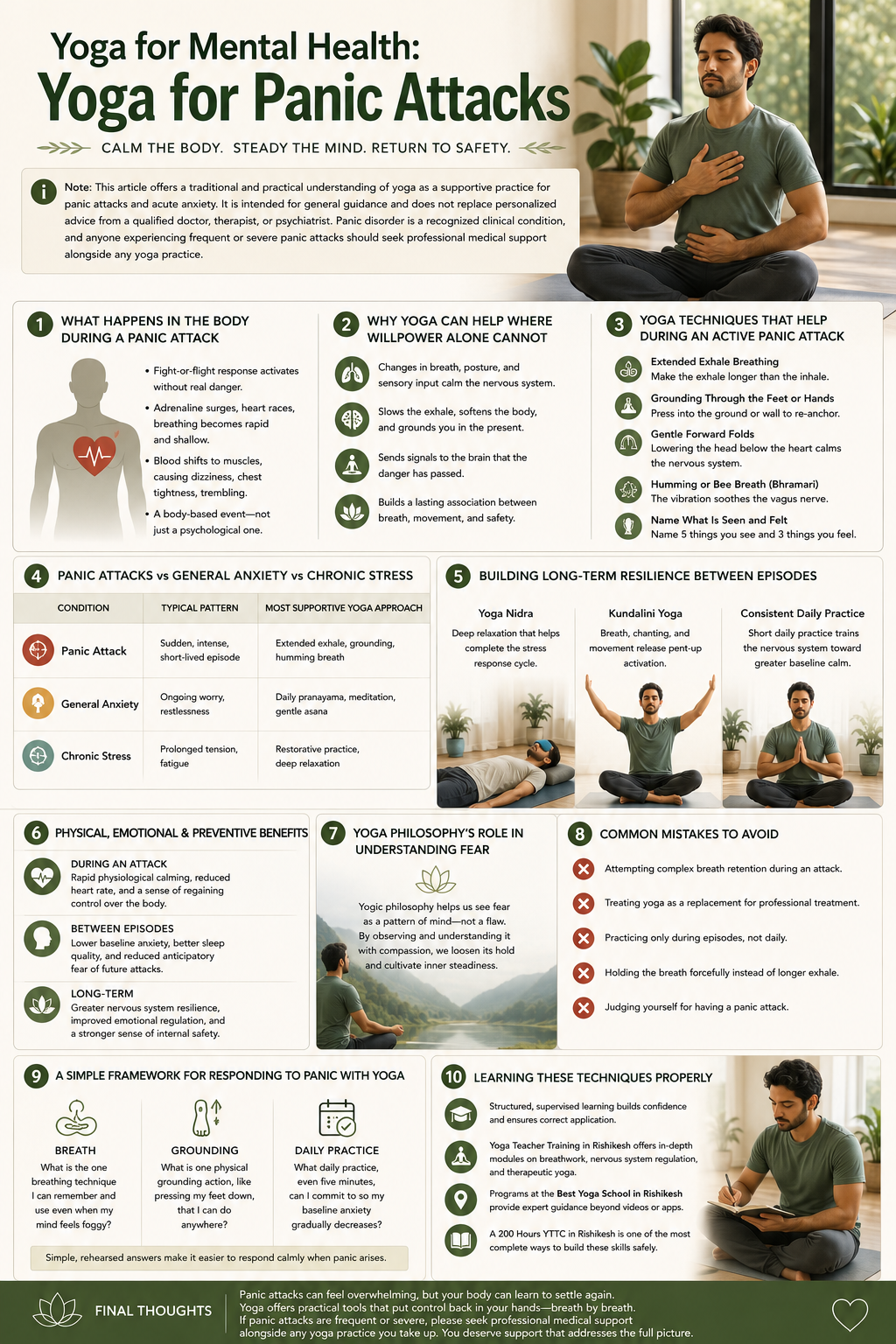
Note: This article offers a traditional and practical understanding of yoga as a supportive practice for panic attacks and acute anxiety. It is intended for general guidance and does not replace personalized advice from a qualified doctor, therapist, or psychiatrist. Panic disorder is a recognized clinical condition, and anyone experiencing frequent or severe panic attacks should seek professional medical support alongside any yoga practice.
A panic attack can feel like the body has declared an emergency with no warning. The heart races, the chest tightens, breathing becomes shallow and rapid, and a wave of fear washes over the mind, often with no clear external threat in sight. For anyone who has experienced one, the memory of that sudden loss of control can be as distressing as the attack itself.
While panic attacks are a clinical phenomenon best addressed with proper medical and psychological care, yoga offers a set of practical, body-based tools that can meaningfully support the nervous system before, during, and after an episode. Unlike purely cognitive approaches, yoga works directly on the physiological state of the body, the same state that a panic attack hijacks, making it a valuable complementary practice for many people managing anxiety.
This guide explains what happens in the body during a panic attack, how yoga interacts with that process, and which specific practices are most supportive for building long-term resilience against panic and acute anxiety.
1. What Actually Happens in the Body During a Panic Attack
A panic attack is the body’s fight-or-flight response firing at full intensity in the absence of real danger. The sympathetic nervous system floods the body with adrenaline, the heart rate spikes, breathing becomes fast and shallow, and blood is redirected away from digestion and toward the muscles. This is precisely why panic attacks produce such intense physical symptoms, chest tightness, dizziness, trembling, and a sense of unreality, even though no physical threat is present.
Understanding this physiological basis matters because it reframes the panic attack as a body-based event, not simply a psychological one. This is also why body-based interventions, including breathwork and grounding postures explored in Yoga for Mental Health in Rishikesh India, can interrupt the cycle in ways that thinking alone often cannot.
2. Why Yoga Can Help Where Willpower Alone Cannot
Trying to simply think your way out of a panic attack rarely works, because the sympathetic nervous system does not respond well to logic in the moment. What it does respond to is a change in physical state, particularly the breath, posture, and sensory input. Slowing the exhale, softening the shoulders, and grounding the feet or hands against a stable surface send direct signals to the brain that the danger has passed, allowing the nervous system to downshift out of its alarm state.
This is the same principle used in structured breath-linked movement practice, such as Vinyasa Yoga in Rishikesh India, where every movement is paired with a specific phase of the breath. Over time, this pairing trains the nervous system to associate steady, controlled breathing with a state of safety and stability, a skill that becomes invaluable during an actual panic episode.
3. Yoga Techniques That Help During an Active Panic Attack
Extended Exhale Breathing: Making the exhale longer than the inhale is one of the fastest ways to activate the parasympathetic nervous system and begin calming a racing heart.
Grounding Through the Feet or Hands: Pressing the feet firmly into the floor, or the hands against a wall or the ground, provides strong sensory input that helps interrupt the spiral of panic and re-anchor attention in the present body.
Gentle Forward Folds: A supported seated or standing forward fold lowers the head below the heart, which can help calm the nervous system and ease feelings of dizziness or overwhelm.
Humming or Bee Breath (Bhramari): The vibration created by a soft humming exhale has a directly soothing effect on the vagus nerve, often reducing the intensity of panic within a few rounds.
Naming What Is Seen and Felt: Softly naming five things you can see and three things you can physically feel helps shift attention away from racing thoughts and back into the present moment.
4. Panic Attacks vs General Anxiety vs Chronic Stress: Key Differences at a Glance
| Condition | Typical Pattern | Most Supportive Yoga Approach |
| Panic Attack | Sudden, intense, short-lived episode | Extended exhale, grounding, humming breath |
| General Anxiety | Ongoing worry, restlessness | Daily pranayama, meditation, gentle asana |
| Chronic Stress | Prolonged tension, fatigue | Restorative practice, deep relaxation |
5. Building Long-Term Resilience Between Episodes
While in-the-moment techniques are essential, the deeper value of yoga for panic-prone individuals lies in the practice built between episodes. A consistent daily routine trains the nervous system toward greater baseline calm, making future episodes less frequent and less intense over time.
Deep restorative practice such as Yoga Nidra in Rishikesh is particularly valuable here, since it allows the body to complete a full stress-response cycle in a safe, guided setting, something that is often missing from daily life. Many practitioners find that regular Yoga Nidra sessions reduce both the frequency and the anticipatory anxiety that often precedes panic attacks.
Energetically focused practices, including Kundalini Yoga in Rishikesh India, are also widely used by practitioners working with anxiety, as the combination of breath, chanting, and movement gives the nervous system a structured outlet for pent-up activation.
6. Physical, Emotional, and Preventive Benefits Compared
- During an Attack: Rapid physiological calming, reduced heart rate, and a sense of regaining control over the body.
- Between Episodes: Lower baseline anxiety, better sleep quality, and reduced anticipatory fear of future attacks.
- Long-Term: Greater overall nervous system resilience, improved emotional regulation, and a stronger sense of internal safety.
7. Yoga Philosophy’s Role in Understanding Fear
Beyond technique, yogic philosophy offers a broader lens for understanding fear itself, not as a flaw to be eliminated, but as a pattern of mind that can be observed, understood, and gradually loosened. Exploring the Values of Yoga in Life India can help practitioners develop a more compassionate relationship with anxious states, rather than treating each panic episode as a personal failure.
This shift in perspective, from fighting fear to understanding it, is often what allows long-term practitioners to feel less afraid of their own anxiety, even when an occasional episode still arises.
8. Common Mistakes to Avoid When Using Yoga for Panic Attacks
- Attempting complex breath retention techniques during an active panic attack, which can worsen symptoms rather than ease them.
- Treating yoga as a replacement for professional treatment rather than a complementary support.
- Practicing only during episodes and skipping the consistent daily routine that builds long-term resilience.
- Holding the breath forcefully instead of focusing on a longer, softer exhale.
- Judging yourself for having a panic attack instead of responding to it with the same calm technique every time.
9. A Simple Framework for Responding to Panic With Yoga
If you are building a personal response plan, ask yourself these three questions:
- What is the one breathing technique I can remember and use even when my mind feels foggy?
- What is one physical grounding action, like pressing my feet down, that I can do anywhere?
- What daily practice, even five minutes, can I commit to so my baseline anxiety gradually decreases?
Having simple, rehearsed answers to these questions before an episode occurs makes it far easier to respond calmly when panic actually arises, rather than trying to recall a technique for the first time under stress.
10. Learning These Techniques Properly Through Structured Training
While many grounding and breathing techniques can be practiced independently, learning them within a structured, supervised setting significantly improves both confidence and correct application, especially for anyone managing recurring panic or anxiety.
This is one of the reasons many practitioners eventually pursue a full Yoga Teacher Training in Rishikesh, not necessarily to teach, but to deepen their personal practice under expert guidance. Programs at the Best Yoga School in Rishikesh typically dedicate specific modules to breathwork, nervous system regulation, and therapeutic applications of yoga, going far beyond what is available through videos or apps alone.
For those curious about how this fits into a complete certification path, our Yoga Instructor Certification Guide in India explains how mental health and therapeutic modules are woven into a broader Yoga TTC India curriculum, and a 200 Hours YTTC Rishikesh India program remains one of the most complete ways to build these skills safely, under real, in-person supervision.
Frequently Asked Questions (FAQs)
Q1. Can yoga actually stop a panic attack once it has started?
Yoga techniques such as extended exhale breathing and grounding can significantly reduce the intensity and duration of a panic attack, though they work best when practiced regularly beforehand so the body recognizes them quickly during an episode.
Q2. What is the fastest yoga technique to calm a panic attack?
Extended exhale breathing, making the exhale noticeably longer than the inhale, is generally the fastest way to activate the parasympathetic nervous system during an acute episode.
Q3. Is yoga a substitute for medication or therapy for panic disorder?
No. Yoga can be a valuable complementary practice, but panic disorder is a clinical condition that should be managed with guidance from a qualified doctor or therapist.
Q4. Can practicing yoga daily reduce how often panic attacks happen?
Many practitioners find that a consistent daily practice lowers baseline anxiety over time, which can reduce both the frequency and intensity of panic episodes, though individual results vary.
Q5. Is it safe to practice yoga during an active panic attack?
Simple techniques like extended exhale breathing and grounding through the feet are generally safe. Complex or advanced breath retention techniques should be avoided during an active episode.
Q6. Which yoga style is best for anxiety and panic-prone individuals?
Gentle, breath-focused styles combined with restorative practice tend to be most supportive, though individual preference and guidance from an experienced teacher play an important role in finding the right fit.
Q7. How long does it take for yoga to help with panic symptoms?
Some techniques offer relief within minutes during an episode, while the deeper, preventive benefits of a regular practice typically build over several weeks of consistency.
Q8. Can beginners with no yoga experience use these techniques?
Yes. The core techniques described here, extended exhale breathing and simple grounding, require no prior experience and can be learned and practiced immediately.
Q9. Does yoga help with the fear of having another panic attack?
Regular practice can reduce anticipatory anxiety by building a greater sense of control over one’s physiological state, which often lessens the fear surrounding future episodes.
Q10. Where can someone learn these techniques in more depth?
Structured yoga teacher training programs, particularly those in Rishikesh, India, often include dedicated modules on breathwork and nervous system regulation taught by experienced instructors.
Final Thoughts
Panic attacks can feel like they arrive out of nowhere and take everything with them, but the body’s alarm system can also be taught, gradually, to settle. Yoga does not offer a cure, but it offers something equally valuable: a set of practical, physical tools that put a measure of control back into your hands, breath by breath.
If panic attacks are a frequent or severe part of your life, please consider speaking with a doctor or mental health professional alongside any yoga practice you take up. You deserve support that addresses the full picture, not just the moments of crisis.
