 Skip to content
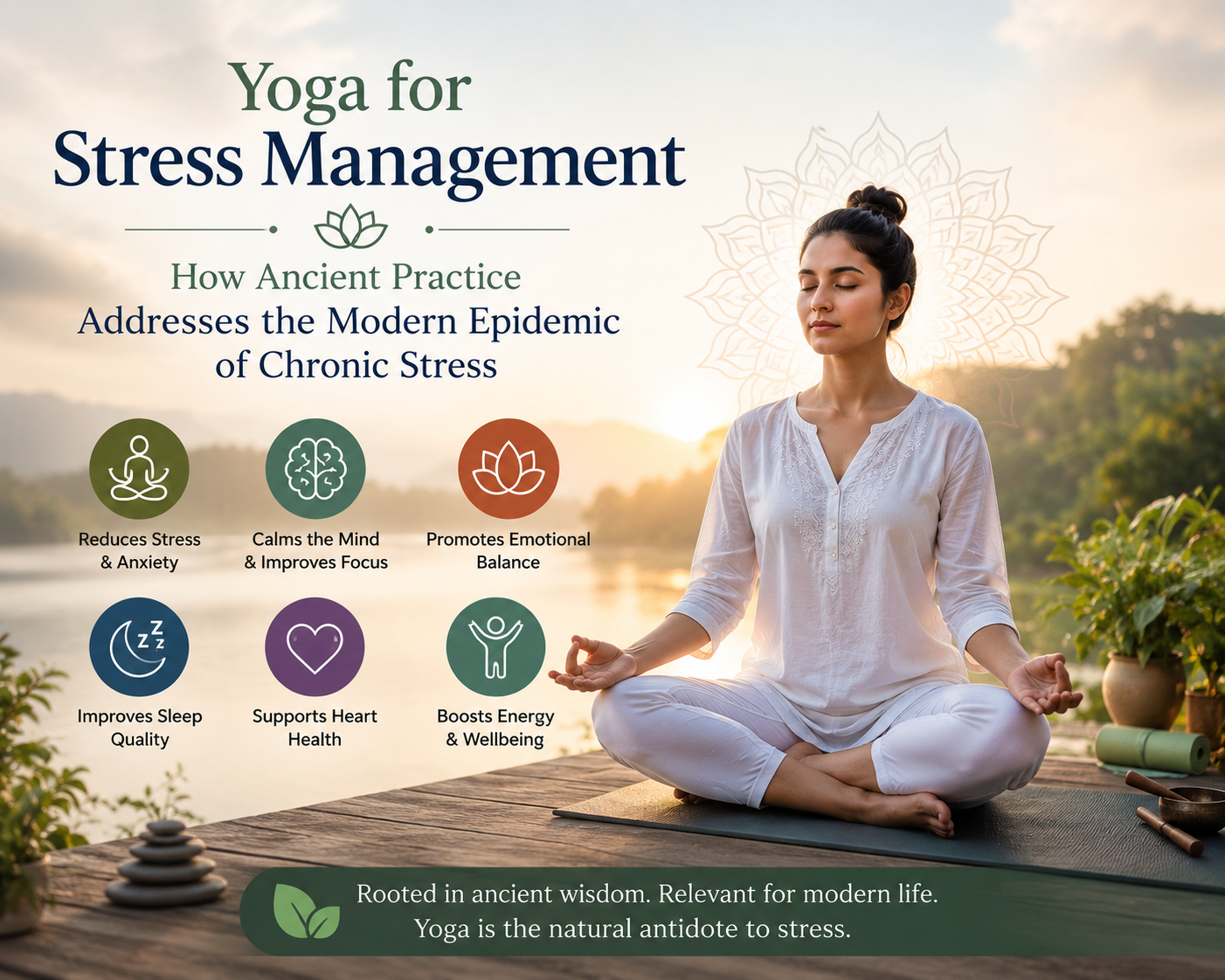
Note: This article presents yoga as a complementary approach to stress management grounded in both ancient wisdom and contemporary research. It is not a substitute for professional medical or psychological care. If you are experiencing severe or debilitating stress, please consult a qualified healthcare provider in addition to any wellness practices you choose to explore.
Stress has become so ubiquitous in modern life that it is often treated as simply the price of being alive in the twenty-first century. Deadlines, financial pressures, relationship demands, information overload, and the relentless pace of urban existence have created a population in which chronic stress is not the exception but the norm. The World Health Organisation has described stress as one of the greatest health epidemics of our time — and the downstream consequences, from cardiovascular disease to immune suppression to mental health disorders, are increasingly well-documented.
What is less well known is that the tools for working with stress skillfully have existed for thousands of years, developed and refined by practitioners who understood the nature of the human nervous system with a precision that modern science is only now catching up to. Yoga — understood not merely as a physical exercise but as a complete system for managing the relationship between body, breath, and mind — offers one of the most comprehensive and evidence-supported approaches to stress management available.
This article explores the specific mechanisms through which yoga addresses chronic stress, the practices most directly effective for stress relief, and the deeper philosophical framework that transforms yoga from a stress management tool into a genuinely transformative way of living.
1. Understanding Stress: What Is Actually Happening in the Body
To understand why yoga works for stress, it helps to first understand precisely what stress does to the body. When the brain perceives a threat — whether physical, psychological, or social — it activates the hypothalamic-pituitary-adrenal (HPA) axis and triggers the sympathetic nervous system’s fight-or-flight response. Cortisol and adrenaline flood the system. Heart rate accelerates. Breathing becomes shallow and rapid. Muscles tense. Digestion slows. The immune system is suppressed.
This response is adaptive in the context of genuine, short-term threats. The problem arises when it is triggered chronically — by work pressures, financial anxiety, relationship conflict, or the mere anticipation of future difficulty. Under conditions of chronic activation, the same physiological cascade that is designed to protect us begins to damage us. Sustained elevated cortisol is associated with weight gain, sleep disruption, cognitive impairment, and accelerated ageing. Chronic sympathetic dominance is a primary driver of cardiovascular disease.
The antidote, physiologically, is activation of the parasympathetic nervous system — the body’s rest-and-digest response. This is precisely the system that yoga’s combination of conscious movement, regulated breathing, and meditative attention is specifically designed to activate. Understanding Yoga for Mental Health in Rishikesh India in its fullest classical sense reveals how deeply this understanding of the mind-body relationship is embedded in the tradition.
2. The Research: What Science Says About Yoga and Stress
The evidence base for yoga as a stress management intervention has grown substantially over the past two decades. Key findings from peer-reviewed research include:
- A consistent reduction in salivary cortisol levels following regular yoga practice, with some studies showing reductions of 25–30% over 8–12 week programmes
- Significant improvements in Heart Rate Variability (HRV) — a key biomarker of autonomic nervous system balance and stress resilience — in practitioners compared to non-practitioners
- Measurable reductions in self-reported stress, burnout, and emotional exhaustion across healthcare workers, teachers, and corporate employees in randomised controlled trials
- Reductions in inflammatory markers including C-reactive protein and interleukin-6, which are elevated under chronic stress and associated with cardiovascular and autoimmune disease
- Improvements in sleep quality, which is both a consequence and a driver of chronic stress, with yoga practitioners consistently reporting better sleep onset and sleep maintenance
What distinguishes yoga from other forms of exercise in these studies is the role of breath and attentional focus. While aerobic exercise also reduces cortisol and improves mood, yoga’s unique integration of regulated breathing and mindful awareness produces additional effects on the nervous system that exercise alone does not replicate.
3. Yoga Poses Most Effective for Stress Relief
Certain categories of yoga postures have a particularly direct relationship with stress reduction, working through the body’s fascial system, the vagus nerve, and the mechanisms of interoception — the body’s capacity to sense its own internal state.
Standing Forward Fold (Uttanasana)
The act of folding forward creates an immediate shift in the nervous system: blood flow moves toward the upper body and head, breath naturally deepens, and the sense of inward withdrawal that the posture creates begins to quiet the mental activity associated with stress. Uttanasana also releases the hamstrings and lower back — two primary sites of stress-related muscular tension — and the gentle compression of the abdomen massages the digestive organs suppressed by chronic stress activation.
Supported Bridge Pose (Setu Bandha Sarvangasana)
With a block or bolster beneath the sacrum, Supported Bridge becomes one of the most effective restorative postures for stress. The gentle opening of the chest and throat activates the vagus nerve — the primary nerve of the parasympathetic system — while the supported nature of the posture removes any muscular effort, allowing the nervous system to begin downregulating almost immediately. This posture is also specifically beneficial for the tension patterns that chronic stress deposits in the thoracic spine and chest.
Supine Twist (Supta Matsyendrasana)
Spinal twists are consistently described in both classical yoga texts and contemporary therapeutic yoga as having a deeply releasing effect on the nervous system. The gentle compression and release of the abdominal region in a supine twist stimulates the digestive organs and the enteric nervous system — the gut’s own neural network, which is intimately connected to stress responses through the gut-brain axis. Many practitioners report a quality of release in a sustained supine twist that feels qualitatively different from other postures.
Wide-Legged Seated Forward Fold (Upavistha Konasana)
This posture combines the calming effect of a forward fold with a deep opening of the inner groin and hips — areas where the body characteristically holds the tension of unprocessed stress and emotional experience. The sustained nature of the stretch, when held for 3–5 minutes with slow, even breathing, allows the fascial system to release patterns of chronic holding that shorter, more active postures cannot reach.
For practitioners interested in how these postures fit within broader therapeutic yoga frameworks, the tradition of Iyengar Yoga in Rishikesh India offers exceptional depth in the therapeutic application of asana, with particular attention to how props and alignment can make each posture accessible and effective for stress-related conditions.
| Pose | Primary Stress-Relief Mechanism | Suggested Hold |
| Standing Forward Fold (Uttanasana) | Quiets mental activity; releases posterior chain tension | 1–3 minutes |
| Supported Bridge Pose | Activates vagus nerve; opens chest and thoracic spine | 3–5 minutes |
| Supine Twist | Releases spinal tension; stimulates enteric nervous system | 2–3 min per side |
| Wide-Legged Forward Fold | Deep hip and groin release; calms fascial stress patterns | 3–5 minutes |
| Legs Up the Wall (Viparita Karani) | Reverses nervous system activation; reduces cortisol | 5–10 minutes |
4. Pranayama for Stress: Breathing Techniques That Directly Regulate the Nervous System
Among all of yoga’s tools for stress management, pranayama — the conscious regulation of breath — offers perhaps the most immediate and measurable physiological effect. The breath is a unique bridge between the voluntary and involuntary nervous systems: it proceeds automatically when unattended, but can be consciously altered in ways that directly and rapidly change the state of the autonomic nervous system.
Extended Exhale Breathing (2:1 Ratio)
The foundational principle of yoga’s approach to stress through breath is the extension of the exhale. When the exhale is twice the length of the inhale, the vagus nerve is stimulated and the parasympathetic nervous system is activated. This can be as simple as inhaling for 4 counts and exhaling for 8 — practiced for 5–10 minutes, it reliably shifts the nervous system out of sympathetic dominance.
This deceptively simple technique is the foundation beneath many of yoga’s more elaborate pranayama practices. It can be practiced anywhere — during a commute, before a difficult meeting, or at the end of a stressful day — without any equipment or formal setting.
Sitali (Cooling Breath)
Sitali is practiced by rolling the tongue into a tube shape, inhaling slowly through this tube, and exhaling through the nose. The evaporation of moisture from the tongue creates a cooling effect that extends through the body and has a measurable calming effect on the nervous system. It is particularly recommended in Ayurvedic and yogic traditions for stress accompanied by heat, irritability, or inflammation.
Sama Vritti (Equal Breathing)
Sama Vritti — equal-ratio breathing, typically 4 counts in and 4 counts out — is one of the most accessible pranayama practices for stress because of its simplicity and the ease with which it can be introduced to complete beginners. The equal rhythm creates mental focus, interrupts the shallow, irregular breathing pattern of chronic stress, and establishes a measurable baseline of nervous system regulation that can be returned to throughout the day.
Kapalabhati (Skull-Shining Breath)
Unlike the calming techniques above, Kapalabhati is an energising pranayama that uses rapid, forceful exhalations to clear the respiratory passages, stimulate the abdominal organs, and generate heat. Its relevance to stress management lies in its capacity to process and discharge accumulated tension and mental stagnation — the kind of stress that has become stuck and inert rather than acute. Used before a calming practice, it clears the system in preparation for deeper relaxation.
For a comprehensive understanding of how pranayama fits within the full classical eight-limbed path, the philosophical and practical depth offered through the Best Yoga School in Rishikesh provides traditional instruction grounded in lineage and lived practice.
5. Meditation and Mindfulness: Rewiring the Stress Response at Its Source
Yoga’s approach to stress management does not stop at the body or the breath. The meditative practices at the heart of classical yoga address stress at a deeper level — at the level of the patterns of thought and perception that generate stress in the first place.
Modern neuroscience has confirmed what the yogic tradition has long maintained: the stress response is not simply triggered by external events but by the mind’s interpretation of those events. The same situation — a critical email from a manager, a traffic jam, a child’s misbehavior — produces radically different stress responses in different individuals, depending on the mental patterns through which they perceive and relate to it.
Regular meditation practice, over time, produces measurable changes in the prefrontal cortex (associated with executive function and emotional regulation) and the amygdala (the brain’s threat-detection centre). Practitioners of sustained meditation show reduced amygdala reactivity to stressors and faster recovery from stress activation — in other words, the same stress occurs, but it lands differently and passes more quickly.
Yoga Nidra — the practice of guided conscious relaxation — is particularly powerful for stress at the structural level. By repeatedly guiding the practitioner through the interface between waking and sleep consciousness, it dissolves the holding patterns that chronic stress deposits in both the body and the subconscious. The tradition of Yoga Nidra in Rishikesh offers a depth of instruction in this practice that is difficult to find outside of India’s classical teaching environments.
6. Yoga Styles Best Suited to Stress Management
Different yoga styles engage with stress in different ways. Understanding the spectrum of available approaches allows practitioners to choose the style most suited to their current stress profile — whether that stress manifests primarily as agitation and restlessness, or as depletion and exhaustion.
Restorative Yoga: For Exhaustion-Based Stress
When stress has depleted the system — producing fatigue, flat affect, difficulty concentrating, and physical heaviness — restorative yoga is the most appropriate intervention. Using props to support the body completely in passive shapes, restorative yoga requires no muscular effort and allows the nervous system to experience safety and rest that it may not have accessed in weeks or months. A single 45-minute restorative session can produce a physiological reset that practitioners describe as more refreshing than several hours of sleep.
Vinyasa Yoga: For Agitation-Based Stress
When stress manifests as restlessness, mental agitation, and an inability to settle, a mindfully sequenced Vinyasa Yoga in Rishikesh India practice offers an effective channel for the excess energy of sympathetic activation. The key is breath-movement synchronisation: each movement is linked directly to an inhale or exhale, creating a moving meditation that satisfies the body’s need for physical expression while simultaneously directing mental attention inward. A well-sequenced Vinyasa class ends with a long Savasana that allows the nervous system to integrate the physical discharge and settle into genuine calm.
Ashtanga Yoga: For Building Long-Term Stress Resilience
For those seeking not just immediate relief but the development of long-term physiological and psychological resilience to stress, the disciplined, sequential practice of Ashtanga Yoga in Rishikesh India offers a uniquely structured path. The consistent repetition of the same sequence — practiced daily, progressed gradually — builds a quality of nervous system adaptability and mental stability that practitioners consistently describe as transforming their relationship to stress across every domain of their lives.
Kundalini Yoga: For Deep-Seated Stress Patterns
For stress that feels deeply embedded — carried in the body for years, resistant to conventional approaches — the energetically focused practices of Kundalini Yoga in Rishikesh India work directly with the body’s energetic anatomy in ways that complement and deepen physical and breathing practices. The tradition’s specific kriyas for adrenal fatigue, mental exhaustion, and nervous system overload have been refined over centuries of practical application.
7. The Philosophical Dimension: Yoga’s Root Teaching on Stress
The deepest contribution yoga makes to stress management is not a technique but a perspective. The Yoga Sutras of Patanjali identify the root cause of human suffering — including the suffering of chronic stress — as Avidya: the fundamental misidentification of the self with the transient, ever-changing contents of experience. When we believe that our wellbeing is entirely dependent on external circumstances going a particular way, we have created the conditions for chronic stress that no amount of external management can fully resolve.
The practice of Vairagya — non-attachment, or the capacity to engage fully with life without being held hostage by its outcomes — is one of yoga’s central teachings on what might be called stress inoculation at the level of identity and worldview. This does not mean detachment or passivity. It means the development of an inner stability from which full, committed engagement with the demands of life becomes possible without the chronic activation of the threat response.
The Karma yoga path — the yoga of conscious, non-attached action — offers perhaps the most directly applicable philosophical framework for managing the specific stressors of professional and relational life. Exploring the deep classical lineage of Jnana & Karma Yoga in Rishikesh reveals how these ancient teachings translate into genuinely practical tools for modern stress.
The broader understanding of the Values of Yoga in Life India reveals how the ethical and philosophical dimensions of yoga — the Yamas and Niyamas of Patanjali’s path — create the conditions for a life in which chronic stress is structurally less likely to arise. Practices like Santosha (contentment), Tapas (disciplined effort), and Svadhyaya (self-study) are not merely spiritual ideals but practical antidotes to the specific thought patterns that sustain chronic stress.
8. A Daily Yoga Practice for Stress Management: A Practical Framework
The most important variable in yoga’s effectiveness for stress is not the style, the duration, or the sophistication of the practice — it is consistency. A modest daily practice maintained over months produces far more lasting change in stress physiology and psychology than intensive but irregular sessions.
The following framework is designed as a realistic, sustainable starting point for practitioners at any level:
- Morning (10–15 minutes): 5 minutes of Sama Vritti or Extended Exhale pranayama, followed by 5–7 minutes of gentle spinal movement (Cat-Cow, seated twists, forward folds). This establishes a regulated, grounded nervous system state before the day’s demands begin.
- Midday reset (5 minutes): A brief pause for 5 rounds of Extended Exhale breathing, practiced in a quiet location if possible. Research consistently shows that even a 5-minute physiological reset mid-day significantly reduces cumulative stress accumulation.
- Evening practice (20–30 minutes): A restorative sequence including Supported Bridge, Supine Twist, and Legs Up the Wall, followed by 10–15 minutes of Yoga Nidra or body-scan meditation. This sequence directly prepares the nervous system for sleep and prevents the overnight cortisol consolidation associated with chronic stress.
For those wishing to understand how this kind of integrated daily rhythm is lived within a traditional yoga immersion, the detailed account available in Daily Routine During Yoga Teacher Training in Rishikesh offers an illuminating picture of how ancient rhythms of practice support mental and physical wellbeing in a sustained, structured way.
9. Deepening the Practice: From Stress Relief to Resilience
There is a meaningful distinction between using yoga as a tool for acute stress relief and engaging with it as a path toward genuine stress resilience — the capacity to meet the inevitable difficulties of life without being destabilised by them. Both are valuable. But the deeper engagement produces more lasting and fundamental change.
For practitioners ready to move beyond self-guided home practice into a more structured, traditional learning environment, Rishikesh offers a context that is genuinely unique. As documented in What Makes Rishikesh the Yoga Capital of the World?, the city’s convergence of lineage teachers, natural environment, and centuries of living yogic tradition creates conditions for immersive practice that are transformative in ways that urban studios and online courses rarely replicate.
The structured training pathway offered through Yoga Teacher Training in Rishikesh provides not only certification but a comprehensive immersion in the philosophical, anatomical, and therapeutic dimensions of yoga — including its applications for mental health and stress. Training options are available at every level, from the 200 Hours YTTC Rishikesh India foundational certification through to the 300 Hours YTTC Rishikesh India and 500 Hours YTTC Rishikesh India for those committed to advanced study.
For those not yet ready for full teacher training, a Yoga Retreat in Rishikesh offers a shorter, focused immersion that can produce a profound reset of a chronically stressed nervous system — with effects that practitioners often describe as carrying forward into their daily lives for months.
Frequently Asked Questions (FAQs)
Q1. How quickly can yoga reduce stress?
Many practitioners notice a measurable shift in their stress levels within a single session, particularly when pranayama and restorative postures are included. For more structural, lasting change — changes in baseline cortisol levels, HRV, and stress reactivity — research consistently points to 8–12 weeks of regular practice as the threshold at which physiological adaptation becomes measurable. The key variable is regularity: even 15–20 minutes daily produces more lasting change than longer, infrequent sessions.
Q2. Is yoga better for stress than conventional exercise?
Both yoga and aerobic exercise reduce stress hormones and improve mood. What distinguishes yoga is the additional role of pranayama and meditative attention, which produce specific effects on the vagus nerve and parasympathetic nervous system that conventional exercise does not fully replicate. Research comparing yoga to walking, for example, has found that yoga produces significantly greater increases in brain GABA levels and greater reductions in self-reported anxiety. For stress that manifests primarily as nervous system hyperactivation, yoga’s combination of movement, breath, and stillness is often more directly effective.
Q3. Can yoga help with work-related stress specifically?
Yes — and this is one of the areas where both clinical research and practitioner testimony are most consistent. Work-related stress characteristically involves sustained mental activation, physical sedentariness, and a feeling of diminishing agency and control. Yoga’s combination of physical movement (addressing the bodily consequences of sedentary cognitive work), pranayama (directly regulating the nervous system activation produced by sustained mental effort), and meditative practice (cultivating a different relationship to uncontrollable circumstances) addresses all three dimensions of work stress simultaneously.
Q4. How is yoga different from general relaxation or stretching for stress?
The critical differentiator is the role of conscious attention — both to breath and to internal sensation. Stretching without breath awareness and attentional focus produces physical flexibility but does not consistently produce the nervous system regulation or the meditative benefits of yoga. The practice of systematically directing attention inward, synchronising movement with breath, and maintaining a quality of non-reactive awareness — these are specifically yogic and they are what produce yoga’s distinctive effects on the stress response.
Q5. What is the best yoga pose for immediate stress relief?
If a single posture is most universally recommended for immediate stress relief, it is Legs Up the Wall (Viparita Karani). Within 2–3 minutes of this supported inversion, most practitioners notice a measurable quieting of mental activity and a shift in physiological state. Combined with slow, extended exhale breathing, it is one of the most reliable and accessible postures for rapid nervous system regulation available.
Q6. Should I practice yoga before or after work for stress management?
Both are beneficial but serve different functions. A morning practice — even 10–15 minutes of pranayama and gentle movement — establishes a regulated nervous system baseline that makes the stress of the working day land on a more resilient system. An evening practice — restorative postures, Yoga Nidra, extended exhale breathing — processes the accumulated stress of the day and prepares the nervous system for restorative sleep. For optimal benefit, a brief morning practice combined with an evening restorative practice produces more comprehensive results than either alone.
Q7. Is yoga useful for stress-related physical symptoms like tension headaches and back pain?
Yes, significantly. Tension headaches and chronic back pain are among the most common physical manifestations of chronic stress, arising from sustained muscular tension in the neck, shoulders, and lower back. The combination of targeted asana (standing forward folds, supine twists, supported bridge), breathing practices that release thoracic holding, and the systemic reduction of cortisol produced by regular yoga practice addresses these symptoms both directly and at their physiological root. Many practitioners report substantial reductions in tension headache frequency and back pain severity within 6–8 weeks of consistent practice.
Final Thoughts
Stress is, in many ways, a problem of relationship — the relationship between the demands placed on a human being and the inner resources available to meet them. Conventional stress management approaches focus almost exclusively on reducing the demands: managing time better, setting firmer limits, simplifying commitments. These are valuable. But yoga’s contribution is something rarer and ultimately more powerful: the systematic development of the inner resources themselves.
Through the consistent practice of asana, pranayama, and meditation, yoga reshapes the nervous system’s baseline relationship to stress. It does not eliminate the stressors of a full, engaged life. It changes the practitioner’s capacity to meet them — with steadiness, with perspective, and with the quality of presence that makes even difficulty navigable.
The path is available to everyone, regardless of age, fitness level, or prior experience. It requires only the willingness to begin — and the patience to allow a practice that has served human beings for thousands of years to do what it has always done.
May your practice become the still centre from which every storm can be met — and may the steadiness you cultivate on the mat extend, gradually and naturally, into every corner of your life.
