 Skip to content
Wellness guide by Rishikesh Yog Darshan: how a consistent, correctly guided yoga practice can support thyroid function, ease common hypothyroid symptoms, and help you build a sustainable daily routine around it.
Hypothyroidism is one of the most common hormonal conditions worldwide, and yet most people diagnosed with it are handed a prescription and very little else. Medication manages the numbers on a blood report, but it rarely addresses the fatigue, weight gain, brain fog, and low mood that come with an underactive thyroid. This is where yoga earns its place — not as a replacement for medical treatment, but as a daily practice that works on the nervous system, circulation, and stress response that so heavily influence thyroid health. This guide walks through why yoga helps, which practices matter most, and how to build them into a routine you can actually sustain.
Women are affected far more often than men, particularly during the years surrounding pregnancy and menopause when hormonal fluctuation is already significant, but the condition is increasingly diagnosed in younger adults as well, often linked to chronic stress, disrupted sleep, and inflammatory diets. Whatever the underlying cause, the day-to-day experience tends to look similar: a body that feels perpetually low on fuel, no matter how much rest is taken. That shared experience is exactly why a slow, restorative style of yoga tends to suit hypothyroidism far better than a fast-paced, high-intensity class.
1. Understanding Hypothyroidism and Why Yoga Helps
The thyroid is a small, butterfly-shaped gland at the base of the neck, but it regulates something as large as your entire metabolism. When it produces too little hormone — a state called hypothyroidism — nearly every system in the body slows down. Common signs include persistent tiredness, unexplained weight gain, cold intolerance, dry skin, hair thinning, constipation, and a general mental heaviness that many describe as “thinking through fog.”
Thyroid function does not operate in isolation. It is closely tied to the hypothalamic-pituitary-thyroid axis, a feedback loop that is highly sensitive to chronic stress. Elevated cortisol from ongoing stress can suppress the conversion of T4 into the more active T3 hormone, and can aggravate autoimmune thyroid conditions such as Hashimoto’s thyroiditis, which is the leading cause of hypothyroidism in many parts of the world. This is precisely where yoga becomes relevant: its combination of movement, breath regulation, and relaxation directly targets the stress axis that so often sits underneath sluggish thyroid function.
Yoga will not cure a diagnosed thyroid disorder on its own, and it should never replace prescribed medication or regular blood work. But as a consistent, well-taught practice, it can meaningfully reduce symptom load, support healthier circulation to the neck and throat region, and improve the resilience of the nervous system that governs hormonal balance overall.
2. The Science Behind Yoga’s Effect on Thyroid Function
Three mechanisms explain most of yoga’s benefit for people managing an underactive thyroid.
None of these effects are instant. Like any hormonal intervention, yoga’s benefits for thyroid health accumulate over weeks and months of steady practice rather than appearing after a single session, which is why routine matters more than intensity.
It also helps to understand what yoga is not doing. It is not directly increasing thyroid hormone output the way medication does, and no controlled study has shown asana practice alone normalising thyroid-stimulating hormone (TSH) levels in someone with an established clinical diagnosis. What the research does support more consistently is yoga’s effect on the perceived symptom burden — sleep quality, anxiety, fatigue, and general quality of life — which for most people living with hypothyroidism is where the day-to-day struggle actually lies.
3. Best Yoga Asanas for Hypothyroidism
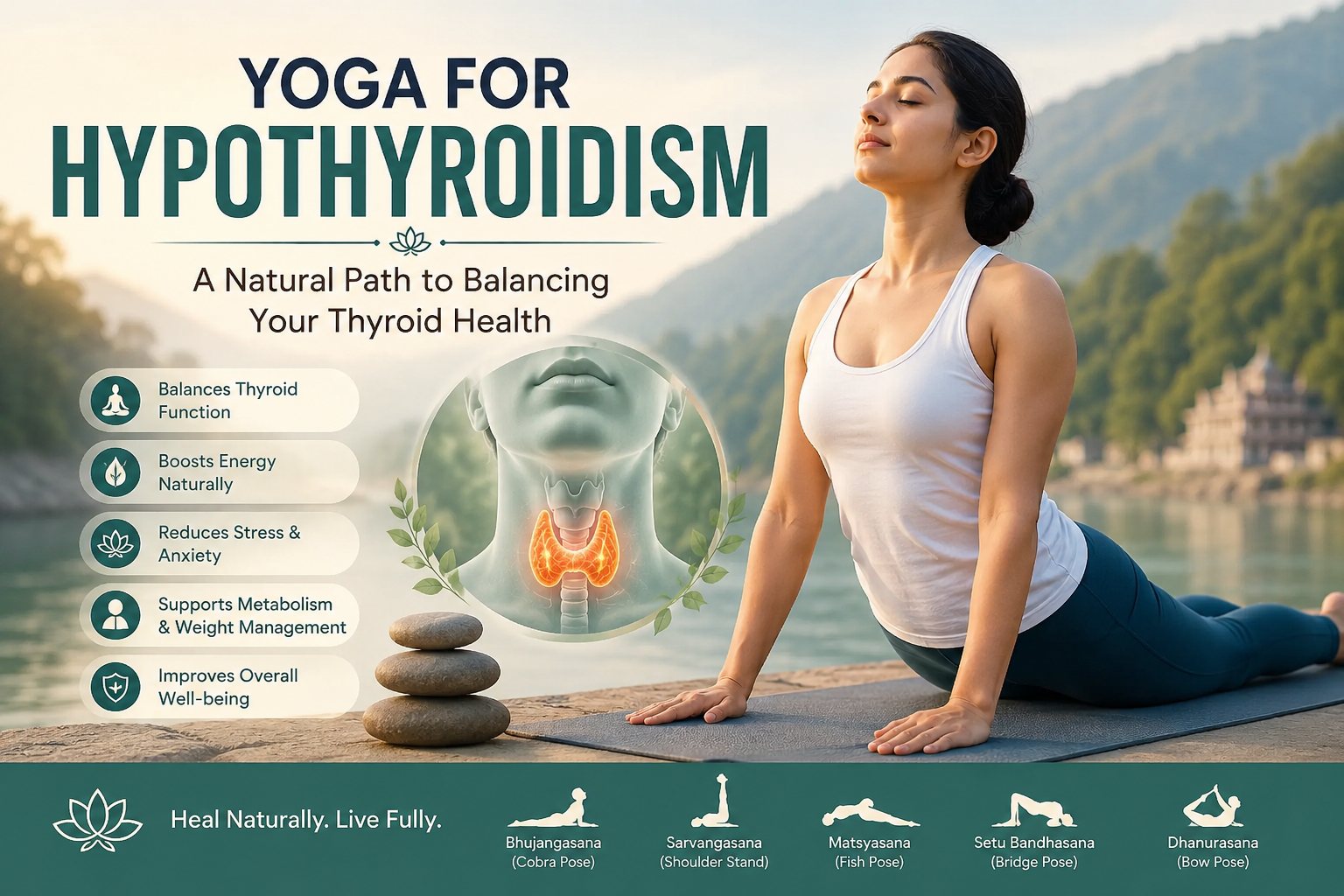
The postures most frequently recommended for thyroid support share one theme: they work the throat, chest, and upper spine while also calming the nervous system. The table below summarises the core group and what each one is doing physiologically.
| Asana | Primary Action | Benefit for Thyroid Health |
| Sarvangasana (Shoulder Stand) | Gentle inversion, chin pressed toward chest | Increases blood flow to the thyroid region; traditionally considered the primary thyroid asana |
| Matsyasana (Fish Pose) | Deep backbend, throat and chest expansion | Stretches and stimulates the front of the neck, balancing the effect of shoulder stand |
| Halasana (Plough Pose) | Forward-folding inversion | Compresses and releases the thyroid area, supporting circulation and lymphatic flow |
| Ustrasana (Camel Pose) | Backbend with throat opening | Opens the chest and throat, easing tightness that builds up from a hunched, low-energy posture |
| Bhujangasana (Cobra Pose) | Gentle backbend, mild neck extension | Stimulates the thyroid and improves flexibility along the spine, suitable as a beginner-friendly alternative |
| Ardha Matsyendrasana (Seated Twist) | Spinal rotation | Massages abdominal organs and supports digestion, which is often slowed by low thyroid output |
Inversions like shoulder stand and plough pose are powerful but not universal — they are unsuitable during pregnancy, for people with uncontrolled high blood pressure, glaucoma, or neck injuries, and for beginners without supervision. This is exactly the kind of nuance that is difficult to self-teach from a video alone, which is why many practitioners eventually choose a structured, in-person course.
A properly supervised Iyengar Yoga in Rishikesh India program is particularly well suited to thyroid-related practice, since Iyengar methodology uses props — blocks, bolsters, and chairs — to make inversions and backbends safe and accessible for people with limited neck mobility or fluctuating energy levels.
4. Pranayama and Yoga Nidra for Hormonal Balance
Breathwork deserves equal attention to asana in a thyroid-focused practice, because it works directly on the stress axis rather than only on local circulation.
Deep relaxation practices matter just as much as active breathwork. A structured session of Yoga Nidra in Rishikesh guides the body into a state between waking and sleep where cortisol drops significantly and the nervous system gets a genuine chance to reset — something that is difficult to achieve through willpower alone when someone is already dealing with the low energy and low motivation that hypothyroidism often brings.
Because hypothyroidism is so closely linked with mood changes, anxiety, and low motivation, it is also worth exploring Yoga for Mental Health in Rishikesh India as a complementary focus, rather than treating the physical and emotional symptoms of thyroid imbalance as unrelated issues.
5. Building a Daily Yoga Routine for Thyroid Health
A realistic, sustainable routine matters more than an intense but occasional one. A simple structure to follow:
- Begin with five to ten minutes of Anulom Vilom or Ujjayi breathing to settle the nervous system before any physical movement.
- Move through gentle warm-ups — neck rolls, shoulder rotations, and cat-cow stretches — to prepare the spine and throat for deeper postures.
- Practice two to three thyroid-focused asanas from the table above, holding each for 30 to 60 seconds and always following an inversion with a counter-pose such as fish or child’s pose.
- Add one seated twist and one gentle backbend to support digestion and chest opening.
- Close with 10 to 15 minutes of Yoga Nidra or simple relaxation in Savasana, since this is where much of the hormonal benefit consolidates.
- Practice at a consistent time each day if possible — early morning on an empty stomach is traditionally preferred, since a full stomach makes twists and inversions uncomfortable.
- Track energy, sleep, and mood weekly rather than only tracking weight, since these are usually the first markers to improve and can keep motivation steady while any hormonal change takes longer to show up.
A session built this way rarely takes more than 35 to 45 minutes, which matters, because a routine someone can realistically repeat five or six days a week will always outperform an elaborate one that gets skipped after the first fortnight.
6. Lifestyle and Ayurvedic Practices That Complement Yoga
Yoga works best as part of a broader daily rhythm rather than as an isolated 20-minute block. A few habits consistently reinforce what the practice is trying to achieve:
- Prioritise seven to eight hours of sleep, since poor sleep directly raises cortisol and undermines whatever calming effect the practice provides.
- Eat warm, easily digestible meals, since hypothyroidism already slows digestion and cold or heavy food adds further strain.
- Reduce processed sugar and excess caffeine, both of which can aggravate the fatigue-energy crash cycle common with low thyroid output.
- Get natural sunlight exposure in the morning where possible, which supports circadian rhythm and, indirectly, hormonal regulation.
Ayurveda offers additional support alongside yoga, particularly through warm oil massage (abhyanga), which improves circulation and is traditionally used to calm an aggravated nervous system. Learning these techniques properly through a dedicated Ayurvedic Massage Course in Rishikesh India gives practitioners a genuinely complementary toolkit rather than relying on yoga alone.
None of these habits need to be perfect from day one. Most practitioners find it easier to add one change every couple of weeks — sleep first, then diet, then sunlight exposure — rather than overhauling everything at once, which tends to be the reason lifestyle changes fail to stick in the long run.
Frequently Asked Questions (FAQs)
No. Yoga supports symptom management and overall hormonal balance, but hypothyroidism, especially when autoimmune in origin, requires ongoing medical supervision and, in most cases, medication. Yoga works alongside treatment, not in place of it.
Sarvangasana, or shoulder stand, is traditionally regarded as the primary thyroid-stimulating posture because of the gentle chin lock and increased blood flow to the neck. It should always be balanced with a counter-pose like fish pose and avoided if you have neck issues, high blood pressure, or are pregnant.
Generally yes, for most people without additional complications, but inversions should be learned under supervision first. People with high blood pressure, glaucoma, vertigo, or cervical spine issues should modify or avoid them and use supported alternatives instead.
Energy and mood often improve within a few weeks of consistent practice, while measurable hormonal shifts, if any, tend to take several months of steady effort combined with medical treatment and lifestyle changes.
Yes. Chronic stress raises cortisol, which interferes with the conversion of T4 into active T3 hormone and can aggravate autoimmune thyroid conditions. This is exactly why breathwork and relaxation practices are considered as important as the physical postures themselves.
Yes, but beginners should start with gentle postures like cobra pose and seated twists before attempting inversions, and ideally learn from a qualified teacher who can assess individual limitations rather than following generic videos alone.
Yes. Many people join a Yoga Teacher Training in Rishikesh program specifically to deepen their personal practice and get individual correction on postures they had been doing incorrectly for years, which matters even more when a health condition like hypothyroidism is involved.
Final Thoughts
Hypothyroidism is a long-term condition, and long-term conditions respond best to consistent, sustainable habits rather than short bursts of effort. Yoga offers exactly that: a daily practice that works simultaneously on circulation, the stress response, and digestion — three of the systems most affected by an underactive thyroid.
Whether you practice at home with guidance from a qualified teacher or choose to go deeper through a dedicated Yoga Retreat in Rishikesh, the underlying principle stays the same: correctly practiced, regularly repeated, and paired with sound medical care, yoga can meaningfully ease the daily burden of hypothyroidism even though it is not a substitute for the treatment your doctor has prescribed.
