 Skip to content
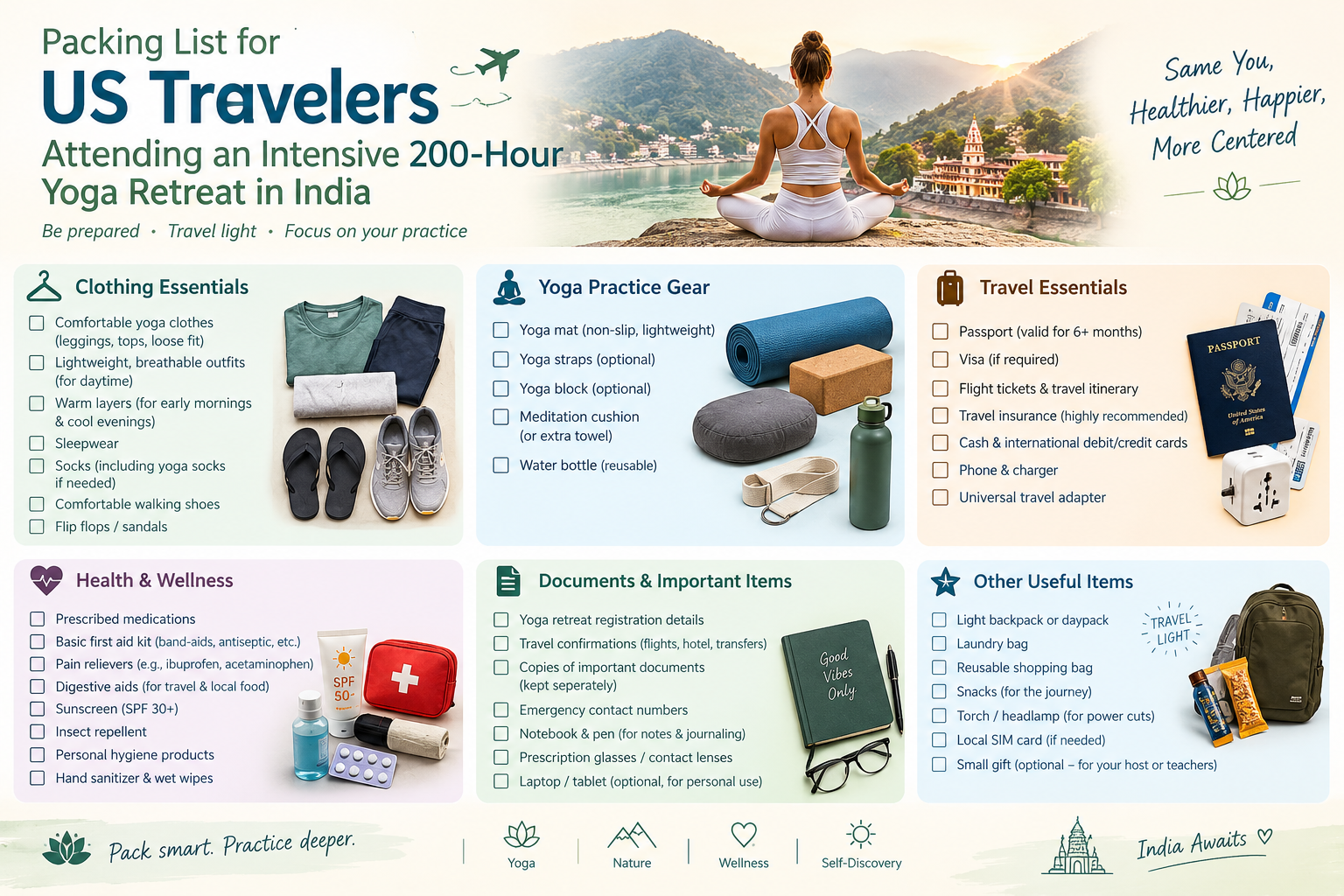
A practical, category-by-category packing guide for Americans preparing for several weeks of intensive daily practice, study, and ashram-style living in India.
A 200-hour yoga retreat is not a beach holiday, and packing for one requires a different kind of thinking than most Americans bring to international travel. The days are long, physically demanding, and structured around early mornings, simple accommodation, and a routine that leaves little room for the kind of last-minute shopping trip that solves a packing mistake back home.
Getting the packing list right matters more than it might seem. Showing up without the right practice gear, appropriate clothing, or basic health essentials does not just create minor inconvenience, it can genuinely affect how well someone is able to participate in weeks of daily training. At the same time, overpacking creates its own problems in small rooms and during travel between cities.
This guide walks through exactly what US travelers should pack for an intensive 200-hour program in India, organised by category, with practical reasoning behind each recommendation rather than a generic checklist.
1. Why Packing Right Matters More for This Kind of Trip
Most students arriving for Yoga Teacher Training in Rishikesh underestimate just how full the daily schedule is until they are already in it. With practice sessions starting before sunrise and running through the evening, there is very little time or energy left over to fix a packing oversight, which is exactly why getting the list right before departure matters so much more here than for a typical vacation.
Accommodation at most schools is comfortable but simple, closer to a well-run guesthouse than a hotel, which means many of the small comforts Americans take for granted at home need to be brought along rather than assumed.
2. Understanding the Climate and Season Before You Pack
Rishikesh and the surrounding region see genuinely different conditions across the year, from cold winter mornings to intense pre-monsoon heat and heavy monsoon rain. Checking the specific season a trip falls into before packing is one of the single most useful steps a traveler can take, since a packing list built for October will look quite different from one built for June or December.
Layering is the safest general strategy regardless of season, since mornings and evenings tend to be noticeably cooler than midday even during the warmer months, and temple and ashram settings often require more coverage than daytime heat alone would suggest.
3. Yoga and Practice Gear Essentials
A personal yoga mat is worth bringing rather than relying entirely on what a school provides, since consistency with a familiar mat matters over weeks of daily practice. A yoga towel, a strap, and a block are worth packing as well, particularly for students planning to focus on Iyengar Yoga in Rishikesh India, which relies heavily on props for correct alignment work.
A lightweight meditation cushion or shawl is also useful for the seated pranayama and meditation portions of most 200-hour curriculums, since floor sitting for extended periods takes some adjustment for anyone not already used to it.
4. Clothing for Daily Practice and Off-Mat Life
Breathable, moisture-wicking practice clothing in natural fabrics like cotton generally performs better than synthetic gym wear in Rishikesh’s climate, particularly during the hotter months. Packing enough for several days between laundry cycles, most schools offer affordable local laundry services, saves considerably on luggage space compared with trying to bring enough for the full course.
Beyond practice wear, modest, loose-fitting clothing that covers the shoulders and knees is essential for temple visits, ashram settings, and general daily life in a town where conservative dress is both culturally expected and genuinely more comfortable in the local climate than form-fitting Western activewear.
5. Footwear and Temple Etiquette Considerations
Comfortable walking sandals that are easy to remove are worth prioritising over sneakers as an everyday choice, since shoes come off constantly, entering temples, ashrams, and even some accommodation areas. A sturdier pair of shoes is still worth packing for walks along uneven riverside paths or any side trips into the surrounding hills.
Flip-flops for showers and general use around a guesthouse round out a practical footwear list, and are inexpensive enough locally that travelers short on luggage space can simply buy a pair after arrival rather than packing them from home.
6. Toiletries and Personal Care Items
Basic toiletries are available locally, but travelers with specific skincare needs, particular sunscreen formulations, or preferred menstrual products should bring their own supply, since matching Western brands are not always easy to find. A high-SPF sunscreen and a good insect repellent are worth prioritising regardless of season, given the amount of time spent outdoors during a typical training day.
A small quick-dry towel is a genuinely useful addition beyond whatever a guesthouse provides, particularly for anyone planning early morning practice sessions or river visits where a heavier towel becomes impractical to dry between uses.
7. Health, Medication, and First-Aid Essentials
Any prescription medication should be packed in its original packaging with enough supply to cover the full course plus a buffer for travel delays, along with a copy of the prescription itself in case questions arise during travel. A basic personal first-aid kit, rehydration salts, common pain relief, and any regularly used over-the-counter medication, is worth assembling before departure rather than assuming everything will be easily available locally.
Given how physically demanding an intensive course can be, students focused specifically on Yoga for Mental Health in Rishikesh India as part of their training often find it worth packing a journal specifically for tracking how both body and mind respond across the weeks, which becomes a genuinely useful record once the course is underway.
8. Electronics and Connectivity
A universal travel adapter is essential, since Indian outlets differ from US standards, and a small portable power bank is worth packing given that charging opportunities can be limited during full training days. Most students find a local SIM card or an international data plan more useful than relying on guesthouse Wi-Fi alone, particularly for staying in touch with family back home.
It is worth deliberately packing light on entertainment electronics. Most 200-hour programs discourage heavy phone or laptop use during the course specifically, since the immersive, distraction-free structure is part of what makes the training effective.
9. Documents, Money, and Travel Essentials
A valid passport with several months of remaining validity, a printed and digital copy of the Indian e-visa, travel insurance documentation, and course confirmation paperwork should all be packed together, with photocopies kept separately from the originals in case anything is lost. A small amount of US dollars for the airport and initial days is useful, though most ongoing expenses are handled more efficiently through a local debit card withdrawal or currency exchange after arrival.
A money belt or a similar discreet way to carry a passport and cash during travel days is a sensible precaution, even though Rishikesh itself is generally considered a safe town for international students.
10. Bedding, Comfort Items, and Room Essentials
Most schools provide basic bedding, but a lightweight sleeping bag liner or a familiar pillowcase from home can make simple accommodation feel considerably more comfortable during the adjustment period. A headlamp or small flashlight is genuinely useful for pre-dawn practice sessions and any power fluctuations, which are not unusual in the region.
Earplugs and a sleep mask are worth packing as well, since ashram and guesthouse settings often mean early morning activity and sound carries more than in a typical Western hotel.
11. Books, Journals, and Study Materials
A dedicated notebook for philosophy and anatomy lectures is worth bringing rather than relying entirely on digital notes, since many students find handwriting helps retention during dense theoretical sessions. Anyone specifically drawn to the philosophical side of training may also want to bring, or plan to pick up locally, material related to Values of Yoga in Life India, which many students find deepens the classroom portion of an intensive course considerably.
12. What Not to Bring
Overpacking is one of the most common mistakes among first-time travelers to Rishikesh. Excessive amounts of Western clothing, high-value jewellery, and bulky non-yoga workout equipment all tend to sit unused for the duration of a training-focused trip. Valuable electronics beyond what is genuinely needed for the course are also worth leaving at home, both for practical reasons and simply because the intensive schedule leaves little time to use them.
Heavy guidebooks and printed reference materials can generally be left behind in favour of digital versions, since luggage space is genuinely limited on the return journey once students have accumulated books, gifts, and other items picked up during the course.
13. Packing for Side Trips and Free Time
Most 200-hour programs build in at least some free time, whether for a single day off each week or a short break before or after the intensive portion. Travelers hoping to explore Spiritual Places to Visit in Rishikesh During Yoga TTC during these breaks should pack a small daypack separately from their main luggage, making it easy to head out for a few hours without disturbing an otherwise well-organised room setup.
A reusable water bottle with a built-in filter is worth the investment for these outings specifically, reducing single-use plastic while making longer excursions away from the main accommodation considerably more comfortable.
14. Final Packing Checklist and Tips
Before finalising a bag, it is worth cross-checking against a school’s specific pre-arrival material, since requirements can vary slightly between programs. Reviewing a resource like What to Pack for Yoga Teacher Training in Rishikesh alongside this guide gives a more complete picture, since different schools sometimes have slightly different expectations around uniform colours, mat requirements, or specific course materials.
It is equally worth reading through a general Daily Routine During Yoga Teacher Training in Rishikesh before finalising a bag, since seeing exactly how a typical day unfolds makes it much easier to judge which comfort items are genuinely worth the luggage space and which are unlikely to get used.
Frequently Asked Questions (FAQs)
Q1. Should I bring my own yoga mat or rely on the one provided by the school?
Bringing a personal mat is generally recommended, since consistency with a familiar surface matters over weeks of daily practice, even though most schools do provide mats for students who cannot travel with one.
Q2. How many changes of clothing should I pack for a multi-week course?
Packing enough for four to five days between laundry cycles is usually sufficient, since affordable local laundry services are widely available and reduce the need to overpack.
Q3. Do I need to bring my own toiletries, or are they available locally?
Basic toiletries are easy to find locally, but anyone with specific skincare needs, a particular sunscreen formulation, or preferred menstrual products should bring their own supply from home.
Q4. Is it safe to drink tap water during the course?
No, bottled or properly filtered water is recommended throughout the stay, and a reusable filtered water bottle is a practical way to reduce single-use plastic while staying hydrated.
Q5. What should I do about prescription medication?
Pack enough supply to cover the full course plus a buffer for travel delays, keep medication in its original packaging, and carry a copy of the prescription in case questions arise during travel.
Q6. Will I have reliable internet access during training?
Most accommodation offers Wi-Fi, though connectivity can be inconsistent, and many students find a local SIM card or international data plan more reliable for staying in touch with family.
Q7. How much luggage space should I leave for the return trip?
It is wise to pack the outbound bag no more than two-thirds full, since most students return with books, gifts, and course materials accumulated during the training.
Final Thoughts
Packing well for an intensive 200-hour program is less about bringing everything imaginable and more about being deliberate: the right practice gear, appropriate clothing for both training and temple visits, basic health essentials, and a small set of comfort items that make simple accommodation feel manageable over several weeks. Travelers who take the time to pack thoughtfully, rather than defaulting to a generic international packing list, tend to arrive settled and ready to focus fully on the training itself, which is ultimately what these weeks in India are meant to be about.
