 Skip to content
An informational guide to where traditionally trained yoga teachers are most sought after in the United States, and what studios and employers in these markets actually expect.
Yoga has been part of mainstream American fitness culture for long enough that the market has started to differentiate between generalist instructors and teachers trained in a deeper, more traditional lineage. Studios, corporate wellness programs, and boutique retreat centers increasingly describe what they are looking for as ‘authentic’ or ‘traditionally trained’ teaching, a phrase that usually points to instructors who studied in India rather than exclusively at a domestic weekend certification.
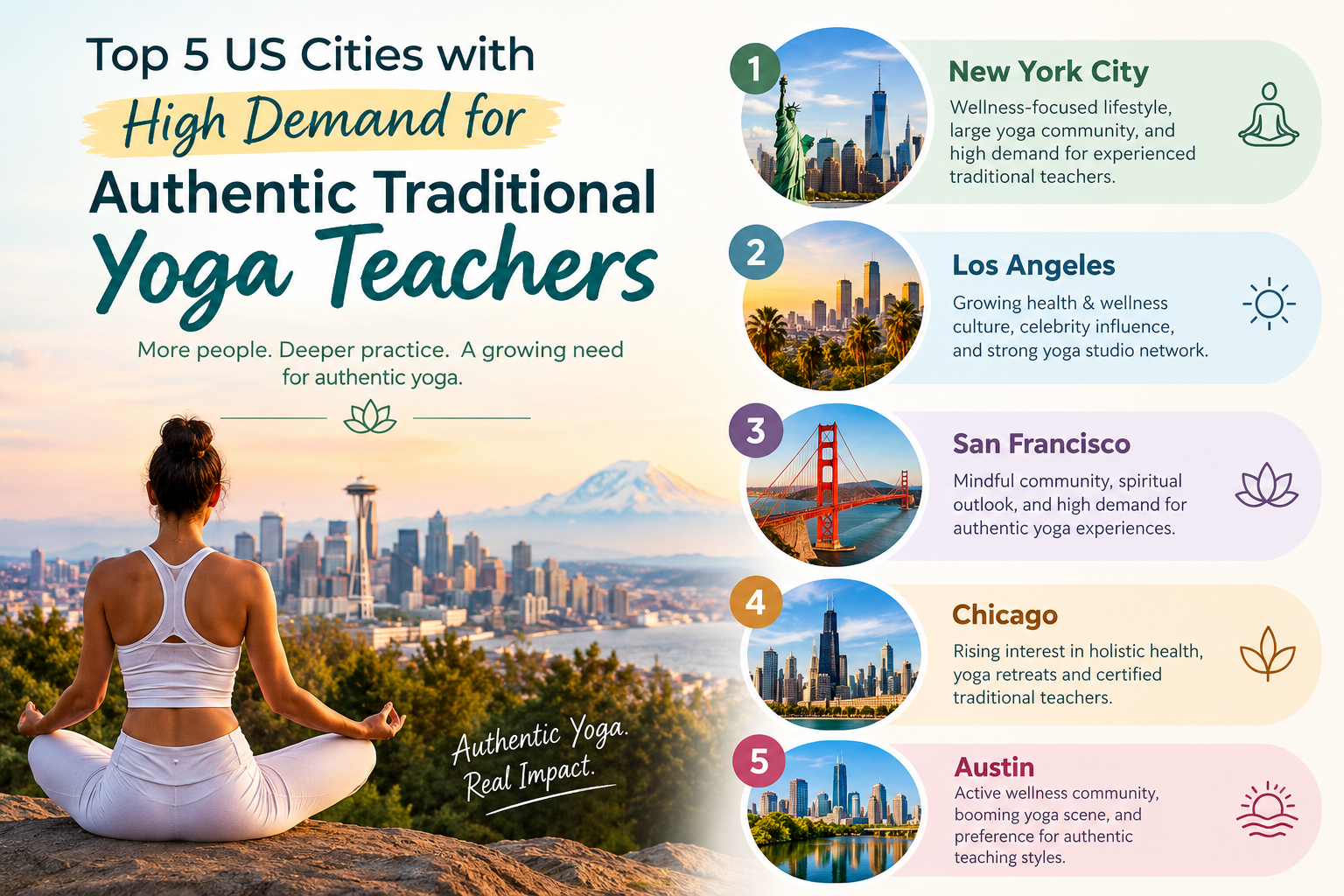
This shift is not evenly distributed across the country. A handful of American cities, driven by dense concentrations of studios, wellness-conscious populations, and clients willing to pay for depth of training, account for a disproportionate share of this demand. Understanding where that demand actually concentrates matters for anyone deciding where to build a teaching career after certification.
This guide looks at five US cities where demand for traditionally trained yoga teachers is strongest, what distinguishes each market, and what it actually takes to compete for teaching roles once you get there.
1. Why Demand for Traditionally Trained Teachers Is Rising
Part of this shift is simple market maturity. American yoga students, many of whom have been practicing for a decade or more, have grown more discerning about the difference between a teacher who learned a sequence from a video course and one trained through sustained, in-person study. Understanding What Makes Rishikesh the Yoga Capital of the World? helps explain why so many studios specifically list Indian training as a preferred, and sometimes required, qualification in job postings.
Corporate wellness programs have added another layer of demand. Companies bringing yoga in-house for employee wellness increasingly want instructors who can speak credibly about the philosophy and history behind the practice, not just lead a physical sequence, which further favours teachers with deeper, traditional training.
2. What ‘Authentic’ Actually Means to US Employers
The word authentic gets used loosely in fitness marketing, but in hiring contexts it usually has a fairly specific meaning: training completed at a recognised school in India, ideally with a defined lineage or teaching tradition behind it, rather than a certificate earned entirely online or over a single weekend. Studios use this as a filter partly for genuine quality reasons and partly because it has become a meaningful marketing differentiator with increasingly informed clients.
This does not mean domestically trained teachers cannot succeed in these markets. It means that in the specific cities covered below, traditional training tends to open more doors, faster, particularly for higher-paying private and corporate work.
3. Los Angeles, California
Los Angeles remains the largest and most saturated yoga market in the country, with more studios and registered teachers than any other US city. That scale cuts both ways: competition for studio spots is intense, but the sheer size of the market also means more total opportunity, particularly in private teaching, celebrity and entertainment-industry wellness work, and studio ownership.
Traditionally trained teachers tend to stand out here specifically because the domestic training pool is so large. In a market flooded with 200-hour certificates earned in a single weekend, a teacher who trained over several weeks in India, with real depth in philosophy and alignment, has a clear differentiator when competing for premium studio slots or private clients.
4. New York City, New York
New York’s yoga market is smaller in raw studio count than Los Angeles but pays noticeably better on average, driven by high demand relative to available teaching hours and a client base accustomed to paying premium rates for wellness services. Corporate wellness work is particularly strong here, with major employers building in-house yoga and mindfulness programs that specifically seek out instructors with credible, traditional training backgrounds.
The pace of the city also shapes what studios look for. Classes tend to be tightly scheduled and efficiently run, which rewards teachers who can deliver a well-structured, technically precise class within a fixed window, a skill that traditional training with a strong emphasis on sequencing and alignment tends to build particularly well.
5. San Francisco Bay Area, California
The Bay Area combines a wellness-conscious population with one of the country’s highest concentrations of tech-sector wealth, producing strong demand for both studio classes and higher-paying private and corporate sessions. Tech companies in particular have been early and consistent adopters of in-house wellness programming, and many specifically seek instructors who can speak to the meditative and philosophical dimensions of practice, not just the physical sequence.
Cost of living here is a genuine consideration for teachers relocating specifically for this market, and most successful full-time teachers in the Bay Area combine studio work with private clients and corporate contracts rather than relying on studio pay alone.
6. Austin, Texas
Austin has developed one of the fastest-growing yoga scenes in the country over the past decade, driven by a large influx of health-conscious transplants and a local culture that already prizes outdoor fitness and wellness. Studio growth here has outpaced many older, more established markets, which has created real opportunity for teachers willing to build a client base in a still-developing scene rather than competing in an already saturated one.
The market skews slightly less formal than New York or Los Angeles, but studios and wellness centers here are increasingly specific about wanting instructors with a genuine grounding in traditional practice, particularly as the city’s broader wellness industry matures and clients become more knowledgeable.
7. Boulder and Denver, Colorado
Colorado has one of the highest concentrations of yoga studios per capita of any state in the country, with Boulder and Denver forming the core of a wellness culture built around outdoor activity, altitude training, and a genuinely health-focused local population. Demand here is strong across both studio teaching and more specialised offerings tied to athletic recovery and mountain-sport communities.
Because the local population tends to be knowledgeable about yoga generally, traditionally trained teachers often find it easier here than in some other markets to build a reputation quickly, since students are more likely to recognise and value depth of training when they encounter it.
8. What These Five Markets Have in Common
Across all five cities, the pattern is consistent: demand is strongest where client bases are both wealthy enough to pay for premium instruction and informed enough to seek it out specifically. Corporate wellness programs, private clients, and boutique studios in these markets increasingly treat traditional training as a genuine hiring criterion rather than a nice-to-have.
Smaller or less saturated markets outside these five can still offer good opportunities, particularly for teachers willing to build a client base gradually, but the concentration of premium, traditionally focused roles is heaviest in these specific cities.
9. Credentials That Matter Most in These Markets
A 200 Hours YTTC Rishikesh India certification remains the baseline most studios in these markets expect, but teachers targeting the higher end of any of these five cities, private clients, corporate contracts, senior studio roles, increasingly benefit from continuing toward a 500 Hours YTTC Rishikesh India qualification once they have some teaching experience under their belt.
Working through a proper Yoga Instructor Certification Guide in India before choosing a school matters more for these competitive markets than for smaller cities, since employers here are more likely to ask specific questions about where and how a teacher trained.
10. Building a Teaching Career Before Relocating
Moving to one of these cities without any teaching experience or client base is a difficult way to start. Most successful teachers complete training, build initial experience and confidence teaching in a lower-cost market or online, and only then relocate once they have a body of work to point to. Training through a proper Yoga TTC India program before making that move gives new teachers a credential that travels well across all five of these markets, rather than one recognised only regionally.
Building an online teaching presence before relocating also helps considerably, since it gives a teacher existing clients and a portfolio of testimonials to bring into a new, competitive market rather than starting entirely from zero.
11. Specialised Niches in High Demand Within These Cities
General studio teaching is the most competitive segment in all five markets. Teachers who develop a specific niche tend to differentiate more easily, whether that is the precise, alignment-focused approach of Iyengar Yoga in Rishikesh India, the disciplined structure of Ashtanga Yoga in Rishikesh India, or growing corporate demand for classes framed specifically around Yoga for Mental Health in Rishikesh India, which resonates particularly well with wellness programs in cities like San Francisco and New York.
12. Cost of Living and Realistic Income Expectations
All five of these cities carry a significantly higher cost of living than the national average, which needs to factor directly into any relocation decision. Teachers who move without a financial buffer or a plan for building income gradually often struggle in the first several months, regardless of how strong demand is in the underlying market.
A realistic income plan usually combines a base of studio classes with private clients, workshops, and increasingly online offerings that are not limited by geography, giving teachers in expensive markets multiple income streams rather than relying on studio pay alone.
13. Positioning Yourself as a Traditionally Trained Teacher
Once trained, how a teacher communicates that background matters considerably in these competitive markets. Being specific about where and how you trained, rather than using vague marketing language, tends to build more credibility with both studios and increasingly informed clients who are actively looking for exactly this kind of depth.
A well-documented teaching bio, a consistent online presence, and genuine familiarity with the philosophy behind the practice, not just the physical postures, all help a teacher stand out in markets where competition for the best roles is genuinely fierce.
14. Planning the Move: Practical Steps
Anyone planning this path should treat both the training and the relocation as connected decisions rather than separate ones. Reading through practical resources such as Things to Know Before Doing Yoga Teacher Training in India before committing to a school helps ensure the training itself sets a teacher up well for whichever of these five markets they eventually target.
Building a rough timeline, training, initial experience, savings, and a target relocation window, gives the whole process structure, rather than treating the move as a single leap made immediately after certification.
Frequently Asked Questions (FAQs)
Q1. Which US city has the most yoga teaching jobs overall?
Los Angeles has the largest total number of studios and teaching positions of any US city, though competition for those roles is correspondingly intense.
Q2. Which city pays yoga teachers the most?
New York and San Francisco tend to offer the highest average pay per class and the strongest demand for premium private and corporate sessions, largely due to client bases accustomed to paying more for wellness services.
Q3. Is traditional Indian training actually required to teach in these cities?
It is rarely a strict legal requirement, but in these five markets specifically, it has increasingly become a meaningful hiring preference, particularly for corporate wellness roles and premium private clients.
Q4. Is it better to build experience before moving to one of these cities?
Yes, in most cases. Teachers who arrive with existing experience, a client base, or an online following generally have an easier time establishing themselves than those who relocate immediately after certification.
Q5. Are smaller US cities worth considering instead of these five?
Smaller markets can offer real opportunity, particularly for teachers willing to build a client base gradually, though the concentration of premium, traditionally focused roles remains heaviest in these five cities.
Q6. What certification level is enough to start applying for jobs in these markets?
A 200-hour certification is the standard minimum most studios expect, though teachers targeting corporate or higher-paying private work often benefit from further training over time.
Q7. How important is a specific yoga niche when job hunting in these cities?
Increasingly important. General studio teaching is the most competitive segment in all five markets, so a defined specialty tends to make a teacher considerably easier to place and to market.
Final Thoughts
Demand for traditionally trained yoga teachers in the United States is real and growing, but it concentrates heavily in a handful of markets where clients are both willing and able to pay for genuine depth of training. Los Angeles, New York, the Bay Area, Austin, and the Boulder-Denver corridor each offer distinct opportunities, but all five reward teachers who arrive with credible, well-documented training rather than a minimal certificate earned as quickly as possible. For teachers planning this path seriously, treating training and career planning as one connected process, rather than separate steps, remains the clearest route to building a sustainable teaching career in any of these cities.
