 Skip to content
Note: This article offers a traditional and practical understanding of yoga as a supportive practice for cervical spondylosis and general neck health. It does not replace personalized advice from a qualified doctor, physiotherapist, or orthopedic specialist. Cervical spondylosis varies widely in severity, and results of any yoga practice depend on individual diagnosis, consistency, and guidance received.
Cervical spondylosis is often described to patients as simple “wear and tear,” a phrase that can make an uncomfortable, sometimes frightening condition sound almost dismissible. In reality, the stiffness, aching, and occasional radiating discomfort it produces can meaningfully affect daily life, from turning to check a blind spot while driving to sitting through a full workday without a dull ache building at the base of the skull. Yoga has become a widely recommended complementary approach for this kind of age- and posture-related neck degeneration, not because it reverses the underlying changes in the cervical spine, but because it directly addresses the muscular tension, restricted mobility, and postural habits that so often make the condition feel worse than the imaging alone would suggest.
Modern daily life does the cervical spine very few favors. Hours spent looking down at a phone or forward at a screen place sustained load on the neck it was never designed to hold for so long, and this steady strain compounds over years, often well before any formal diagnosis is made. Yoga offers a structured way to counteract this pattern, not through forceful correction, but through patient, consistent movement that gradually restores mobility and eases the muscular guarding that builds up around a stiff or degenerating joint.
This guide explores what cervical spondylosis actually involves, which yoga practices genuinely help, and how to build a sustainable, safe routine around it. It is worth noting from the outset that cervical spondylosis is not something yoga is expected to reverse. Degenerative changes in the cervical discs and joints are a normal part of aging for most adults, and imaging findings do not always correlate closely with how much pain a person actually feels. What yoga can meaningfully influence is the surrounding muscular tension, postural alignment, and nervous system reactivity that often determine whether those underlying changes translate into daily discomfort or stay largely unnoticed.
1. What Cervical Spondylosis Actually Involves
Cervical spondylosis refers to age-related degeneration of the discs, vertebrae, and joints of the neck, including gradual disc thinning, bone spur formation, and stiffening of the supporting ligaments. It is extremely common, present to some degree in most people over fifty, and doesn’t always cause symptoms. When it does, the typical complaints are neck stiffness, a dull ache that worsens with prolonged posture, and occasionally pain, tingling, or weakness radiating into the shoulder or arm if a nerve root becomes compressed.
This concept is explored in more depth in our broader guide to Yoga for Mental Health in Rishikesh India, which looks at how the nervous system’s stress response can amplify the perception of chronic pain, including the kind associated with degenerative neck conditions.
2. Why the Neck Is So Vulnerable to Chronic Strain
The cervical spine supports the full weight of the head, roughly five kilograms in a neutral position, but that load increases sharply as the head tips forward, a posture now sustained for hours daily by phone and screen use. This forward-head posture places disproportionate strain on the lower cervical discs and the muscles at the base of the skull, accelerating the degenerative changes that define cervical spondylosis and intensifying the muscular tension around them.
Because emotional stress is also held physically in the neck and shoulders, chronic tension from daily pressures compounds this mechanical strain further, tightening muscles already compensating for years of forward-leaning posture. This is part of why cervical spondylosis symptoms often flare during high-stress periods, even without any new physical injury.
3. Yoga Practices That Support Cervical Spondylosis
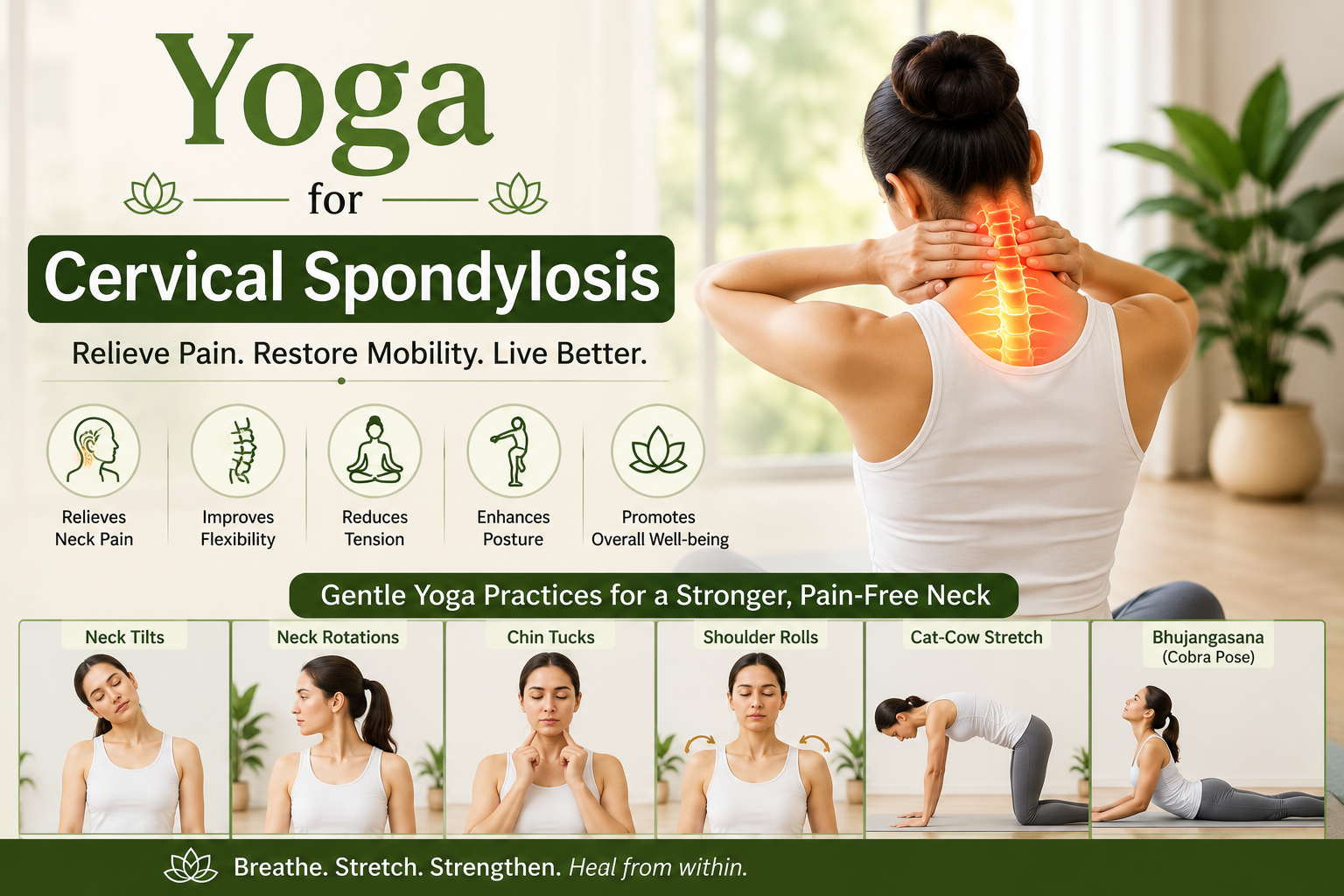
Gentle Neck Mobilization: Slow, small-range movements such as chin tucks and side bends help maintain mobility without provoking the joint, and are typically the safest starting point during a flare-up.
Diaphragmatic Breathing: Deep, slow belly breathing reduces the general muscular guarding around a chronically tense neck, since shallow chest breathing relies on and reinforces tight upper trapezius muscles.
Supported Restorative Postures: Bolsters and blankets supporting the head and neck in a neutral, aligned position allow chronically tight muscles to release passively rather than through active stretching.
Shoulder Blade Strengthening: Gentle activation of the muscles between the shoulder blades helps correct the forward-head, rounded-shoulder posture that places ongoing strain on the cervical spine.
Mindful Postural Awareness: Simple seated or standing alignment practice, returning attention to a neutral head position throughout the day, addresses the root postural habit rather than only the resulting tension.
4. Untreated Strain vs Forceful Correction vs Yoga-Supported Neck Care: Key Differences at a Glance
| Approach | What It Looks Like | Long-Term Effect |
| Untreated Strain | Ignoring stiffness, continuing poor postural habits unchanged | Progressive tightness, worsening flare-ups |
| Forceful Correction | Aggressive stretching or cracking the neck to seek quick relief | Irritation, potential nerve or joint aggravation |
| Yoga-Supported Care | Gentle, consistent mobility and postural awareness | Gradual relief, improved daily function |
5. Working With Specific Presentations
Not everyone experiences cervical spondylosis the same way, and practice should be matched to the presentation. Those with mild stiffness and general tightness, without radiating nerve symptoms, often do well with gentle mobilization combined with restorative work, such as Yoga Nidra in Rishikesh, which allows deeply held tension to release over an extended, fully supported relaxation session.
Those experiencing radiating pain, tingling, or weakness into the arm should approach any neck-loading posture with far greater caution, prioritizing gentle, doctor-approved movement and avoiding anything that reproduces the sensation. Alignment-focused practices that emphasize precise, supported positioning are particularly useful here, since the careful, prop-supported nature of each posture reduces the risk of aggravating a sensitive nerve pathway.
Those managing a long-standing, chronic case with periodic flare-ups often benefit most from a flexible approach: gentler restorative practice during flare-ups, paired with consistent mobility and strengthening during calmer periods, rather than forcing the same routine regardless of how the neck feels that day.
6. Physical, Mental, and Functional Benefits Compared
- Physical: Improved neck mobility, reduced surrounding muscular tension, and better postural alignment over time.
- Mental: Lower stress reactivity, which reduces the muscular guarding that often intensifies chronic neck discomfort.
- Functional: Greater ease with everyday movements such as driving, looking over the shoulder, and sitting through a workday without escalating discomfort.
7. The Alignment Principles Behind Lasting Relief
Technique alone rarely produces lasting relief without attention to how a posture is performed. Precise, alignment-focused traditions such as Iyengar Yoga in Rishikesh India place particular emphasis on exact positioning and generous use of props, an approach especially valuable for cervical spondylosis, where a poorly aligned stretch can aggravate the very structures it was meant to help.
This attention to alignment carries a lesson beyond the mat: many postural habits that worsen cervical spondylosis, such as a forward-jutting chin or rounded upper back, are unconscious patterns carried through daily life, not just formal practice. Learning to recognize and correct this alignment on the mat gradually builds the awareness needed to correct it through an ordinary day as well.
8. Common Mistakes to Avoid When Practicing With Cervical Spondylosis
- Forcing full-range neck rotations or aggressive stretching in pursuit of a cracking release.
- Attempting deep backbends or full-weight inversions such as headstand without qualified, individualized guidance.
- Ignoring radiating pain, tingling, or weakness and continuing to push through a posture regardless.
- Practicing only isolated neck stretches while ignoring the shoulder, upper back, and postural habits driving the underlying strain.
- Abandoning gentle daily movement entirely during a flare-up, when careful, doctor-approved motion often helps more than complete stillness.
9. A Simple Framework for Building a Safe Neck Practice
If you are building your own approach, ask yourself these three questions honestly:
- Does my discomfort stay localized to the neck and shoulders, or does it radiate into the arm or hand?
- What postural habits, such as phone use or desk setup, am I realistically able to adjust?
- Which movements ease my stiffness, and which ones consistently seem to aggravate it?
There are no universally right answers here, only the honest starting point of where your presentation currently sits. A short, consistent daily practice of gentle mobilization, breath, and postural awareness tends to shift chronic neck patterns more effectively than occasional, intense stretching.
10. Deepening Practice Through Structured Training
While a personal practice can meaningfully ease cervical spondylosis symptoms, many practitioners eventually seek more structured guidance to sustain these shifts safely. This is one reason so many people travel for Yoga Teacher Training in Rishikesh, immersing themselves in daily practice, alignment principles, and anatomy in a way that’s difficult to replicate through occasional classes at home.
Programs at the Best Yoga School in Rishikesh typically combine asana, breathwork, and hands-on alignment instruction into one cohesive curriculum, giving students both the technique and the anatomical understanding needed to practice safely around a condition like cervical spondylosis long after training ends.
For those curious how this training is structured, our Yoga Instructor Certification Guide in India outlines the different levels of Yoga TTC India programs available, and a 200 Hours YTTC Rishikesh India course remains one of the most complete starting points for building both a personal practice and a deeper understanding of safe neck care through yoga.
Frequently Asked Questions (FAQs)
Q1. What is cervical spondylosis, in simple terms?
Cervical spondylosis is age-related degeneration of the discs, vertebrae, and joints of the neck. It’s extremely common and doesn’t always cause symptoms, though stiffness and a dull ache are the most typical complaints when it does.
Q2. Can yoga really help with cervical spondylosis?
Yoga doesn’t reverse the underlying degenerative changes, but gentle, consistent practice is widely reported to ease surrounding muscular tension, improve mobility, and reduce how much discomfort those changes actually produce day to day.
Q3. How long does it take to notice relief from yoga for neck stiffness?
Some relief, such as looser muscles after a gentle session, can be felt immediately, while lasting improvements in mobility typically develop over several weeks of consistent practice.
Q4. Which yoga poses should be avoided with cervical spondylosis?
Deep backbends, forceful neck rotations, and full-weight inversions such as headstand are generally best avoided or approached only with individualized guidance, since they can place excessive load directly on a vulnerable cervical spine.
Q5. Is it safe to do yoga during a cervical spondylosis flare-up?
Very gentle, doctor-approved movement is often more helpful than complete stillness during a flare-up, but any posture that reproduces radiating pain, tingling, or weakness should be stopped immediately.
Q6. Can yoga help with the arm pain or tingling associated with cervical spondylosis?
Gentle mobility and postural correction can reduce nerve irritation over time, but radiating arm symptoms should always be evaluated by a doctor first, since they can indicate nerve root involvement requiring specific care.
Q7. How often should I practice for cervical spondylosis relief?
A short daily practice, even ten minutes of gentle mobilization and postural awareness, tends to be more effective for chronic neck conditions than longer, infrequent sessions.
Q8. Does yoga replace medical treatment for cervical spondylosis?
No. Yoga can be a valuable complementary practice, but it isn’t a substitute for medical evaluation, physiotherapy, or other treatment recommended by a qualified doctor, particularly when nerve symptoms are present.
Q9. Can beginners with no yoga background start practicing for neck health?
Yes. Simple chin tucks, gentle mobilization, and postural awareness require no prior experience and can be started immediately, ideally under guidance if a diagnosed condition is already present.
Q10. Where can I learn a complete, safe approach to yoga for cervical spondylosis?
Structured yoga teacher training programs, particularly those in Rishikesh, India, typically include dedicated modules on anatomy, alignment, and therapeutic modification that together support safe, long-term neck care through yoga.
Final Thoughts
Cervical spondylosis is not something to fight against or expect to fully undo, but it is something a patient, consistent yoga practice can genuinely ease. Yoga does not erase the natural changes in an aging spine; it builds the mobility, awareness, and muscular support that allow you to move through daily life with noticeably less strain and greater comfort.
If neck pain is severe, persistent, or accompanied by radiating symptoms into the arm or hand, consider speaking with a qualified doctor or physiotherapist before beginning any new yoga practice. Medical guidance and a careful personal practice can work well together, each supporting the other.
