 Skip to content
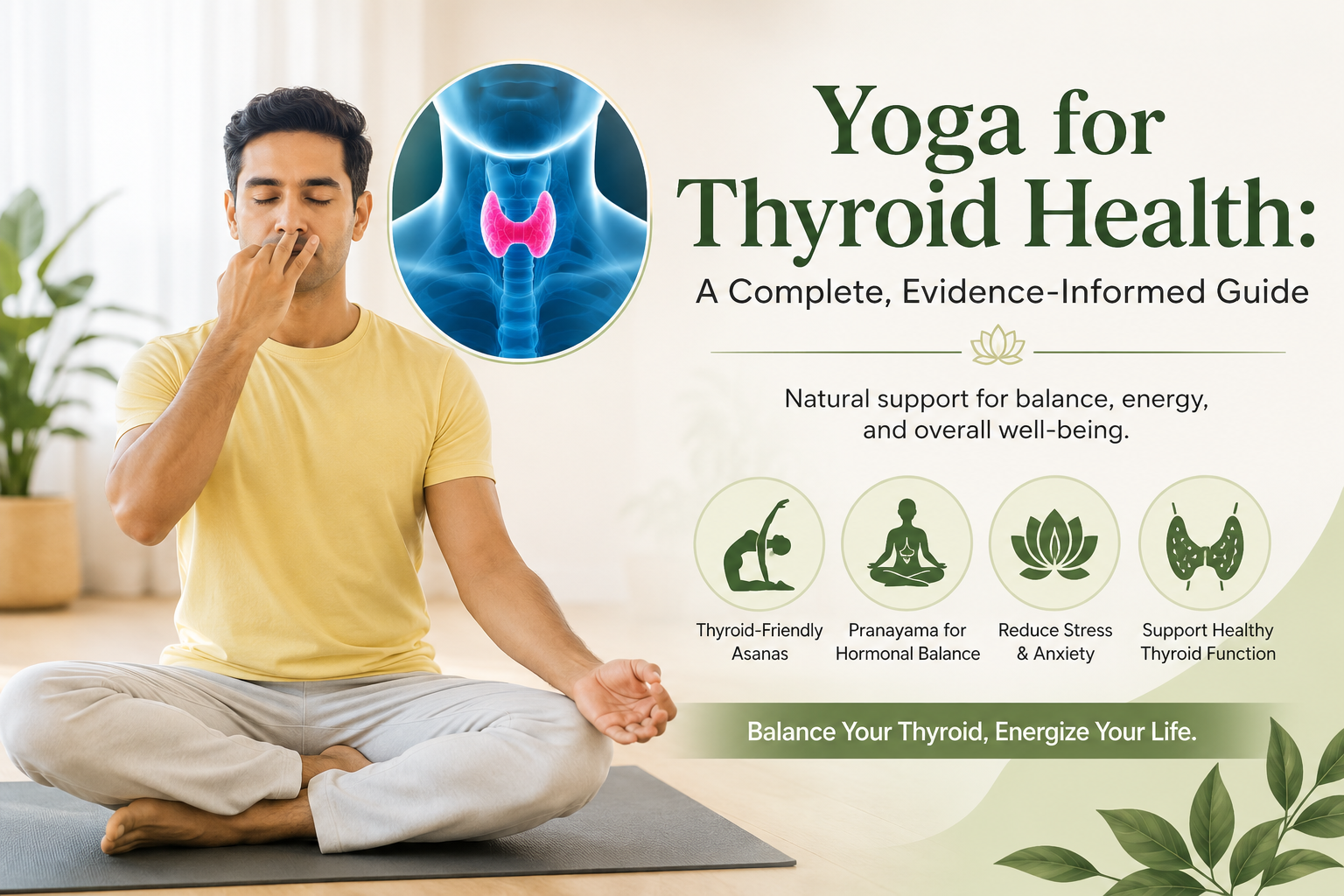
An informational guide to yoga and thyroid health — covering how the thyroid actually functions, where breath work and movement genuinely support wellbeing alongside thyroid conditions, and where popular claims about yoga “curing” or “fixing” the thyroid go further than the evidence supports.
Yoga is frequently recommended for people managing thyroid conditions, and it is often marketed with sweeping promises: that a specific pose or sequence will regulate hormone levels, reverse a diagnosed thyroid disorder, or replace the need for medical treatment altogether. The more accurate picture is more modest: the thyroid is regulated by a complex hormonal feedback loop involving the brain, pituitary gland, and thyroid itself, a system that a physical practice does not directly override, and no single sequence corrects a diagnosed thyroid condition on its own. What yoga can genuinely offer is support for the stress, energy, and body-awareness factors that interact with thyroid health, a real and useful role that falls short of a medical treatment.
This guide walks through what the thyroid actually does and how it is regulated, where a yoga practice has an evidence-aligned role in supporting people living with thyroid conditions, and where popular claims about yoga and the thyroid outpace what the research supports. Yoga is not a substitute for medical diagnosis or treatment, and anyone with a diagnosed thyroid condition should treat a yoga practice as a complement to, not a replacement for, appropriate medical care.
1. What the Thyroid Actually Does and How It Is Regulated
The thyroid is a small, butterfly-shaped gland in the neck that produces hormones regulating metabolism, energy use, and temperature control throughout the body. Its activity is governed by a feedback loop involving the hypothalamus and pituitary gland, which release signalling hormones that tell the thyroid how much hormone to produce. Conditions such as hypothyroidism and hyperthyroidism reflect this system producing too little or too much hormone, often due to autoimmune activity, genetics, or other underlying causes that a physical practice cannot directly correct. Understanding this clarifies what a yoga practice can realistically do: support the body around this system through stress reduction and gentle movement, rather than reset the gland’s hormone output itself.
2. Why Claims That Yoga “Fixes” Thyroid Disorders Go Too Far
It is easy to find wellness content suggesting that specific postures compress or stimulate the thyroid gland enough to normalise hormone levels without medication. These claims are not well supported, since thyroid hormone production is governed by a hormonal feedback system that responds to blood chemistry, immune activity, and pituitary signalling, not to physical pressure from a pose held for a few breaths. The more accurate picture is that yoga can meaningfully support how someone feels while living with a thyroid condition, including energy, mood, and stress levels, offering modest, real benefits without correcting the underlying hormonal imbalance itself.
3. What the Research Actually Shows
Research on yoga and thyroid conditions is limited compared with research on yoga and stress or mood, and much of what exists involves small studies with mixed or inconclusive results on whether yoga measurably changes thyroid hormone levels. Where the evidence is more consistent is in yoga’s broader, well-documented effects on stress reduction, since chronic stress is known to interact with thyroid and adrenal function, and in its support for general wellbeing, sleep, and energy in people managing a chronic health condition. The fair summary: yoga offers genuine, well-supported support for the stress and lifestyle factors surrounding thyroid health, while claims that specific poses directly regulate hormone output outpace what has actually been demonstrated. A broader look at how a structured, breath-led practice supports overall wellbeing can be found in resources on Values of Yoga in Life India.
4. Why a Gentle, Consistent Practice Suits Thyroid Conditions
People managing thyroid conditions often experience fluctuating energy, so a practice that adapts to how the body feels on a given day tends to work better than a rigid, high-intensity routine. This does not mean the practice needs to be limited or overly cautious; it means the emphasis usually shifts toward steady, breath-led movement and postures that can be modified for fatigue or joint sensitivity, both of which are common in thyroid conditions, rather than fast-paced or highly demanding sequences.
5. Breath Work and the Thyroid-Adjacent Nervous System
A few minutes of slow, diaphragmatic breathing is one of the more directly useful elements of a thyroid-supportive practice, since it engages the parasympathetic nervous system and can help ease the physical tension that often accompanies both hypothyroidism and hyperthyroidism. Some people also explore gentle throat-opening breath techniques, though these should be introduced carefully and are not appropriate for everyone, particularly those with hyperthyroidism, an enlarged thyroid, or any condition where increased pressure or stimulation in the neck area has not been cleared by a doctor.
6. Postures Commonly Associated with Thyroid Support
A number of postures are traditionally associated with thyroid health, particularly those involving gentle neck flexion, such as certain seated forward folds and supported inversions that bring the chin toward the chest. Simple shoulder and neck mobility work, along with gentle twists, tends to be well tolerated by most people and can ease general tension in the area, though there is no strong evidence that any single posture measurably changes thyroid hormone output. A structured approach to sequencing these kinds of postures safely, of the sort taught in Iyengar Yoga in Rishikesh India, places particular emphasis on precise alignment and supported variations, which can be especially useful for anyone approaching neck-focused postures with a diagnosed thyroid condition.
7. Postures and Approaches to Take Caution With
Because inversions and deep neck postures increase pressure and blood flow in the neck and throat area, anyone with an enlarged thyroid, thyroid nodules, hyperthyroidism, or a recent thyroid-related procedure should approach these postures cautiously and ideally under guidance from a qualified teacher and treating doctor. A more disciplined, structured practice such as the sequential approach found in Ashtanga Yoga in Rishikesh India can still be adapted for thyroid conditions, but modifications and props are often necessary rather than optional, particularly around inverted and deep neck-flexion postures.
8. Structuring a Realistic Thyroid-Supportive Practice
A realistic thyroid-supportive practice generally moves through a few clear stages: a gentle warm-up with breath awareness, mobility work for the neck and shoulders, a moderate sequence of standing and seated postures adapted to energy levels, and a closing period of relaxation or restorative stillness. Learning to build and adapt this kind of sequence properly, of the kind covered in a structured Yoga Instructor Certification Guide in India, can offer a useful reference for how a condition-specific practice is traditionally developed alongside broader anatomy and sequencing principles.
9. How Often and How Long a Practice Needs to Be
There is no fixed duration or frequency that suits everyone, particularly given how much energy levels can fluctuate with thyroid conditions, and much of the general research on yoga and chronic health support shows benefits from sessions as short as fifteen to twenty minutes, provided they happen consistently. A shorter, adaptable practice that respects a low-energy day tends to be more sustainable, and therefore more beneficial over time, than an ambitious routine that gets abandoned during a flare or fatigue episode.
10. Common Mistakes People Make with Yoga and Thyroid Conditions
A few patterns tend to undermine an otherwise well-intentioned practice: attempting intense neck-focused postures or inversions without medical clearance, treating yoga as a replacement for prescribed thyroid medication, and pushing through fatigue on days when the body clearly needs a gentler approach. A practice built on realistic, medically informed expectations tends to be both safer and more sustainable than one built on the hope that postures alone will resolve a diagnosed condition.
11. Adapting the Practice to Thyroid-Related Energy Levels
A yoga practice for thyroid health looks different depending on symptoms and energy on a given day, and adjusting the approach matters more than following an identical sequence regardless of how the body feels.
- Check with a treating doctor before introducing inversions or deep neck-flexion postures if thyroid nodules, an enlarged thyroid, or hyperthyroidism are present.
- Use gentle neck and shoulder mobility work as a low-risk starting point on most days.
- Keep a shorter, restorative backup sequence in mind for low-energy or fatigue-heavy days.
- Continue prescribed thyroid medication and monitoring exactly as directed, treating yoga as a supportive addition rather than a substitute.
- Pay attention to how the body responds and adjust intensity accordingly, rather than following a fixed plan regardless of symptoms.
12. Red Flags in Yoga-and-Thyroid Claims
A few common red flags tend to signal claims about yoga and thyroid health that outpace the evidence.
- Promises that a specific pose or sequence will cure a diagnosed thyroid condition or replace medication.
- Suggestions that yoga alone can normalise thyroid hormone levels without any medical monitoring.
- Claims that intense inversions or neck compression postures are safe for everyone with a thyroid condition, regardless of diagnosis.
- Vague claims that a practice “detoxifies” or “resets” the thyroid without any explanation of mechanism.
13. Learning These Practices Properly
Because building a thyroid-supportive sequence that is genuinely well-adapted, rather than a generic routine borrowed from a video, involves understanding both anatomy and the specific thyroid condition involved, learning from a properly trained teacher makes a real difference. A structured Yoga Teacher Training in Rishikesh programme typically covers how to adapt postures for medical conditions like thyroid disorders alongside broader anatomy and sequencing principles, offering a grounded foundation for anyone who wants a practice built on sound understanding rather than wellness marketing.
Safety Notes and When to See a Doctor
Yoga can genuinely support how someone feels while managing a thyroid condition, but it should never replace appropriate medical diagnosis, monitoring, or treatment.
- Anyone with a diagnosed thyroid condition should confirm which postures, particularly inversions and deep neck-flexion poses, are appropriate before starting a new practice.
- Thyroid nodules, an enlarged thyroid (goitre), or a history of thyroid surgery warrant specific medical guidance before attempting neck-focused postures.
- New or worsening symptoms such as unexplained fatigue, rapid heartbeat, or significant weight change should be evaluated by a doctor rather than managed through yoga alone.
- Thyroid medication should never be stopped, reduced, or replaced with yoga without direct medical guidance.
Frequently Asked Questions (FAQs)
Q1. Can yoga cure hypothyroidism or hyperthyroidism?
No. Thyroid disorders are regulated by a hormonal feedback system that yoga does not directly correct. Yoga can support how someone feels while managing a diagnosed condition, but it is not a substitute for medical treatment.
Q2. Which yoga poses are considered good for the thyroid?
Gentle neck and shoulder mobility work, supported forward folds, and certain seated postures are commonly associated with thyroid support, though the evidence for direct hormonal effects is limited. Anyone with an enlarged thyroid or nodules should confirm suitability with a doctor first.
Q3. Are inversions safe for people with thyroid conditions?
Not always. Inversions increase blood flow and pressure in the neck and throat, so they require caution, and sometimes avoidance, for people with an enlarged thyroid, nodules, or hyperthyroidism, ideally under medical and teacher guidance.
Q4. Can yoga replace thyroid medication?
No. Thyroid medication should be continued exactly as prescribed, with yoga used as a supportive addition rather than a replacement, and any changes to medication should only be made in consultation with a treating doctor.
Q5. How much yoga is needed to notice a difference in energy or stress with a thyroid condition?
There is no fixed amount that suits everyone, but even fifteen to twenty minutes of consistent, gentle practice tends to support stress and energy levels more reliably than occasional, longer sessions.
Q6. Is it safe to practise yoga during a thyroid flare or period of fatigue?
Gentle, restorative practice is often appropriate, but intensity should be reduced significantly, and anyone experiencing a significant flare or new symptoms should check with their doctor before continuing a regular practice.
Q7. What is the most evidence-based way to think about yoga and thyroid health?
The most accurate framing is that yoga offers genuine, well-supported support for stress, energy, and general wellbeing alongside a thyroid condition, rather than a way to directly regulate thyroid hormone levels on its own.
Final Thoughts
Yoga for thyroid health is not a substitute for medical treatment so much as a supportive, adaptable practice that can ease stress and support overall wellbeing alongside a diagnosed condition, and the most honest, evidence-aligned view of its role is a modest one: gentle movement, steadier breath, and a consistent anchor that supports the body without claiming to fix the thyroid on its own. This is a more realistic picture than some wellness marketing suggests, but it is also a far safer one.
Approached carefully, adapted to the specific thyroid condition involved, and paired with appropriate medical guidance and monitoring, yoga can offer many people a genuinely useful, low-risk way to support their wellbeing alongside thyroid care.
