 Skip to content
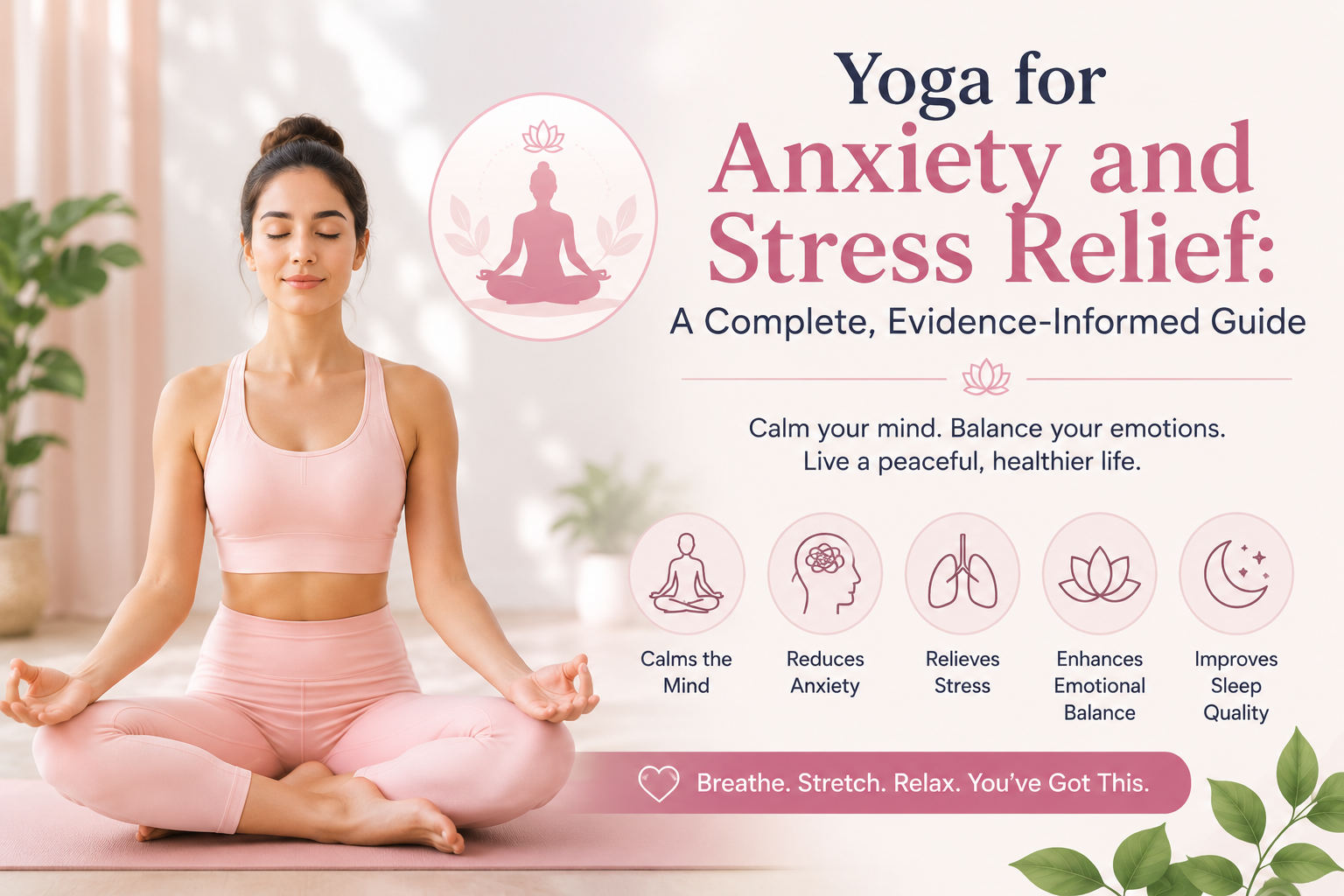
An informational guide to using yoga for anxiety and stress relief — covering how the body actually responds to stress, where breath work and movement genuinely help calm the nervous system, and where popular claims about yoga “curing” anxiety go further than the evidence supports.
Yoga is one of the most widely recommended tools for anxiety and stress relief, and it is often marketed with sweeping promises: that a particular sequence or breathing technique will eliminate anxiety altogether or replace the need for any other form of support. The more accurate picture is more modest: anxiety and stress involve a mix of nervous system activation, hormonal responses, and thought patterns that a single practice does not switch off entirely, and no sequence works identically for everyone. What yoga can genuinely offer is a reliable way to calm physical tension, slow an overactive stress response, and build a steadier baseline over time, a real and useful role that falls short of a guaranteed cure.
This guide walks through what stress and anxiety actually do to the body, where a yoga practice has an evidence-aligned role in supporting calm, and where popular claims about yoga for anxiety outpace what the research supports. Yoga is not a substitute for medical or psychological care, and anyone managing a diagnosed anxiety disorder should treat a yoga practice as a complement to, not a replacement for, appropriate professional guidance.
1. What Stress and Anxiety Actually Do to the Body
Stress and anxiety activate the sympathetic nervous system, the body’s “fight or flight” response, which raises heart rate, tightens muscles, and shifts breathing into a shorter, shallower pattern. Cortisol and adrenaline rise, digestion slows, and attention narrows toward perceived threats, even when those threats are not physically present. Understanding this clarifies what a yoga practice can realistically do: help shift the body toward the parasympathetic, “rest and digest” state through breath and movement, rather than eliminate the underlying causes of stress itself.
2. Why Claims That Yoga “Cures” Anxiety Go Too Far
It is easy to find wellness content suggesting that a specific pose, breathing technique, or thirty-day challenge will permanently resolve anxiety. These claims are not well supported, since anxiety is shaped by many overlapping factors, including genetics, life circumstances, sleep, and in many cases clinical conditions that benefit from therapy or medication. The more accurate picture is that yoga can meaningfully reduce the physical intensity of stress and support emotional regulation, offering modest, real benefits without guaranteeing that anxiety disappears altogether.
3. What the Research Actually Shows
Research on yoga and stress shows reasonably consistent support for short-term reductions in perceived stress, muscle tension, and physiological markers like heart rate variability, along with more modest evidence for longer-term improvements in anxiety symptoms when practice is sustained over weeks or months. Evidence that yoga outperforms other established approaches, such as cognitive behavioural therapy, for diagnosed anxiety disorders is much thinner, and much of what is presented online as proof of a uniquely powerful effect is anecdotal. The fair summary: yoga offers genuine, well-supported support for everyday stress, while claims that it alone resolves clinical anxiety outpace what has actually been demonstrated. For a broader look at how a structured practice can support psychological wellbeing over time, resources on Yoga for Mental Health in Rishikesh India lay out this evidence in more detail.
4. Why Yoga Suits Stress Relief Specifically
Yoga combines three elements that, together, address stress more directly than movement or breath work alone: physical release of muscular tension, breath regulation that signals safety to the nervous system, and a period of focused attention that interrupts anxious thought loops. This does not mean yoga needs to be elaborate or advanced; it means the emphasis usually shifts toward slower, breath-led movement and stillness rather than fast-paced or highly demanding sequences, since the goal is to calm the nervous system rather than to build intensity.
5. Breath Work to Calm the Nervous System
A few minutes of slow, extended-exhale breathing is one of the most directly useful tools for anxiety, since lengthening the exhale relative to the inhale activates the parasympathetic nervous system and can measurably lower heart rate within minutes. Alternate nostril breathing and simple box breathing patterns are widely used for this purpose, though they should be introduced gently, and rapid or forceful breathing techniques are not appropriate for everyone, particularly during an acute anxious episode when the body is already highly activated.
6. Postures That Help Release Physical Tension
A stress-relief sequence generally benefits from postures that ground the body and release commonly tense areas: gentle neck and shoulder rolls, seated forward folds, and supported hip-opening postures tend to be well tolerated by most people carrying tension from stress. Standing balance postures can also help by requiring focused attention, which naturally interrupts rumination, though these should be approached gently rather than as a test of skill. Pushing into deep or unfamiliar postures during a period of high anxiety increases the risk of frustration rather than calm, so simplicity matters more here than in almost any other type of practice.
7. Restorative and Nidra-Based Practices for Deeper Calm
For deeper stress relief, longer holds in supported, passive postures allow the nervous system more time to shift out of activation than a faster-paced sequence typically allows. A structured practice of the sort found in Yoga Nidra in Rishikesh illustrates this approach, using guided relaxation and body awareness to bring about a state of conscious rest that many people find particularly effective for anxiety that has a strong physical or sleep-related component.
For those drawn to a practice that also incorporates focused breath and subtle energy work, the disciplined approach found in Kundalini Yoga in Rishikesh India has long combined movement, chanting, and breath in ways that some practitioners find useful for working through periods of chronic stress, though as with any practice, individual response varies considerably.
8. Structuring a Realistic Anxiety-Relief Sequence
A realistic anxiety-relief sequence generally moves through a few clear stages: a brief settling period with slow breathing, gentle tension-releasing movement, a short series of grounding postures, and several minutes of stillness or guided relaxation to close. Building this kind of sequence with proper guidance, of the kind taught in a structured Yoga Teacher Training in Rishikesh programme, can be a useful reference point for how a calming practice is traditionally sequenced, even for someone with no intention of teaching.
9. How Often and How Long a Practice Needs to Be
There is no fixed duration or frequency that suits everyone, and much of the research on yoga and stress shows benefits from sessions as short as ten to fifteen minutes, provided they happen consistently across the week. A shorter, realistic practice that fits into a busy schedule tends to be more sustainable, and therefore more beneficial over time, than an ambitious hour-long practice reserved only for days when stress feels overwhelming.
10. Common Mistakes People Make with Yoga for Anxiety
A few patterns tend to undermine an otherwise well-intentioned practice: treating yoga as a one-time fix rather than a habit that compounds with consistency, forcing breath work that feels uncomfortable rather than adjusting the pace, and abandoning the practice entirely after one session that did not produce immediate calm. A practice built on realistic, patient expectations tends to be far more effective over months than one built on the hope of instant relief.
11. Adapting the Practice to Different Anxiety Levels
A yoga practice for anxiety looks different depending on how activated the nervous system is on a given day, and adjusting the approach matters more than following a fixed routine regardless of circumstance.
- Use slow, extended-exhale breathing as a first step whenever anxiety feels acute, before attempting any postures.
- Choose grounding, supported postures over demanding or unfamiliar ones during periods of high stress.
- Keep a very short, simple sequence in mind for days when even ten minutes feels like too much.
- Save longer restorative or Nidra-based sessions for times when there is space to fully unwind.
- Treat consistency, even in small amounts, as more valuable than occasional long sessions.
12. Red Flags in Anxiety-Relief Yoga Claims
A few common red flags tend to signal claims about yoga and anxiety that outpace the evidence.
- Promises that a specific pose or breathing technique will eliminate anxiety permanently.
- Suggestions that yoga alone is sufficient for a diagnosed anxiety disorder without any other support.
- Claims that rapid or intense breathing techniques are safe for everyone during an acute anxious episode.
- Vague claims that a single class “removes trauma” or “clears” anxiety without any explanation of mechanism.
13. Learning These Practices Properly
Because building a stress-relief sequence that genuinely calms the nervous system, rather than simply resembling a class seen online, involves understanding the physiology of stress, learning from a properly trained teacher makes a real difference. A structured Yoga Instructor Certification Guide in India typically covers how to build and adapt a calming practice alongside breath work and broader sequencing principles, offering a grounded foundation for anyone who wants a practice built on sound understanding rather than wellness marketing.
Safety Notes and When to See a Doctor
Yoga can genuinely support a calmer nervous system, but it should never replace appropriate diagnosis or treatment for a mental health condition.
- Anyone with a diagnosed anxiety disorder, panic disorder, or related condition should discuss a new yoga practice with a treating professional before starting.
- Persistent anxiety that interferes with daily functioning should be evaluated by a doctor or mental health professional rather than managed through yoga alone.
- Dizziness, fainting, or significant breathlessness during breath work is a signal to stop and return to normal breathing.
- Anyone with a diagnosed cardiovascular or respiratory condition should confirm which breathing techniques are appropriate before introducing more advanced practices.
Frequently Asked Questions (FAQs)
Q1. Can yoga actually help with anxiety, or is this mostly a wellness myth?
Yoga has reasonably consistent research support for reducing short-term stress and physical tension, and more modest evidence for longer-term anxiety benefits when practised consistently. It is genuinely helpful for many people, though it is not a guaranteed cure on its own.
Q2. How quickly can breath work calm anxiety?
Slow, extended-exhale breathing can begin to lower heart rate within a few minutes for many people, though the degree of relief varies from person to person and tends to improve with regular practice.
Q3. Is it safe to do intense breathing exercises during a panic attack?
Not necessarily. Rapid or forceful breathing techniques can sometimes increase physical activation rather than calm it, so slow, gentle breathing is generally the safer starting point during acute anxiety.
Q4. What if I don’t have time for a full yoga session when I’m stressed?
A short sequence of just a few minutes of slow breathing and gentle stretching tends to be more valuable in the moment than skipping practice entirely while waiting for a longer session to fit into the day.
Q5. Is restorative yoga or a more active practice better for anxiety?
Both have a role. Restorative and Nidra-based practices tend to suit deeper, longer-term calm, while gentle active postures can help in the moment by requiring focused attention that interrupts anxious thoughts.
Q6. Can yoga replace therapy or medication for anxiety?
No. Yoga can be a valuable complement to professional care, but a diagnosed anxiety disorder is generally best addressed directly with a qualified mental health professional, with yoga supporting rather than replacing that treatment.
Q7. What is the most evidence-based way to think about yoga for anxiety?
The most accurate framing is that yoga offers genuine, well-supported support for everyday stress and physical tension, and contributes to steadier emotional regulation over time, rather than single-handedly curing anxiety.
Final Thoughts
Yoga for anxiety is not a guarantee of permanent calm so much as a reliable, practical tool for easing the body’s stress response, and the most honest, evidence-aligned view of its role is a modest one: releasing physical tension, steadying the breath, and offering a consistent anchor that supports emotional regulation over time. This is a more realistic picture than some wellness marketing suggests, but it is also a far more sustainable one.
Approached gradually, adjusted to how anxiety actually feels on a given day, and paired with appropriate professional support when needed, yoga can offer many people a genuinely useful, low-risk way to build a calmer, steadier relationship with stress.
