 Skip to content
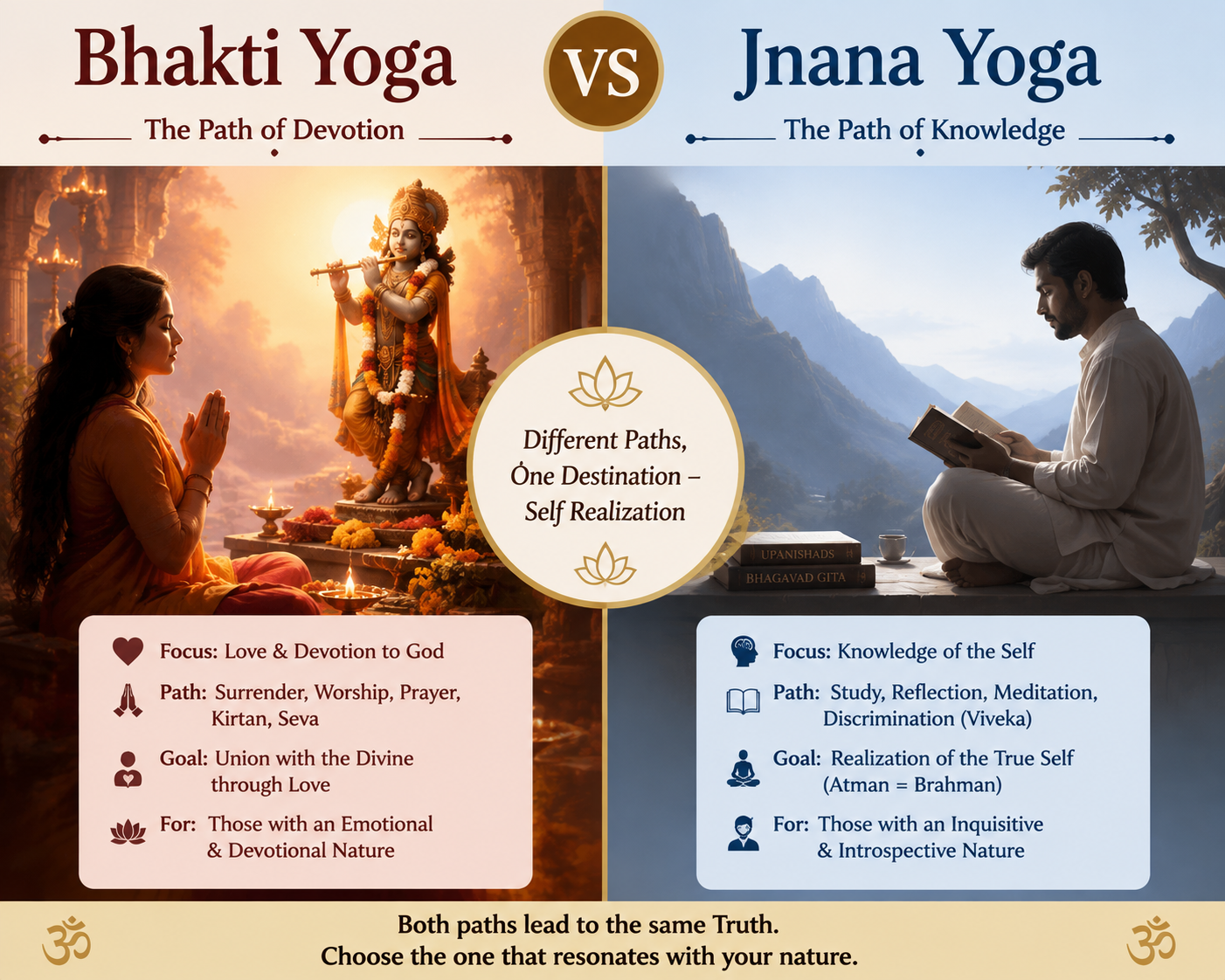
Among the four classical paths of yoga, Bhakti Yoga and Jnana Yoga are often presented as opposites, one built on heartfelt devotion and surrender, the other built on rigorous self-inquiry and discernment. That contrast is real, but it can also be misleading if it suggests the two paths are in competition, with one being more “advanced” or more “authentic” than the other. In the traditional framework, both are considered complete paths toward the same goal, simply suited to different temperaments and different ways of relating to truth.
At Rishikesh Yog Darshan, both paths are taught with equal seriousness, since a genuine understanding of yogic philosophy requires recognizing that not everyone approaches self-realization through the same doorway. This guide examines what Bhakti Yoga and Jnana Yoga actually involve, how their methods and underlying assumptions differ, where they overlap, and how a practitioner might recognize which path, or combination of paths, genuinely fits their own temperament.
What Is Bhakti Yoga?
Bhakti Yoga is the path of devotion, built around love, surrender, and a deeply personal relationship with the divine, however that divine is conceived. Rather than working primarily through intellectual analysis, Bhakti Yoga works through the heart, using practices such as chanting, prayer, ritual worship, and remembrance to cultivate a continuous, loving orientation toward something greater than the individual self.
Central to Bhakti Yoga is the idea that intense, sincere devotion can dissolve the sense of separation between the devotee and the divine, not through effortful reasoning, but through the natural expansion that comes from sustained love and surrender. This doesn’t require abandoning the intellect, but it does mean the intellect isn’t the primary tool being used; emotion, sincerity, and relationship take the lead.
Traditional texts describe several forms this devotion can take, ranging from quiet, personal remembrance to communal chanting and structured ritual worship. What unites these varied expressions is a consistent orientation: repeatedly turning attention and feeling toward something greater than the isolated self, until that orientation becomes second nature rather than an occasional practice reserved for specific moments.
What Is Jnana Yoga?
Jnana Yoga is the path of knowledge, built around direct self-inquiry, discernment, and a sustained investigation into the nature of the self. Where Bhakti Yoga cultivates devotion, Jnana Yoga cultivates discrimination, the ability to distinguish between what is permanent and what is fleeting, between the true self and the various roles, thoughts, and identities a person mistakes for it.
The central practice of Jnana Yoga is self-inquiry, often expressed through the question “who am I?”, pursued not as an abstract philosophical exercise but as a direct, sustained investigation meant to strip away false identifications one by one. This path tends to appeal to practitioners drawn to reasoning, introspection, and a more analytical relationship with spiritual questions, though traditional teaching is careful to note that Jnana Yoga’s goal is direct realization, not merely intellectual understanding.
This distinction matters considerably, since it’s possible to accumulate a great deal of philosophical knowledge about the self without ever directly investigating personal experience closely enough to see through the assumptions that knowledge is meant to dissolve. Traditional Jnana Yoga practice therefore combines study of foundational texts with sustained, personal inquiry, ensuring that conceptual understanding doesn’t substitute for the direct realization the path is ultimately oriented toward.
Core Differences Between Bhakti Yoga and Jnana Yoga
While both paths lead toward the same traditional goal, their methods and underlying orientation differ in several clear ways.
- Primary faculty engaged – Bhakti Yoga works primarily through the heart and emotion, while Jnana Yoga works primarily through the intellect and discernment.
- Relationship to the divine or the self – Bhakti Yoga typically maintains a relationship between devotee and divine, often described in terms of love and surrender, while Jnana Yoga tends to move toward a direct realization of non-separation between the individual self and ultimate reality.
- Primary practices – Bhakti Yoga relies heavily on chanting, prayer, ritual, and remembrance, while Jnana Yoga relies on self-inquiry, study of philosophical texts, and sustained discrimination between the real and the unreal.
- Role of ego – Bhakti Yoga tends to soften the ego through surrender and humility before something greater, while Jnana Yoga tends to dismantle the ego through direct inquiry into whether it truly exists as it appears to.
- Emotional tone of practice – Bhakti Yoga is generally warm, expressive, and relational, while Jnana Yoga is generally quiet, analytical, and internally focused.
Where the Two Paths Overlap
Despite their different methods, Bhakti Yoga and Jnana Yoga share more common ground than their contrasting reputations might suggest. Both ultimately aim at dissolving a limited, isolated sense of self, whether through loving surrender or direct inquiry. Both require sustained discipline and consistency, since neither devotion nor self-inquiry tends to produce lasting transformation through occasional or half-hearted effort. And both traditions caution against their most common distortions, sentimental devotion without depth on one side, and dry intellectualism without genuine realization on the other.
Traditional teachers have long argued that mature practice in either path eventually touches the other. Deep devotion naturally raises questions about the nature of the self being surrendered, while deep self-inquiry often opens into a quality of humility and reverence that closely resembles devotion, even without formal ritual. This overlapping territory is part of why many practitioners find value in exploring the broader landscape of paths, including how Jnana & Karma Yoga in Rishikesh are taught alongside each other, rather than treating each path as an isolated, standalone system.
Common Misunderstandings About Bhakti and Jnana Yoga
A few recurring misconceptions tend to distort how these paths are compared to one another.
- Assuming Jnana Yoga is more “advanced” or intellectually superior to Bhakti Yoga, when traditional texts present both as complete paths suited to different temperaments, not as a hierarchy.
- Assuming Bhakti Yoga is purely emotional and lacks discipline, when sustained devotional practice requires as much consistency and inner work as any analytical path.
- Believing a practitioner must choose one path exclusively, when many traditional teachers describe elements of both showing up naturally as a practice matures.
- Reducing Bhakti Yoga to religious ritual alone, or Jnana Yoga to abstract philosophy alone, when both are meant to produce direct, lived transformation rather than remaining theoretical.
How to Recognize Which Path Fits Your Temperament
Rather than choosing a path based on which sounds more appealing in theory, traditional guidance suggests paying attention to how a person naturally engages with meaning and connection.
- Notice whether emotional practices such as chanting, prayer, or heartfelt remembrance feel more natural and sustaining than analytical reflection.
- Notice whether questioning the nature of thoughts, identity, and experience feels more engaging than devotional or relational practices.
- Consider that many practitioners benefit from elements of both, using devotion to soften rigidity and self-inquiry to deepen discernment.
- Recognize that temperament can shift over time, and a practice that feels right at one stage of life may evolve as understanding deepens.
- Approach either path with patience, since both are traditionally understood as long-term disciplines rather than techniques that produce quick results.
Why Understanding Both Paths Deepens a Wider Yoga Practice
For practitioners primarily drawn to the physical or breath-based aspects of yoga, understanding Bhakti and Jnana Yoga adds meaningful depth to how the wider tradition is understood. A physical practice grounded in awareness of these underlying paths tends to feel less like an isolated fitness activity and more like one visible expression of a much larger system concerned with the nature of the self and one’s relationship to something greater than the individual ego. This broader context connects closely with material on the Values of Yoga in Life India, which explores how yogic philosophy extends well beyond any single technique or lineage.
This wider understanding also tends to matter significantly for anyone considering teaching, since guiding students through physical postures without any grounding in the philosophical paths behind the tradition often produces a shallower, less complete kind of instruction.
Why Learn This From Rishikesh Yog Darshan
Rishikesh has served as a center for studying both devotional and philosophical yogic traditions for generations, and comparing paths like Bhakti and Jnana Yoga is exactly the kind of nuanced subject that benefits from proper, contextual teaching rather than a simplified online summary. Taught superficially, the two paths can seem like competing ideologies. Taught properly, they reveal themselves as complementary doorways into the same underlying goal.
A well-structured Yoga Teacher Training in Rishikesh programme typically introduces both paths early, giving students the philosophical grounding needed to understand where physical practice fits within this much larger tradition. For those specifically interested in the credentialing side of this study, a detailed Yoga Instructor Certification Guide in India usually outlines how philosophical study, including comparative paths like these, fits into a complete certification curriculum.
Frequently Asked Questions
1. Which is better, Bhakti Yoga or Jnana Yoga?
Neither path is considered inherently better in traditional yogic philosophy; they are presented as complete paths suited to different temperaments, with devotion appealing to the heart and self-inquiry appealing to the intellect.
2. Can a person practice both Bhakti Yoga and Jnana Yoga at the same time?
Yes. Many traditional teachers describe elements of both paths naturally arising as a practice matures, and combining devotional practice with self-inquiry is common rather than unusual.
3. Does Bhakti Yoga require belief in a specific religion?
Not necessarily. While Bhakti Yoga is often expressed through a specific devotional tradition, its underlying principle, love and surrender directed toward something greater than the individual self, can be adapted to different beliefs and contexts.
4. Is Jnana Yoga only for intellectual or academically inclined people?
Not exclusively. While Jnana Yoga does rely heavily on discernment and self-inquiry, its goal is direct realization rather than academic understanding, meaning intellectual interest alone isn’t sufficient without sustained, honest inquiry.
5. How do I know which path suits me?
Traditional guidance suggests observing which type of practice feels more natural and sustaining, emotional and devotional practices, or analytical self-inquiry, since temperament tends to be a more reliable guide than theoretical preference.
6. Are Bhakti Yoga and Jnana Yoga part of the eight-limbed system of yoga?
They are considered separate classical paths alongside the eight-limbed system, though there is meaningful overlap, particularly with the eight limbs’ emphasis on concentration and meditative absorption.
7. Do I need a teacher to practice Bhakti Yoga or Jnana Yoga properly?
While personal devotional or reflective practice can begin independently, traditional teaching strongly recommends guidance from an experienced teacher, particularly for Jnana Yoga’s more subtle stages of self-inquiry, where self-guided practice can lead to confusion without proper direction.
Final Thoughts
Bhakti Yoga and Jnana Yoga represent two distinct but equally valid doorways into the same traditional goal, one opened through devotion and surrender, the other through discernment and inquiry. Rather than viewing them as competing philosophies, traditional teaching presents them as complementary paths, each capable of deepening and informing the other as a practice matures over time.
Understanding both paths, even for practitioners primarily drawn to physical or breath-based practice, adds genuine depth to how the broader tradition of yoga is understood, transforming an isolated technique into one visible part of a much older, more comprehensive system of self-understanding.
