 Skip to content
Ask most people what yoga is, and the answer usually involves postures, a mat, and perhaps a class before or after work. That picture isn’t wrong, but it’s incomplete. The physical practice most people recognize today is only one part of a much older, far more comprehensive framework known as the eight limbs of yoga, first systematically laid out by the sage Patanjali in the Yoga Sutras. Together, these eight limbs describe a complete path, one that moves from ethical conduct and self-discipline through physical postures and breath control, and ultimately toward deep states of concentration and meditative absorption.
At Rishikesh Yog Darshan, the eight limbs are taught not as an abstract philosophical curiosity but as a practical map, one that helps practitioners understand where a physical practice fits within a much larger tradition. This guide walks through what each of the eight limbs actually means, how they build on one another, and why understanding this framework changes how a yoga practice is approached, whether the goal is personal growth, teaching, or simply a deeper relationship with the practice.
What Are the Eight Limbs of Yoga?
The eight limbs of yoga, often referred to by the Sanskrit term Ashtanga, meaning “eight limbs,” come from the second chapter of Patanjali’s Yoga Sutras, a foundational text believed to have been compiled around two thousand years ago. Patanjali didn’t invent yoga, but he organized existing knowledge into a structured system, presenting the eight limbs as sequential stages of a single, unified path rather than eight separate practices to choose between.
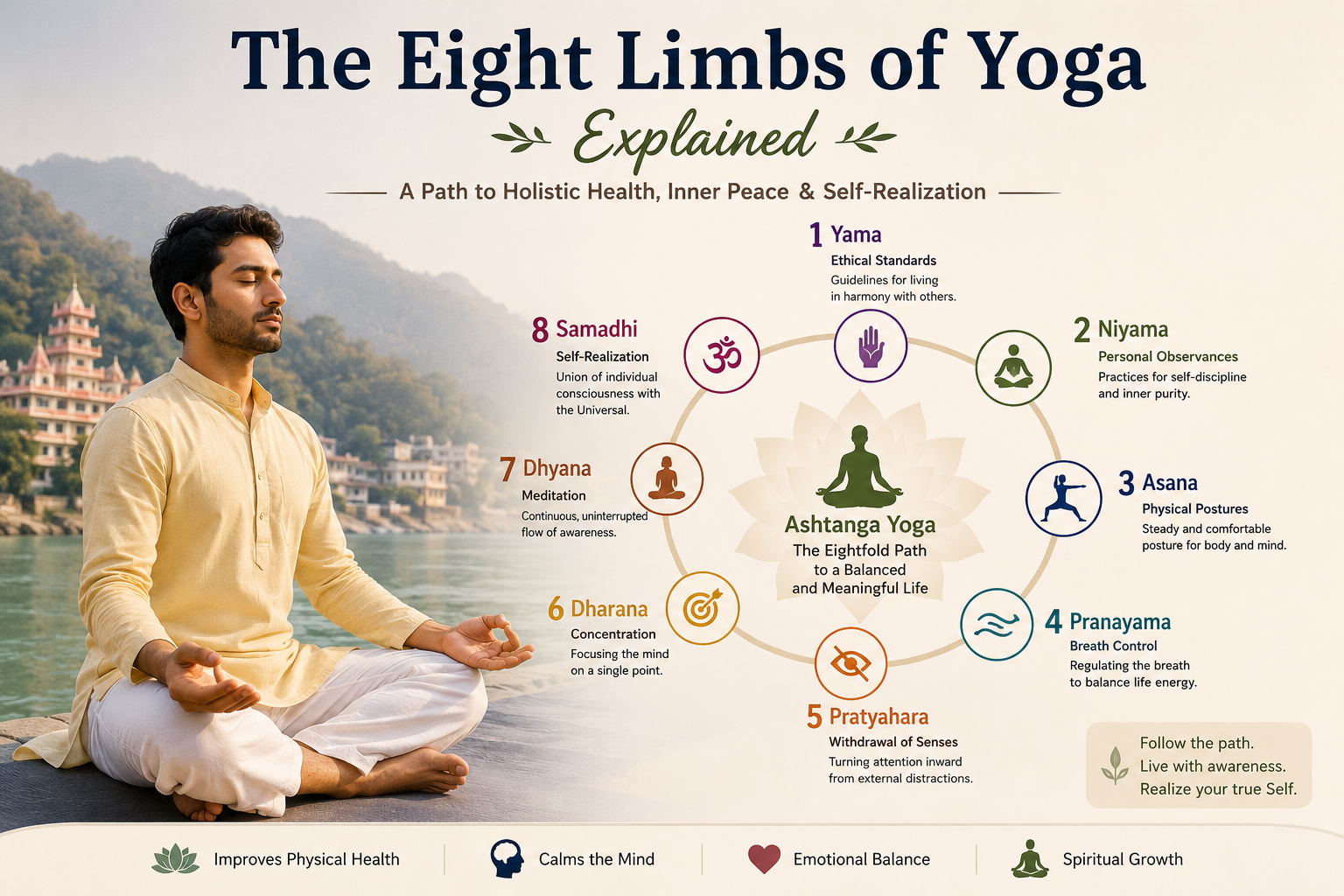
The limbs are, in order: Yama (ethical restraints), Niyama (personal observances), Asana (posture), Pranayama (breath control), Pratyahara (withdrawal of the senses), Dharana (concentration), Dhyana (meditation), and Samadhi (a state of complete absorption or union). Each limb prepares the ground for the next, which is part of why modern yoga’s heavy emphasis on Asana, the third limb, often represents such a small slice of what the tradition originally intended.
The Eight Limbs, One by One
Understanding each limb individually makes it much easier to see how the full system fits together.
- Yama (ethical restraints) – The first limb concerns how a practitioner relates to others, covering principles such as non-violence, truthfulness, non-stealing, moderation, and non-possessiveness. These aren’t abstract virtues; they’re described as the foundation without which deeper practice is considered unstable. A grounded understanding of these principles connects closely with broader teachings on the Values of Yoga in Life India, which explore how yogic ethics extend well beyond the mat.
- Niyama (personal observances) – Where Yama governs relationships with others, Niyama governs the relationship with oneself, including cleanliness, contentment, discipline, self-study, and surrender to something greater than the individual ego. Together, Yama and Niyama form the ethical and personal groundwork the remaining six limbs are built upon.
- Asana (posture) – The third limb, and by far the most widely recognized in the modern West, refers to a steady, comfortable physical posture. Patanjali’s own description of Asana is notably brief, emphasizing stability and ease rather than range of motion or complexity, a far cry from the elaborate postural systems now associated with the word “yoga.” A precise, alignment-focused approach such as that found in Iyengar Yoga in Rishikesh India reflects this original emphasis, prioritizing steadiness and correct structure over performance.
- Pranayama (breath control) – The fourth limb involves regulating the breath, extending and controlling inhalation, exhalation, and the pauses between them. Traditionally, Pranayama is introduced only once Asana has become steady, since a restless body makes controlled breathing far more difficult to sustain.
- Pratyahara (withdrawal of the senses) – Often considered the hinge point between the outward-facing and inward-facing limbs, Pratyahara involves consciously drawing attention away from external sensory input. This is frequently described as one of the more difficult limbs to grasp, since it isn’t about blocking the senses but about no longer being pulled around by them.
- Dharana (concentration) – The sixth limb refers to sustained, single-pointed focus on one object, thought, or point of attention. This might involve a mantra, the breath, or a visual point, and it serves as direct preparation for meditation itself.
- Dhyana (meditation) – Where Dharana involves effort to maintain focus, Dhyana describes a state where that focus becomes effortless and continuous, an uninterrupted flow of attention toward a single point. This limb is closely tied to broader reflective and contemplative approaches, including those explored through Jnana & Karma Yoga in Rishikesh, which emphasize self-inquiry and selfless action as complementary paths toward the same inward stillness.
- Samadhi (absorption) – The eighth and final limb describes a state in which the sense of a separate observer dissolves entirely into the object of meditation. Traditionally described in stages of increasing depth, Samadhi is presented not as a technique to perform but as a natural culmination of the previous seven limbs practiced consistently over time.
Why the Eight Limbs Matter Beyond the Physical Practice
Understanding the eight limbs reframes what a yoga practice is actually working toward. A strong, well-aligned posture practiced without any attention to ethical conduct or mental discipline represents, at most, one limb of an eight-limbed system, useful, but far from complete. This is part of why practitioners who explore the fuller framework often describe a shift in how they relate to their practice, moving from a primarily physical activity toward something closer to a sustained discipline touching how they think, act, and relate to others.
This broader view also explains why so much traditional yoga teaching places as much emphasis on daily conduct and mental habits as it does on physical technique. The eight limbs were never meant to function as a menu of unrelated options; they describe a single, gradually unfolding path, where progress in one area genuinely supports progress in the next.
Common Misunderstandings About the Eight Limbs
A few recurring misconceptions tend to distort how the eight limbs are understood outside traditional teaching contexts.
- Believing that mastering physical postures is equivalent to progressing through the eight limbs, when Asana represents only the third of eight stages.
- Treating the limbs as a strict, one-at-a-time checklist rather than an interconnected system where elements of ethical conduct, breath awareness, and concentration often develop simultaneously.
- Assuming Pratyahara and Dharana are exotic or inaccessible states, when in practice they begin with simple, everyday moments of undistracted attention.
- Expecting Samadhi to be a dramatic, sudden event rather than understanding it as the gradual result of sustained, consistent practice across the earlier limbs.
How the Eight Limbs Build Toward a Complete Practice
The eight limbs are traditionally described as progressing from the outer to the inner: Yama and Niyama shape external conduct and internal discipline, Asana and Pranayama stabilize the body and breath, Pratyahara turns attention inward, and Dharana, Dhyana, and Samadhi represent increasingly refined states of meditative absorption. This progression doesn’t mean a practitioner must fully master one limb before touching the next; in real practice, the limbs tend to reinforce each other, with steadier ethics supporting a calmer mind, and a calmer mind supporting deeper concentration.
A well-structured approach to learning this progression, of the kind found in a properly sequenced Yoga Teacher Training in Rishikesh programme, typically introduces the eight limbs early, precisely because they provide the conceptual foundation for everything that follows, including how postures, breath work, and meditation are taught and understood.
Bringing the Eight Limbs Into a Modern Practice
Most practitioners today won’t approach the eight limbs as a strict, sequential monastic discipline, and that’s entirely reasonable. A few practical starting points make the framework accessible without requiring a complete lifestyle overhaul.
- Begin noticing Yama and Niyama in daily interactions and habits, rather than treating them as abstract ideals reserved for a formal practice.
- Use the steadiness emphasized in Asana as a genuine goal, prioritizing comfortable stability over intensity or complexity in physical postures.
- Introduce a few minutes of simple breath awareness as a starting point for Pranayama, rather than attempting advanced techniques immediately.
- Practice brief, undistracted attention during ordinary daily moments as an accessible entry point into Pratyahara and Dharana.
- Treat any resulting sense of calm or clarity as a natural byproduct of consistent practice, rather than a goal to force or rush.
Why Learn This From Rishikesh Yog Darshan
Rishikesh has been a center of yogic study for centuries, and the eight limbs are exactly the kind of foundational framework that benefits from proper, contextual teaching rather than fragmented online explanations. Taught in isolation, the eight limbs can feel like an abstract list to memorize. Taught properly, they become a coherent, practical lens for understanding an entire tradition.
A structured Yoga Instructor Certification Guide in India typically walks through the eight limbs in real depth, connecting philosophy directly to posture, breath, and meditation instruction, so that students graduate with a grounded understanding of where each element of a yoga class actually comes from, rather than a collection of disconnected techniques.
Frequently Asked Questions
1. What are the eight limbs of yoga in order?
The eight limbs, in the order presented by Patanjali, are Yama, Niyama, Asana, Pranayama, Pratyahara, Dharana, Dhyana, and Samadhi, progressing from ethical conduct through physical practice toward meditative absorption.
2. Do I need to master one limb before moving to the next?
Not strictly. While the limbs are traditionally sequential, most practitioners develop several simultaneously, with progress in one area, such as steadier ethics or calmer breathing, naturally supporting development in the others.
3. Why does modern yoga focus so heavily on Asana if it’s only one of eight limbs?
Asana is the most physically visible and easily taught limb, which is part of why it became the primary focus as yoga spread globally, even though it represents a relatively small part of the original eight-limbed framework.
4. What is the difference between Dharana and Dhyana?
Dharana involves effortful, sustained concentration on a single point, while Dhyana describes a more effortless, continuous state of focus that develops once concentration becomes stable and consistent.
5. Can the eight limbs be practiced without a spiritual or religious framework?
Yes. Many practitioners apply the eight limbs as a practical, ethical, and mental framework without adopting any specific religious belief, focusing instead on the psychological and behavioral principles the limbs describe.
6. Is Samadhi achievable for an average practitioner?
Traditional texts describe Samadhi as a gradual, cumulative result of sustained practice across all eight limbs rather than an exclusive or rare achievement, though it’s generally understood as a long-term outcome rather than a short-term goal.
7. How long does it take to understand the eight limbs properly?
Basic conceptual understanding can develop quickly, but deeper, lived understanding of how the limbs interact typically develops over months or years of consistent practice and study, often supported by structured teaching.
Final Thoughts
The eight limbs of yoga offer something a physical practice alone cannot: a complete, structured path connecting ethics, discipline, breath, body, and mind into a single coherent system. Understanding this framework doesn’t require abandoning a purely physical practice, but it does offer a far richer way to understand where that practice fits within a much older, more comprehensive tradition.
Approached with patience and proper guidance, the eight limbs can transform yoga from a series of postures into a genuinely complete practice, one capable of shaping not just how a person moves, but how they think, act, and relate to the world around them.
