 Skip to content
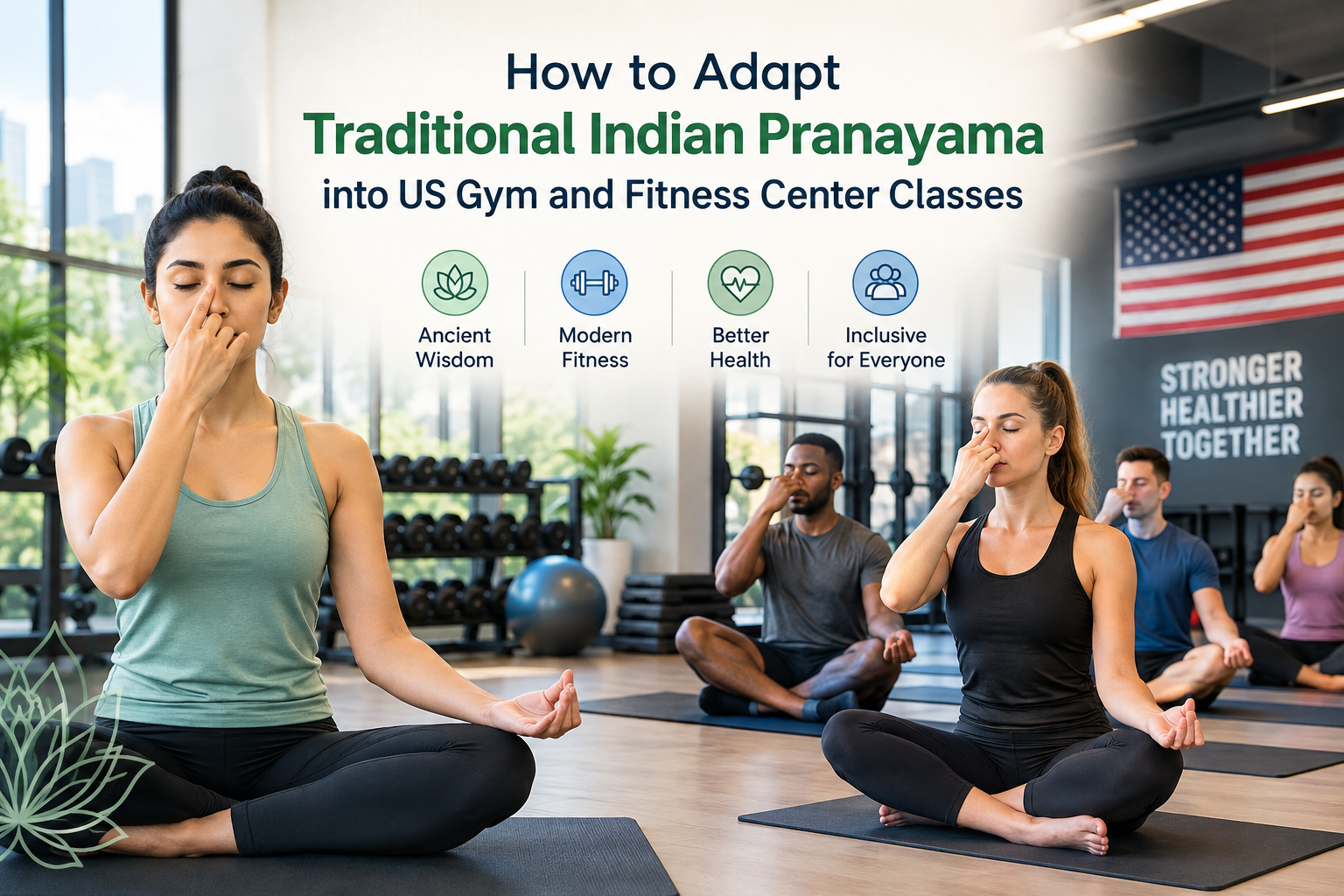
A practical guide for instructors and studio managers on bringing pranayama, the yogic science of breath, into American gym and fitness center classes: which techniques translate well, how to structure them, and how to keep the teaching authentic and safe.
Walk into almost any US fitness center today and you will find a schedule that reaches well beyond strength and cardio. Mobility sessions, recovery classes, and mind-body formats now sit beside spin and HIIT, and members increasingly ask for ways to manage stress, not just burn calories. Pranayama, the traditional Indian practice of conscious breath regulation, fits this demand well. It needs no equipment, takes little floor space, and can be taught in five minutes or fifty.
Adapting a centuries-old practice for a gym setting takes care, though. Done carelessly, it becomes a gimmick, a few “deep breaths” with a Sanskrit word attached. Done well, it becomes one of the most useful additions to a fitness program. This guide covers what to teach, how to structure it, and how to stay faithful to the tradition while meeting the realities of a US fitness facility.
1. What Pranayama Actually Is
Pranayama is usually translated as “extension of the life force” (prana meaning vital energy, ayama meaning extension or regulation). In classical yoga texts it is one of the eight limbs of practice, positioned between physical postures and meditation. Its techniques manipulate the length, rhythm, and pathway of the breath, and in traditional teaching it prepares the mind for concentration.
For a fitness audience, the simplest description is that pranayama is structured breath training. Members already understand training a muscle, so training the breath is an easy concept to introduce.
2. Why Pranayama Fits Modern Gym Culture
Several trends make the timing right for US fitness centers:
- Stress-related demand. Many members come to the gym specifically to unwind after work, and a class that teaches a portable stress tool gives them more than an hour of exercise.
- Recovery awareness. Members increasingly value recovery days, and breathwork suits active recovery and cooldown formats.
- Performance interest. Athletes and lifters are curious about breathing mechanics, including bracing, tempo, and recovery between sets.
- Class differentiation. A well-taught breath class gives a facility something the big-box competitor down the road may not offer.
It is worth being honest about the evidence when you market these classes. Research on individual pranayama techniques generally shows modest benefits, such as improved relaxation and perceived stress, but many studies are small. Position breathwork as a low-risk complementary practice, not a treatment for any medical condition. That honesty is part of building trust with members and with your own reputation.
3. Choosing the Right Techniques for a Gym Setting
Not every pranayama technique suits a group fitness room. Start with gentle, low-risk options and hold the intensive ones for specialised settings.
Well suited to gym classes:
- Diaphragmatic (belly) breathing. The foundation for everything else, and easy to teach in any format.
- Nadi Shodhana (alternate nostril breathing). Calming, simple, and easy to teach seated or lying down. A hold-free version is best for beginners.
- Ujjayi (ocean breath). A soft constriction at the back of the throat creates an audible, steady breath that pairs well with flowing movement.
- Bhramari (humming bee breath). Quiet, soothing, and useful in cooldowns, though the humming may feel unusual to first-timers.
- Extended-exhale breathing. A modern, non-Sanskrit framing of a traditional principle, and very approachable for skeptical members.
Approach with caution or reserve for trained teachers:
- Kapalabhati and Bhastrika (forceful, rapid breathing), which can cause light-headedness.
- Any technique involving prolonged breath retention (kumbhaka).
- Practices designed to heat or energise the body intensely.
The forceful techniques are part of the tradition and have their place, but a mixed-ability gym crowd is not the right audience without careful screening and instruction.
4. Fitting Breathwork into Existing Class Formats
You do not need a brand-new class to start. Pranayama slots into formats you already run.
Warm-up (2–3 minutes). Begin any class with diaphragmatic breathing to help members arrive, settle, and notice how they feel. It also improves ribcage mobility before movement.
Between intervals or sets. Use slow nasal breathing to bring heart rate down. This gives members a practical tool they can feel working immediately.
Cooldown (5–7 minutes). This is the natural home for Nadi Shodhana, extended-exhale breathing, or a short guided body scan. Members leave the room calmer than they came in.
Standalone breathwork or recovery class (30–45 minutes). A slower format combining gentle mobility, two or three pranayama techniques, and a closing relaxation.
Pairing with movement styles. Pranayama pairs naturally with flowing formats. Instructors curious about coordinating breath with movement can learn from traditional styles like Vinyasa Yoga in Rishikesh India, where breath and motion are linked by design, an approach that translates well to gym-based flow or mobility classes.
5. A Sample 45-Minute Breath and Recovery Class
Here is a template instructors can adapt:
- Minutes 0–5: Arrival and diaphragmatic breathing, seated or lying down.
- Minutes 5–15: Gentle mobility (cat-cow, thoracic rotations, hip openers) with breath cues.
- Minutes 15–25: Ujjayi breath paired with slow, simple flow or standing sequences.
- Minutes 25–35: Seated Nadi Shodhana for five to eight rounds, no holds, followed by a few natural breaths.
- Minutes 35–42: Extended-exhale breathing in a reclined position.
- Minutes 42–45: Quiet closing and brief reflection.
Keep the language plain. Use “alternate nostril breathing” alongside “Nadi Shodhana” so members learn the tradition’s name without feeling alienated.
6. Teaching Cues That Work with US Fitness Audiences
Wording matters as much as technique. Some principles that help:
- Explain the why in one sentence. “Slow breathing signals your nervous system to shift toward recovery” respects members’ intelligence without lecturing.
- Use a comfortable count. A steady inhale of four and exhale of six suits most beginners. Tell members to shorten the count if they feel strained.
- Normalise opting out. Say plainly, “If anything feels uncomfortable, return to normal breathing.” Nobody should feel they are failing.
- Avoid exaggerated claims. Do not promise detoxification, disease cures, or dramatic transformations. Overstatement erodes credibility quickly.
- Offer positional choices. Chairs, mats, and reclined options let members with mobility or comfort issues participate fully.
7. Respecting the Tradition While Adapting It
Adapting pranayama for a gym is not the same as stripping it of meaning. A few practices help keep the teaching respectful:
- Credit the source. Briefly note that pranayama comes from the Indian yogic tradition and explain the term you are using.
- Use terminology accurately. If you use a Sanskrit name, learn its correct meaning and pronunciation.
- Keep the spiritual framing optional. Many members are comfortable with a secular, physiological framing. You can mention the traditional context without imposing it.
- Do not fake authority. If your training in breathwork is limited, say so and teach within your scope.
The last point ties directly to instructor education, discussed next.
8. Instructor Qualifications and Continuing Education
In the United States, yoga teaching is not government-licensed, but the industry generally recognises credentials such as Yoga Alliance registration (RYT-200 or RYT-500), and gyms often require a recognised group fitness certification as well. Breathwork sits in a grey area: many instructors learn it informally, which can leave gaps in understanding contraindications and progression.
Instructors who want deeper grounding often pursue structured study. Traditional immersive programs, such as Yoga Teacher Training in Rishikesh, typically cover pranayama progressively, from basic breath awareness to more advanced techniques, under direct supervision, in a way short weekend workshops rarely can. Anyone considering that route may find it useful to read Things to Know Before Doing Yoga Teacher Training in India, which covers practical expectations for international students.
Whatever route you choose, verify that any training program is transparent about its curriculum, lead teachers, and hours. This is a good habit for evaluating any credential.
9. Safety, Screening, and Contraindications
Facilities carry liability responsibilities, and instructors carry a duty of care. Basic safeguards include:
- A short health screen or verbal check-in. Ask whether anyone has respiratory conditions, uncontrolled high blood pressure, a history of panic attacks, or is pregnant.
- Hold-free defaults. Teach without breath retention unless you have appropriate training and a suitable group.
- Clear stopping cues. Remind members to return to natural breathing if they feel dizzy, tingling, or anxious.
- Congestion awareness. If a member’s nose is blocked, they should skip nostril-based techniques and use gentle diaphragmatic breathing instead.
- Facility policy alignment. Check your center’s waiver language and insurance coverage for mind-body offerings.
Breathwork is generally low-risk when taught gently, but it is not risk-free, and members with medical conditions should consult their healthcare provider.
10. Supporting Mental Wellbeing Without Overreaching
Many members will come to breathwork classes because of stress, low mood, or difficulty sleeping. Instructors are not therapists, and it is important to stay within scope. Pranayama can support relaxation and a sense of calm, and traditional yogic approaches to emotional wellbeing are explored in resources like Yoga for Mental Health in Rishikesh India. Still, when a member discloses serious mental health struggles, the right response is empathy and a referral to a qualified professional, not an attempt to treat.
11. Marketing and Scheduling Your Breathwork Offering
A few practical tips for gym managers:
- Name the class clearly. Titles like “Breath and Recovery” or “Breathwork and Mobility” communicate the benefit better than obscure Sanskrit.
- Schedule strategically. Late afternoon or early evening slots suit stress relief, while a short post-class add-on can capture members already in the building.
- Start with a pilot. Run a four-week series, gather feedback, and adjust.
- Collect testimonials responsibly. Use member feedback about how they felt, avoiding health claims you cannot substantiate.
- Cross-promote. Offer a brief breath session before strength or cycling classes as a taster.
12. Measuring Whether It Is Working
Track attendance, retention, and simple member feedback. A two-question survey works well: “How did you feel before the class?” and “How do you feel after?” Over time this builds a modest but genuine record of value. Just be careful not to present informal feedback as scientific evidence.
Frequently Asked Questions (FAQs)
Q1. Do I need to be a yoga teacher to teach pranayama at a gym?
There is no legal licensing requirement in most US states, but appropriate training is strongly recommended. Gentle techniques can be taught within a general fitness or mind-body certification, while advanced practices call for specialised instruction.
Q2. Which pranayama technique should I introduce first?
Diaphragmatic breathing is the best starting point, followed by hold-free Nadi Shodhana and extended-exhale breathing. All three are gentle and easy to teach to mixed groups.
Q3. Is pranayama safe for all gym members?
Gentle, hold-free techniques are generally safe for most people, but those with respiratory conditions, uncontrolled high blood pressure, panic disorder, or pregnancy should be cautious and consult a healthcare professional.
Q4. How long should breathwork be in a group fitness class?
Two to three minutes works as a warm-up, five to seven minutes as a cooldown, and 30 to 45 minutes for a dedicated class.
Q5. Do I have to use Sanskrit terms?
No, but pairing English descriptions with the traditional names acknowledges the practice’s origins and helps members connect with the wider yoga tradition.
Q6. Can breathwork replace other recovery methods?
No. It works best as a complement to sleep, nutrition, mobility work, and appropriate rest, not as a substitute for them.
Final Thoughts
Bringing pranayama into US gyms and fitness centers is less about importing an exotic trend and more about offering members a practical, time-tested skill for managing stress and supporting recovery. The best adaptations are gentle, clearly explained, and honest about what breathwork can and cannot do.
Start with simple techniques, build them into formats you already run, screen for safety, and keep learning. Instructors who invest in proper training, such as a structured program like a 200 Hours YTTC Rishikesh India, tend to bring greater depth and confidence to their classes. Approached with patience and respect for its origins, pranayama can become a lasting, valued part of your fitness center’s offering.
