 Skip to content

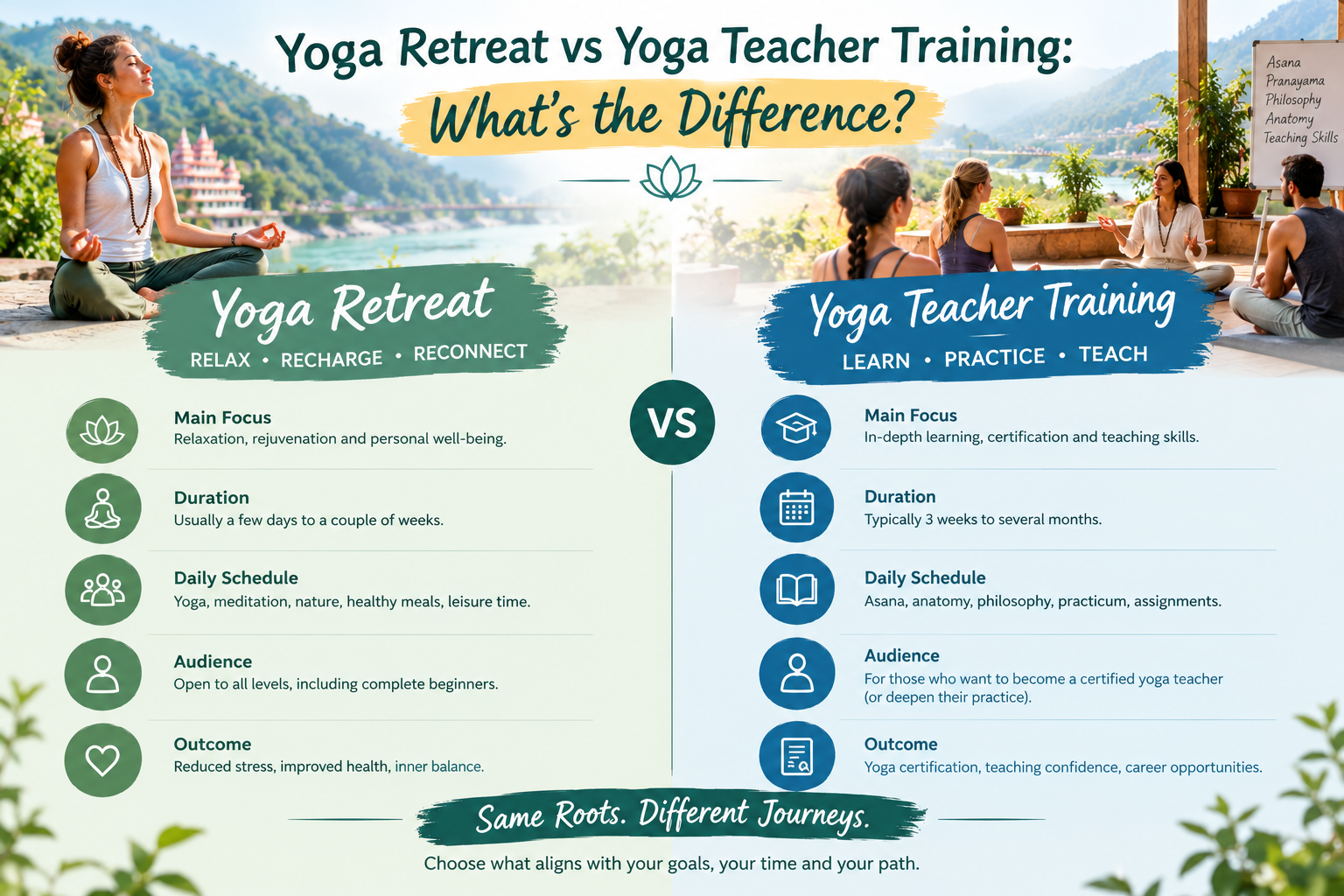
An informational guide to the differences between a yoga retreat and a yoga teacher training in Rishikesh, covering purpose, duration, intensity, certification, cost, and how to decide which one suits your experience, health, and goals.
Both a yoga retreat and a yoga teacher training (YTT) can take place in the same Himalayan town, in the same kind of ashram or studio, and even with the same teachers. That is why many first-time visitors to Rishikesh assume they are the same thing. They are not. A retreat is designed to help you practise, rest, and reset. A teacher training is designed to teach you how to teach yoga, and it asks far more of your time, energy, and attention.
This guide explains how the two formats differ, who each one suits, what to ask before booking, and which health situations call for extra care, so that you choose the experience that matches your real goals rather than the one with the more appealing brochure.
1. What Is a Yoga Retreat?
A yoga retreat is a short, structured stay focused on your own practice and wellbeing. Programs usually combine gentle to moderate postures, breathing practices, meditation, relaxation, and sometimes a short talk on yoga philosophy. There is no exam, no teaching practice, and no expectation that you leave qualified to do anything except continue practising.
Retreats are commonly offered for three, seven, or ten days, although some run longer. Because the aim is restoration and learning, most programs build in free time, simple meals, and early nights. A good retreat meets you at your level, which is why beginners, returning practitioners, and people simply wanting a pause from routine can all attend the same one.
2. What Is a Yoga Teacher Training?
A yoga teacher training is a formal educational course for people who want to teach yoga or deepen their understanding of it at a professional level. The most common entry point is the 200-hour course, which typically runs for around three to four weeks of full-time study. Longer 300-hour and 500-hour courses are usually taken by people who have already completed a foundation program.
The syllabus is broader than a retreat. Expect posture technique and alignment, teaching methodology, sequencing, anatomy and physiology, yoga philosophy, breathing and meditation, and supervised practice teaching. Many schools also include written work or a practical assessment. The experience is closer to a short intensive course than a holiday.
3. The Core Differences at a Glance
The simplest way to separate the two is to ask what you want to come home with. A retreat gives you an experience and a few habits. A teacher training gives you knowledge, skills, and in many cases a certificate. The main differences are listed below.
Purpose: a retreat supports your personal practice and rest, while a teacher training prepares you to teach.
Duration: retreats often last three to ten days, while a 200-hour training usually runs for about a month.
Intensity: retreats leave room for rest, whereas trainings usually have a full day of classes, study, and practice teaching.
Outcome: retreats end with a refreshed routine, while trainings end with a certificate if you complete the requirements.
Entry level: most retreats welcome complete beginners, while trainings generally expect some prior yoga experience, though requirements vary by school.
4. Daily Schedule and Intensity
A typical retreat day begins with a breathing or cleansing practice and a gentle class, followed by breakfast, a short lecture or free time, an afternoon rest, and an evening class with meditation. The pace is intentionally unhurried, and skipping a session to rest is normally acceptable.
A teacher training day is usually fuller. Mornings often include a longer practice, followed by technique or alignment workshops, anatomy or philosophy lectures, and an afternoon of teaching practice or self-study. Evenings may include a further class or review. The workload is physical, mental, and emotional, and fatigue in the second week is common even among fit students.
5. Certification: What It Does and Does Not Mean
Many teacher trainings are registered with Yoga Alliance, an international body that sets minimum standards for training hours and curriculum. A completed 200-hour course at a registered school allows graduates to apply for the RYT 200 credential. This can be useful if you plan to teach at studios or abroad, but it is a standard of training, not a guarantee of teaching ability.
A retreat does not normally lead to any certification, and you should be cautious if one is promised after a few days. When you assess a school, look at the lead teachers’ own qualifications, how many years they have taught, how many students are in each group, and whether the curriculum is published clearly. Certificates matter, but transparency matters more.
6. Cost and Time Commitment
A retreat is the lower-commitment option in both money and time. Because it is shorter, you can often fit it into a leave period, and you can try it without changing your life. A teacher training costs more overall and needs several uninterrupted weeks, so it is worth treating as a decision rather than an impulse.
Compare what is included rather than just the headline price. Check whether the fee covers accommodation, meals, study materials, airport or station pick-up, and any exam or certificate fee. Clear written terms, including cancellation and refund policies, are a sign of a well-run school.
7. Who Should Choose a Yoga Retreat
A retreat suits you if you are new to yoga, curious about Rishikesh, or looking for a calm break without academic pressure. It is also a sensible first step if you are considering a teacher training but are not sure you want to commit. Many people use a short stay to test the teaching style, the food, the climate, and their own stamina before deciding on something longer.
8. Who Should Choose a Yoga Teacher Training
A teacher training suits you if you want to teach, if you want to understand yoga in depth, or if you already have a steady practice and are ready for a demanding study period. You do not have to plan a teaching career, as many students enrol purely to deepen their own understanding, but you should expect to study as well as practise.
9. Women’s Health Considerations for Both Formats
Both formats can be adapted to different life stages, but they do not suit every stage equally without adjustment. Intensive training days involve long sitting, repeated postures, and sustained effort, so women at certain stages may need modified practice or a gentler format. A broader overview of yoga for women’s health explains how practice is commonly adapted across different needs.
If you are expecting, it helps to understand how yoga during pregnancy differs from regular classes, since many standard postures, deep twists, and strong core work are usually modified. Medical clearance and a school experienced in prenatal needs are essential before any program. After childbirth, a gradual return is generally advised, and reading about the postpartum yoga benefits and their limits can help you set realistic expectations about recovery and pacing.
Hormonal and metabolic conditions also deserve thought. Women exploring yoga for PCOS are often drawn to regular, moderate movement and stress management, which suits a retreat’s gentler rhythm better than a very demanding schedule. Likewise, those looking into yoga for menopause often value rest, breathing, and flexible pacing, so it is worth asking whether a school allows sessions to be adapted for heat sensitivity, sleep changes, or joint discomfort.
In all of these situations, yoga is a supportive practice and not a treatment. Speak with your doctor before booking, and tell the school about your health in advance.
10. Can You Do Both?
Yes, and many people do. A common path is to attend a short retreat first, continue a home practice for several months, and then enrol in a teacher training once you are sure about your interest and stamina. This order protects you from committing to a month-long course before you know whether the style, location, and routine suit you.
11. How to Judge a Program: A Simple Checklist
Use these questions to compare retreats and teacher trainings fairly.
Who are the teachers, and what are their qualifications and years of teaching experience?
Is there a clear, written daily schedule that includes proper rest?
If it is a training, is the school registered with a recognised body, and is the syllabus published?
How large are the groups, and will you receive individual attention?
Does the school ask about your health and offer modifications?
Are the inclusions, pricing, and cancellation terms stated clearly?
Do recent independent reviews describe an experience similar to what is advertised?
A school that answers openly is usually a better choice than one that relies on dramatic promises.
12. Red Flags to Watch For
Promises to cure illness, reverse a diagnosed condition, or replace medication.
A certificate offered after a very short stay, or a course that guarantees a pass.
Guarantees of enlightenment, total stress relief, or life transformation.
Unclear pricing, hidden charges, or pressure to pay quickly.
No health questions and no mention of modifications for different levels.
13. Who Should Be Cautious
Yoga programs are generally low risk for healthy adults when taught sensibly, but a teacher training in particular is physically and mentally demanding. Anyone with a heart condition, high blood pressure, recent surgery, a significant joint or spinal problem, or a pregnancy should consult a doctor before booking either format. People with diabetes, thyroid conditions, or other long-term illnesses should plan medication, meals, and monitoring in advance. Anyone with a history of anxiety, trauma, or an eating disorder should talk with a qualified professional and inform the school beforehand.
Frequently Asked Questions (FAQs)
Q1. Is a yoga retreat the same as a yoga teacher training?
No. A retreat focuses on your own practice, rest, and learning, while a teacher training is a formal course that prepares you to teach and usually includes assessment.
Q2. Do I need experience to join a teacher training?
Requirements vary. Many schools prefer some regular practice beforehand, so check the entry criteria and speak with the school about your level.
Q3. How long is a 200-hour teacher training?
Full-time courses in Rishikesh commonly run for around three to four weeks, although the exact schedule depends on the school.
Q4. Will a retreat give me a teaching certificate?
Usually not. A retreat is for personal practice, and you should be cautious about any short program that promises teaching credentials.
Q5. Which is better for stress relief?
A retreat is generally the better fit, as it allows rest and a slower pace. A training can be rewarding, but its workload may feel tiring rather than restful.
Q6. Can I do a retreat before a teacher training?
Yes. It is a sensible way to test the location, teaching style, and your own stamina before committing to a longer course.
Q7. Is yoga safe during pregnancy or after childbirth?
It can be, with medical clearance and suitable modifications, but intensive programs are not usually advisable without professional guidance. Speak with your doctor first.
Final Thoughts
The difference between a yoga retreat and a yoga teacher training comes down to purpose. A retreat is about resting, practising, and learning for yourself. A teacher training is about studying yoga seriously and preparing to share it. Neither is superior, and each can be the right choice at a different point in your life.
Choose the format that fits your health, your experience, and what you actually want to bring home. Look for honest teachers, a clear schedule, transparent terms, and realistic promises, and seek professional advice where your wellbeing calls for it.
