 Skip to content

Note: This guide offers general, informational content about yoga traditions and practice. It is not medical advice and is not a substitute for diagnosis or treatment from a qualified healthcare professional. Anyone with an existing health condition, pregnancy, or injury should consult a doctor and an experienced yoga teacher before starting new practices, especially breathwork or cleansing techniques.
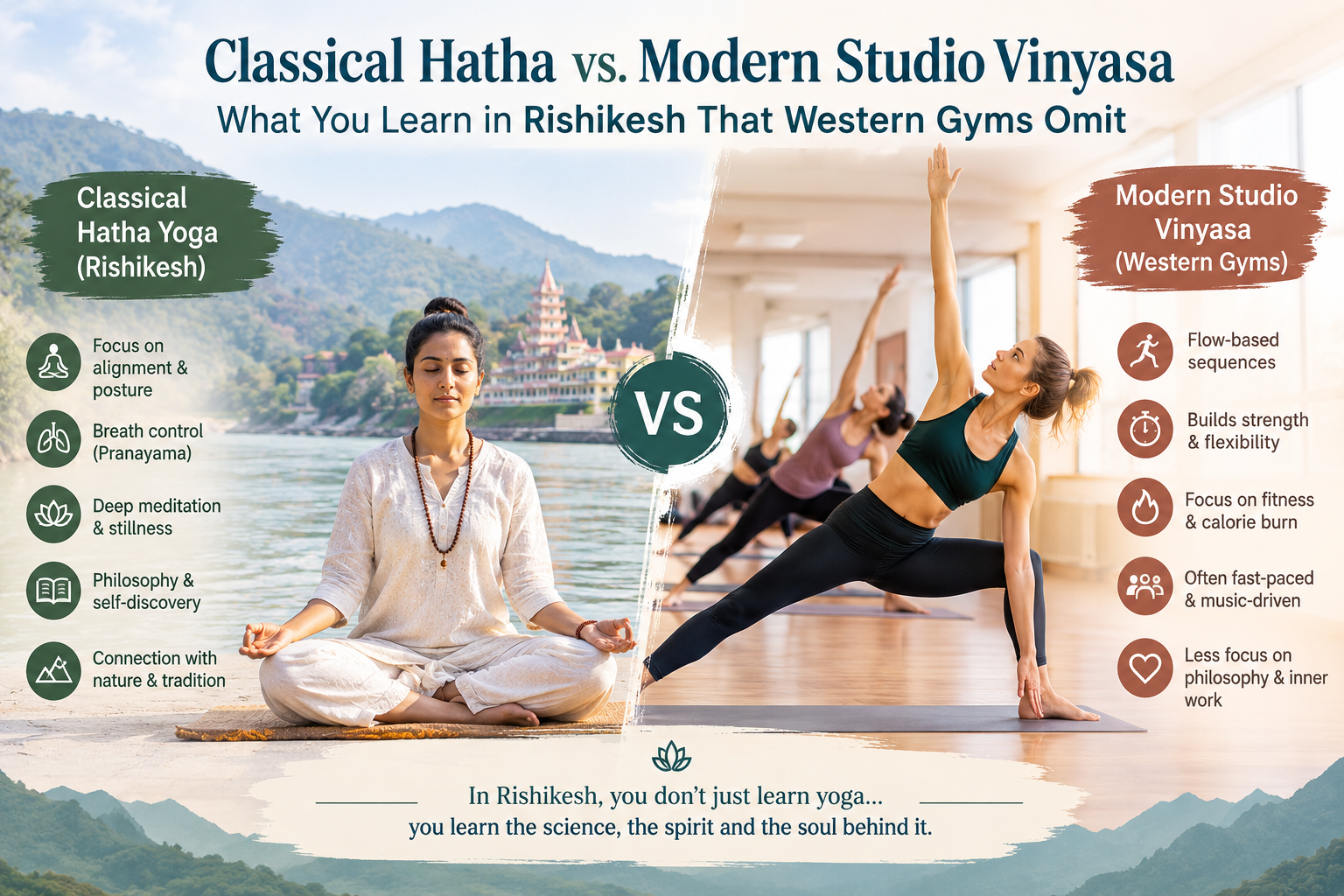
Walk into almost any fitness studio today and the word “yoga” usually means a music-driven vinyasa class: a continuous flow of postures linked by breath, designed to build strength, raise the heart rate, and leave you pleasantly tired. It is a good workout, and for many people it is the doorway into the practice. But it is one slice of a much larger tradition, and the slice that fits most easily into a 60-minute timetable.
Travel to Rishikesh, the town on the Ganga where yoga has been studied and taught for generations, and the contrast becomes clear. Classical Hatha yoga treats posture as one tool among many, alongside purification, breath control, internal energy locks, and meditation. This guide compares the two approaches fairly, explains what traditional training adds that gym-based classes commonly leave out, and helps you decide which suits your goals.
1. Classical Hatha Yoga: A Complete System, Not a Workout
“Hatha” is often explained as the union of sun (ha) and moon (tha), pointing to the balance of opposing forces in body and mind. Its foundational texts, including the 15th-century Hatha Yoga Pradipika by Swami Swatmarama and later works such as the Gheranda Samhita, describe a progression: cleansing practices, postures, breath regulation, and finally meditative absorption. Asana was never the destination. It was preparation, meant to make the body steady and comfortable enough to sit in meditation.
In a traditional Hatha class, you might hold a posture for several minutes, move slowly, and spend as much time on breath and awareness as on the physical shape. The emphasis is on how the practice changes your internal state, not on how the pose looks or how many calories it burns.
2. Modern Studio Vinyasa: What It Does Well
Fairness matters here. Vinyasa links movement to breath in flowing sequences, and its modern forms trace back to twentieth-century teachers such as T. Krishnamacharya and his students. Studio vinyasa has made yoga accessible to millions: it builds muscular endurance, improves flexibility, and offers a motivating, social environment. Research on regular yoga practice across styles suggests benefits for mood, perceived stress, and chronic back pain, although study quality varies.
The limitation is not the style itself but what usually gets trimmed to fit a gym schedule. Fast pacing leaves little room for long holds, breath retention, or stillness. Classes are shaped around fitness outcomes, so the purification and philosophical layers quietly disappear, and many students never learn they exist.
3. Shatkarma: The Cleansing Practices Gyms Rarely Mention
Classical Hatha describes six cleansing techniques, collectively called shatkarma: neti (nasal cleansing), dhauti (cleansing of the digestive tract), nauli (abdominal churning), basti (colon cleansing), trataka (steady gazing), and kapalabhati (rapid exhaled breathing). In Rishikesh, gentle forms such as jala neti and trataka are commonly introduced early and always under supervision, while advanced techniques like nauli and basti are reserved for experienced students.
It is worth being precise about what these practices do. The liver, kidneys, skin, and gut carry out the body’s detoxification, and no posture replaces them. Our evidence-based guide on Yoga and Detoxification explains what yoga can realistically support, such as circulation, digestion, and stress reduction, and what remains marketing. Similarly, our article on Yoga for Liver Health looks at how movement, mindful eating, and lower stress may complement medical care rather than act as a cure.
4. Pranayama, Bandhas, and Mudras: The Internal Engine
Perhaps the biggest gap between a gym class and a traditional course is the inner work. Pranayama in Hatha includes alternate-nostril breathing, ujjayi, bhastrika, and kumbhaka (breath retention). Bandhas are subtle muscular engagements, such as mula bandha at the pelvic floor, used to direct awareness and stabilize the core. Mudras are hand and body gestures used to focus attention.
Many studio classes mention “breathe” and perhaps offer a brief ujjayi cue. Traditional training treats breath as a skill with its own progression: you learn ratios, sequencing, and contraindications, and you build up slowly. Slow, controlled breathing is associated in studies with parasympathetic activation and a lower heart rate, which is exactly why teachers insist on learning it properly instead of copying it from a video. People with high blood pressure, heart or respiratory conditions, or pregnancy need individual guidance before attempting breath retention or forceful techniques.
5. Pace, Stillness, and the Nervous System
Vinyasa tends to be stimulating work: elevated heart rate, rhythmic exertion, and often loud music. That suits people who want energy. But many arrive at yoga already overstimulated, working long hours, sleeping poorly, and treating exercise as another performance target. For them, more intensity is not always the answer.
Classical Hatha deliberately slows the tempo. Long holds, supported postures, yoga nidra, and meditation teach the body to downshift. This is especially relevant for chronic exhaustion, and our guide to Yoga for Burnout Recovery describes how slower, restorative sequencing can rebuild energy gradually instead of draining reserves further. Neither pace is “better”; the key is matching the practice to your current state.
6. Digestion, Diet, and the Ayurvedic Context
In Rishikesh, yoga is rarely taught in isolation. It sits beside Ayurveda, India’s traditional health system, which views digestion (agni) as central to wellbeing and recommends eating according to season, constitution, and daily routine. Students typically eat simple vegetarian meals, learn to eat mindfully, and practice on an empty stomach. Our overview of Ayurveda and Digestion explains how the tradition thinks about digestive strength and everyday eating habits.
The posture side connects directly. Twists, gentle forward folds, and wind-relieving poses are used to support abdominal comfort. If this is your priority, our guide to Yoga for Gut Health covers the gut–brain connection and stress-linked digestive complaints, while our article on Yoga for Bloating outlines postures commonly used to ease trapped gas and discomfort. Persistent bloating, pain, or unexplained weight loss should always be checked by a doctor, since these can signal conditions that need medical care.
7. Philosophy and Ethics: Yoga Beyond Exercise
Traditional study includes the yamas and niyamas, the ethical and personal observances described in Patanjali’s Yoga Sutras, a text that defines yoga as the stilling of the fluctuations of the mind. Themes such as non-harm (ahimsa), truthfulness, contentment, and self-study are not decoration. They shape how you approach practice: whether you push through pain, compare yourself with others, or treat your body as a project. Gyms, understandably, have limited time and different goals, so these ideas rarely appear beyond an occasional quote on the wall.
8. Why Rishikesh Teaches It Differently
Context matters. In Rishikesh you learn within a lineage-based setting where teachers have often practiced for many years, classes begin early, and the daily rhythm blends asana, pranayama, meditation, philosophy, and simple food. Immersion lets concepts build over weeks instead of being sampled once a week between meetings.
That said, a location does not guarantee quality. Look for teachers with verifiable training, ask about their lineage and experience, check whether the program is registered with a recognized body such as Yoga Alliance, and make sure the school offers modifications and individual attention.
A typical day at a traditional school might begin with a cleansing or breathing session at sunrise, followed by a slower asana class, a philosophy lecture, and meditation in the evening. Meals are simple and unhurried. The structure itself teaches something gyms cannot easily replicate: that yoga is a way of organizing a day, not an hour inside it.
9. Common Mistakes When Comparing Yoga Styles
- Assuming “traditional” always means safer, or “modern” always means shallow. Quality varies by teacher, not by label.
- Attempting kapalabhati, breath retention, or cleansing techniques from videos without qualified guidance.
- Treating yoga as a detox method that replaces medical care.
- Choosing a style purely for calorie burn while ignoring recovery and nervous-system needs.
- Judging a retreat by scenery or social media instead of teacher qualifications and safety practices.
10. A Simple Framework for Choosing Your Practice
Rather than picking a side, ask what you actually need right now:
- Do I want fitness, flexibility, and community, or calm, focus, and recovery?
- Is stress, poor sleep, or exhaustion a bigger concern than strength?
- Am I willing to learn breathwork and slower practices progressively?
- Do I have injuries or health conditions that call for individual guidance?
For many people the honest answer is both: vinyasa for energy and movement, Hatha for depth, breath, and rest.
Frequently Asked Questions (FAQs)
Q1. Is Hatha yoga the same as vinyasa? Not exactly. “Hatha” is an umbrella term for the classical tradition and is often practiced slowly with long holds, while vinyasa is a flowing style that links movement to breath. Modern vinyasa actually grew out of Hatha-related lineages.
Q2. Is studio vinyasa a lesser form of yoga? No. It is a legitimate, effective way to build strength and mobility. It simply tends to include less of the breathwork, cleansing, and philosophy found in classical training.
Q3. Do I need to go to Rishikesh to learn classical Hatha? No, but immersion helps. Qualified teachers exist worldwide; Rishikesh offers a concentrated environment where the full system is practiced daily.
Q4. Can yoga detox the body? Yoga can support circulation, digestion, and stress regulation, but the liver and kidneys perform detoxification. Claims that yoga “flushes toxins” are generally not well supported by evidence.
Q5. Are the cleansing practices safe for beginners? Gentle techniques such as jala neti or trataka are often taught to beginners under supervision. Advanced practices like nauli and basti should only be learned in person from an experienced teacher.
Q6. Which style is better for stress? Slower practices with breath regulation and stillness are generally better suited to calming an overstimulated nervous system, though many people also find rhythmic vinyasa helpful for releasing tension.
Q7. Can complete beginners join a Hatha course in Rishikesh? Yes. Many programs are designed for beginners, but check that the school offers modifications and individual attention.
Q8. How do I know whether a yoga teacher is qualified? Ask about their training hours, lineage, and teaching experience, and look for registration with a recognized body such as Yoga Alliance. A good teacher also asks about your health history and offers modifications.
Final Thoughts
Classical Hatha and modern studio vinyasa are not rivals. Vinyasa offers accessible, energizing movement, while Hatha adds the slower, deeper layers of breath, purification, stillness, and ethics that fitness settings often have no time to teach.
If you are curious about those missing layers, start with one small step: a few minutes of supervised breathwork, a slower class, or a few days of structured practice in a traditional setting. Learn from qualified teachers, respect your limits, and let the practice develop gradually.
This guide is intended for general educational purposes only. If you have a diagnosed medical condition, are pregnant, or have persistent symptoms, please consult a qualified healthcare professional before starting new yoga, breathwork, or dietary practices.
