
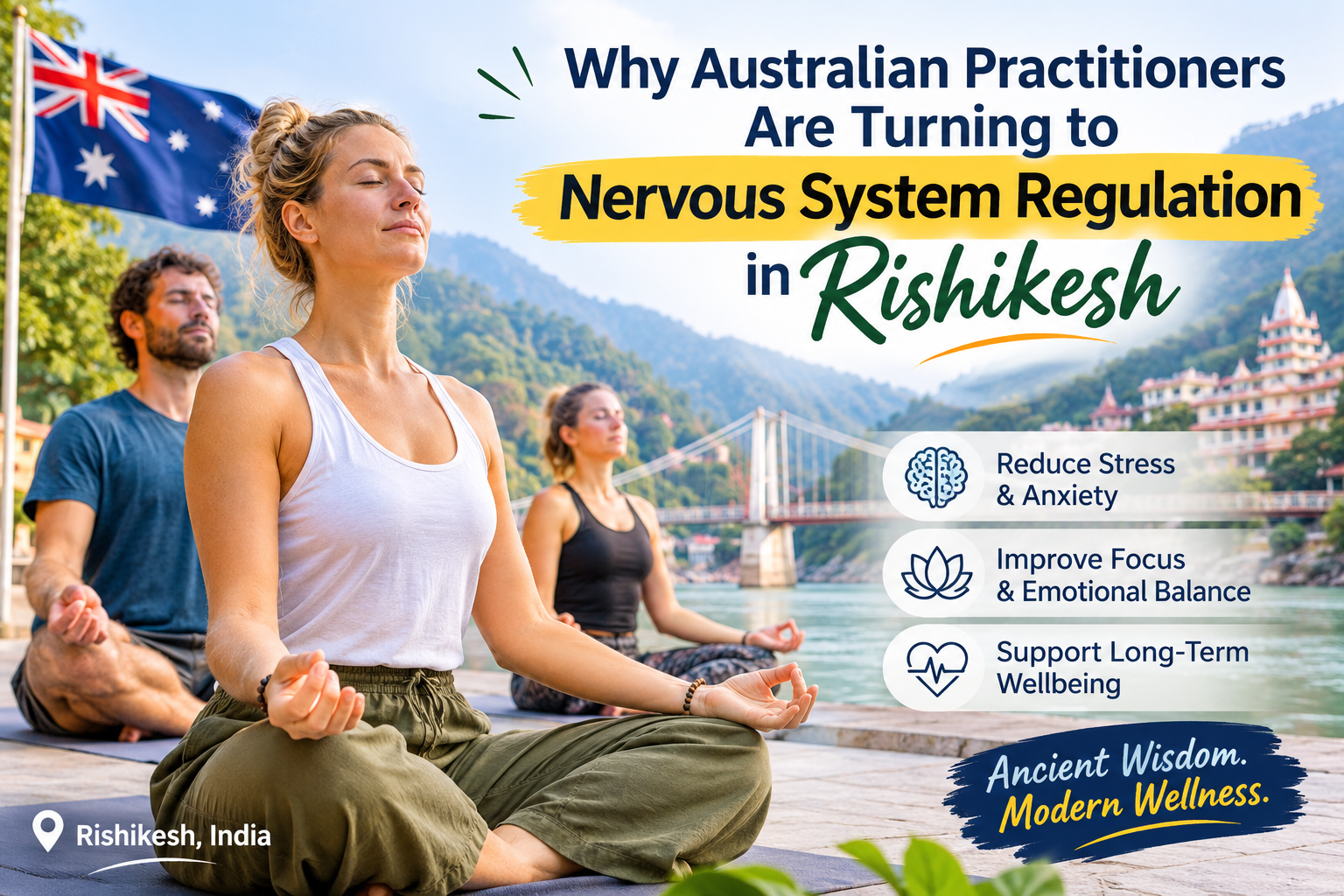
Across Australia, a quiet shift is happening inside the helping professions. Psychologists, physiotherapists, nurses, social workers, yoga teachers and bodyworkers are increasingly booking flights to a small Himalayan foothill town on the Ganges. They are not going for sightseeing. They are going to learn how to calm, steady and retrain their own nervous systems, so they can serve clients without burning out.
Rishikesh, long recognised as the “Yoga Capital of the World”, has become a practical training ground for this work. Here, ancient methods such as breathwork, meditation, mindful movement and Ayurvedic routines are taught within daily life rather than as weekend workshops. In this guide, we explore what nervous system regulation really means, why Australian practitioners feel the need for it, and what makes Rishikesh such a well-suited place to study it.
What Is Nervous System Regulation?
The autonomic nervous system works largely outside our conscious control. It has two main branches: the sympathetic branch, which prepares the body for action (the “fight or flight” response), and the parasympathetic branch, which supports rest, digestion and repair. Nervous system regulation is the skill of moving flexibly between these states, rather than getting stuck in constant alertness or shutdown.
Researchers often describe this capacity using terms such as vagal tone, heart rate variability and interoception, which is the ability to sense internal body signals. The vagus nerve, a major parasympathetic pathway, links the brain with the heart, lungs and digestive system. Polyvagal theory, developed by Dr. Stephen Porges, is one popular framework used by clinicians to discuss these states, although it continues to be debated in scientific circles. A balanced view is helpful: regulation practices are supportive tools, not cure-alls.
In yogic language, the same idea appears as balancing prana, the vital energy, through breath, posture and attention. Different vocabulary, similar goal: a body that can respond to stress and then return to calm.
Why Australian Practitioners Are Feeling the Load
Caring professions carry a unique cost. Listening to distressing stories, managing heavy caseloads and holding emotional space for others can lead to compassion fatigue, a state of emotional and physical exhaustion. Many Australian practitioners also deal with long working hours, administrative pressure and, in some regions, limited peer support.
Several factors push this group towards body-based solutions:
- Talking about stress is not enough. Many practitioners already understand stress intellectually. What they want is a felt, physical experience of calm that they can repeat.
- Clients are asking for embodied tools. Trauma-informed care increasingly recognises that the body holds a central role in recovery, so practitioners want credible, first-hand training before recommending any technique.
- Self-care is an ethical question. Professional bodies in Australia encourage practitioners to look after their own wellbeing, because depleted clinicians cannot offer their best work.
- Time away is rare. A structured stay in a distraction-free environment allows a full reset that short breaks cannot provide.
For these reasons, immersive programmes in India are seen as a professional investment as much as a personal one.
Why Rishikesh Specifically?
Rishikesh sits where the Ganges leaves the Himalayan foothills, and the town has been a centre of yogic study for generations. For Australian visitors, several practical features stand out.
1. Lineage and teacher access. Many teachers here trained in traditional gurukul-style settings and teach the philosophy alongside the postures. This helps practitioners understand why a technique works, not just how to copy it.
2. A supportive daily rhythm. Mornings start early with cleansing practices, pranayama and meditation. Meals are simple and sattvic (light, fresh, plant-based). Evenings are quiet. This repeating rhythm itself acts as a regulating influence on the body clock.
3. Natural surroundings. River sounds, forest air and mountain views reduce sensory overload. For people who spend their days in clinics and screens, this change alone can feel remarkable.
4. Time-zone and travel convenience. Flights from major Australian cities to Delhi are well established, and the road or short domestic transfer to Rishikesh is straightforward. The time difference with Australia is modest compared with long trips to Europe or the Americas.
5. Value and depth. Training hours, accommodation and meals are usually affordable compared with equivalent residential programmes at home, which makes longer stays possible.
Core Practices Used for Nervous System Regulation
A well-designed programme in Rishikesh does not rely on a single method. It layers several complementary tools.
Pranayama (Breath Practices)
Breath is the most accessible doorway to the autonomic nervous system. Slow, extended exhalations, as in practices such as Bhramari (humming bee breath) and Nadi Shodhana (alternate nostril breathing), are commonly taught to encourage a sense of calm. Participants learn to observe the breath first and only then refine it, which is safer for beginners and for people with anxiety.
Yoga Nidra and Deep Rest
Yoga nidra, often described as “yogic sleep”, is a guided relaxation that moves attention through the body while the person remains awake. Many practitioners use it to counter chronic tension and poor sleep. It is also easy to teach to clients afterwards, which adds professional value.
Gentle, Mindful Asana
Rather than intense flows, regulation-focused classes use slow movement, long holds and supported postures. The aim is to build awareness of sensation and release unnecessary effort. Forward folds, supported twists and legs-up-the-wall variations are common examples.
Meditation and Mantra
Simple seated meditation, chanting and sound practices help steady attention. Chanting also lengthens the exhale and engages the vibration of the throat and chest, which many people find soothing.
Self-Observation and Journaling
Structured reflection helps practitioners notice their personal stress signals: tight shoulders, shallow breath, racing thoughts. Knowing your early warning signs is the first step in regulating before overload sets in.
The Gut–Brain Connection and Ayurveda
One topic that surprises many visiting practitioners is how closely digestion and the nervous system are linked. The gut contains a dense network of nerves, often called the enteric nervous system, and it communicates constantly with the brain through the vagus nerve. Stress can influence appetite, bowel habits and comfort, and digestive discomfort can in turn feed anxiety.
In Ayurveda, digestive strength, or agni, is considered a foundation of overall health. If you want to understand this framework in more depth, our article on Ayurveda and Digestion explains how meals, timing and daily routine are viewed in the tradition.
On the movement side, many guests ask which postures are helpful when stress affects the stomach. Our guide to Yoga for Gut Health offers a gentle overview of sequences and breathing that support the gut–brain relationship. For those who struggle with fullness and discomfort after meals, the practical notes in Yoga for Bloating show how mindful twists, forward folds and slow breathing can be used safely.
These resources are educational and are not a substitute for medical assessment. Persistent digestive symptoms should always be reviewed by a qualified healthcare professional.
Support for Women Practitioners
A large share of Australia’s caring workforce is female, and many women balance clinical work with family responsibilities and hormonal transitions. Regulation practices can be adapted to different life stages, from busy working years to perimenopause and beyond. Readers who want a broader look at gentle, cycle-aware practice can explore our overview of Yoga for Women’s Health, which covers principles that apply to many stages of life.
As with any practice, individual needs differ. Pregnancy, recent surgery and medical conditions require individual guidance from a doctor and an experienced teacher.
What a Typical Day Can Look Like
While every school differs, a regulation-oriented day in Rishikesh often follows a pattern like this:
- Early morning: Gentle cleansing practices, pranayama and meditation
- Mid-morning: Philosophy session or practice lab, followed by a simple sattvic breakfast
- Afternoon: Rest, self-study, optional Ayurvedic consultation or bodywork
- Late afternoon: Slow asana or restorative class
- Evening: Chanting, yoga nidra or quiet reflection, early sleep
The repetition builds familiarity, and familiarity helps the nervous system feel safe enough to let go.
How Practitioners Bring the Learning Home
The real test of any retreat is what happens after you return to Sydney, Melbourne, Brisbane or Perth. Experienced participants often recommend a few simple steps:
- Keep a short daily practice. Even ten minutes of breathing and stillness is more useful than an occasional long session.
- Anchor practice to existing habits. Link a breath practice to your morning tea or the drive home from clinic.
- Create micro-pauses at work. A few slow exhalations between clients can reduce build-up of tension.
- Protect your sleep. Regular bedtime, screen limits and an evening wind-down routine support regulation.
- Seek supervision and community. Share the learning with peers and, where appropriate, your own supervisor or therapist.
How to Choose a Trustworthy Programme
Because wellness is a crowded field, practitioners rightly ask for evidence of quality. When comparing options in Rishikesh, look for:
- Transparent teacher credentials, including training background and years of teaching
- Recognised certification, such as registration with Yoga Alliance, if you plan to teach
- Trauma-informed, non-coercive teaching that allows you to opt out or modify practices
- Clear safety guidance about health conditions, medication and contraindications
- Honest claims: reputable schools describe yoga as supportive, not as a guaranteed cure
- Genuine reviews and clear communication before you book
These signals reflect the principles of experience, expertise, authoritativeness and trustworthiness, and they protect you as a consumer and as a professional.
Frequently Asked Questions
Is nervous system regulation the same as relaxation? Not exactly. Relaxation is one outcome. Regulation is the broader ability to move between activation and rest according to what the situation requires.
Do I need prior yoga experience? No. Many programmes welcome beginners, and a good teacher will adapt practices to your level.
How long should I stay? Short retreats of one week can introduce the tools, while stays of two to four weeks allow deeper integration. The best length depends on your schedule and goals.
Is yoga safe for people with anxiety or trauma history? Many people benefit, but intense breath retention or deep emotional release can be unsettling for some. Choose trauma-aware teachers and speak with your healthcare provider beforehand.
Conclusion
Australian practitioners are not turning to Rishikesh because it is fashionable. They are going because the work of caring for others is demanding, and the body needs real training in recovery. The combination of experienced teachers, a rhythmic daily structure, supportive surroundings and traditional frameworks such as pranayama and Ayurveda offers a practical path to steadier energy and clearer presence.
If you are considering this journey, begin with clear intentions, choose a transparent and qualified school, and treat the experience as the start of a lasting daily practice rather than a one-time escape.
Disclaimer: This article is for educational purposes only and does not replace professional medical, psychological or nutritional advice. Please consult a qualified healthcare provider before starting any new practice, especially if you are pregnant, managing a health condition or taking medication.