 Skip to content
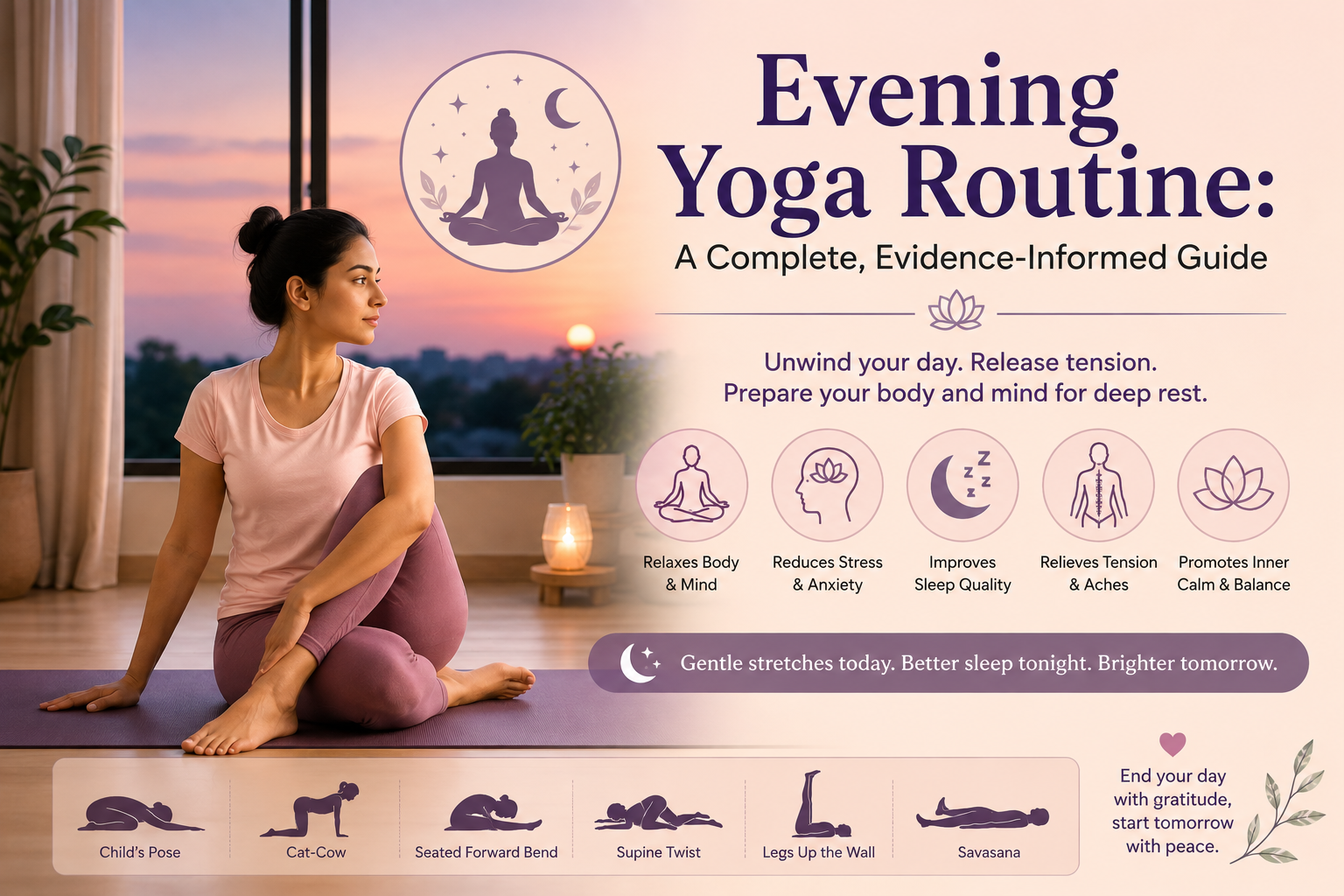
An informational guide to building a realistic evening yoga routine — covering how the body actually winds down after a day of activity, where breath work and gentle movement genuinely help, and where popular claims about an evening practice “erasing” the stress of the day go further than the evidence supports.
An evening yoga routine is one of the most widely recommended wind-down habits, and it is often marketed with sweeping promises: that a specific sequence practised before bed will erase the day’s stress, guarantee deep sleep, and reset the nervous system in minutes. The more accurate picture is more modest: the body’s transition toward rest is governed by circadian and hormonal processes that a short practice does not override, and no single sequence undoes a demanding day on its own. What an evening routine can genuinely offer is a gentler release for tight muscles built up over the day, a few minutes of breath-based calm, and a consistent cue that supports the body’s natural wind-down, a real and useful role that falls short of guaranteeing a perfect night’s sleep.
This guide walks through what actually happens in the body in the hours before sleep, where an evening yoga practice has an evidence-aligned role in supporting relaxation and rest, and where popular claims about evening yoga outpace what the research supports. Yoga is not a substitute for medical care, and anyone managing a diagnosed health condition, including a sleep disorder, should treat an evening routine as a complement to, not a replacement for, appropriate medical guidance.
1. What Is Actually Happening in the Body in the Evening
As evening approaches, the body begins a gradual shift toward rest: core temperature starts to drop, the hormone melatonin begins rising in response to falling light levels, and the alertness-promoting effects of cortisol taper off from their earlier peak. Muscles that have been active, or held in fixed positions such as sitting, throughout the day often carry accumulated tension, particularly through the shoulders, lower back, and hips. Understanding this clarifies what an evening practice can realistically do: work with these natural transitions through slow movement and breath, rather than force the nervous system into calm before the body’s own signals are ready to support it.
2. Why Claims That an Evening Routine “Erases” the Day Go Too Far
It is easy to find wellness content suggesting that a specific evening sequence guarantees deep sleep, eliminates next-day fatigue, or fully resets stress hormones before bed. These claims are not well supported, since sleep quality and next-day energy are shaped by many overlapping factors, including light exposure, caffeine timing, workload, and unpredictable events that a ten-minute practice cannot control on its own. The more accurate picture is that an evening routine can meaningfully support how the transition to sleep feels and can nudge overall stress and tension in a helpful direction, offering modest, real benefits without guaranteeing a specific outcome for the night that follows.
3. What the Research Actually Shows
Research on evening exercise and relaxation practices, including yoga, shows reasonably consistent support for short-term reductions in perceived tension and improvements in self-reported ease of falling asleep, along with more modest evidence linking a consistent evening routine to better long-term sleep habits. Evidence that yoga specifically, practised in the evening, outperforms the same practice done earlier in the day is thinner, and much of what is presented as proof of a uniquely powerful evening effect is anecdotal. The fair summary: evening movement offers genuine, well-supported short-term benefits for relaxation, while claims that only an evening practice “works” for sleep outpace what has actually been demonstrated.
4. Why Evenings Suit Certain Practice Styles
Evenings tend to suit practices that gently release tension and lower arousal rather than deeply heating, energising sequences, since the goal is usually to support the transition toward sleep rather than to build alertness for the hours ahead. This does not mean an evening practice needs to be entirely passive; it means the emphasis usually shifts toward slow mobility, gentle stretching, and breath work that supports a lower heart rate, with more dynamic or heat-building sequences generally sitting more comfortably earlier in the day, when the priority is energy rather than recovery.
5. Breath Work to Close the Day
A few minutes of conscious breathing is one of the more directly useful elements of an evening routine, since slow, extended exhalation can encourage the body’s parasympathetic, rest-oriented response without requiring any physical effort. Simple techniques such as lengthening the exhale beyond the inhale, or a few rounds of slow alternate-nostril breathing, tend to be well tolerated before bed, though vigorous or energising breathing patterns are generally better suited to earlier in the day and are not appropriate for everyone in the hour before sleep.
6. Postures for Releasing the Day’s Tension
An evening sequence generally benefits from moving slowly: a few minutes of gentle spinal movement, hip opening, and forward folds tend to be well tolerated after a day of sitting or activity, since these shapes encourage the nervous system to shift toward rest rather than exertion. Simple seated twists, supported forward bends, and gentle hip-opening postures are commonly used to ease tension built up through the day. Pushing into deep or effortful holds too close to bedtime can be counterproductive, since it may raise alertness rather than lower it, so a slow, low-effort approach matters more in an evening sequence than at almost any other time of day.
7. Restorative and Yin-Style Practice
Once the body has settled into a slower pace, longer-held, passive postures supported by props such as bolsters or blankets are a common and well-supported way to encourage deep relaxation, since holding a gentle shape for several minutes allows connective tissue to release gradually rather than through active stretching. A structured, deeply relaxing practice of the sort found in Yoga Nidra in Rishikesh illustrates this approach, guiding the body into a state between waking and sleep through stillness and guided awareness rather than active movement, which many people find suits an evening setting particularly well.
For those wanting a gentler, more alignment-focused framework that still allows for longer, supported holds, the precise, prop-supported approach found in Iyengar Yoga in Rishikesh India has long been valued for its attention to detail and its suitability for slower, more restorative sessions, making it a useful reference point for anyone building an evening practice around careful, supported postures rather than a faster-paced flow.
8. Structuring a Realistic Evening Sequence
A realistic evening sequence generally moves through a few clear stages: a brief settling period, slow mobility to release tension from the day, a short series of gentle floor-based or seated postures, and a few minutes of stillness or breath work to close. Keeping the sequence simple and repeatable, rather than elaborate, tends to make it easier to sustain on the nights when energy and time are limited, which are often the nights an evening practice is needed most.
9. How Long an Evening Practice Needs to Be
There is no fixed duration that applies to everyone, and much of the research on evening relaxation practices shows benefits from sessions as short as ten to fifteen minutes, provided they happen consistently in the lead-up to sleep. A shorter, realistic sequence that fits comfortably into a typical evening routine tends to be more sustainable, and therefore more beneficial over time, than an ambitious hour-long practice that frequently gets skipped when evenings run long.
10. Common Mistakes People Make with Evening Yoga
A few patterns tend to undermine an otherwise well-intentioned evening routine: choosing fast-paced or heat-building sequences too close to bedtime, treating a missed evening session as a failure rather than simply resting instead, and judging the routine’s success only by how well the following night’s sleep turns out, rather than by whether the practice itself felt calming. An evening routine built on realistic, adjustable expectations tends to last far longer than one built on rigid, all-or-nothing rules.
11. Adapting the Routine to Energy and Time
An evening routine that genuinely supports wellbeing looks adaptable, adjusting to available time and how the body feels on a given night rather than following an identical sequence regardless of circumstances.
- Begin with a few minutes of slow, low-effort movement before any longer-held postures.
- Use slow, extended exhalation to ease the nervous system toward rest rather than starting at full intensity.
- Keep a shorter backup sequence in mind for late nights rather than skipping practice entirely.
- Save faster-paced or heat-building sequences for earlier in the day, when the goal is energy rather than rest.
- Anchor the routine to a consistent, realistic time before bed rather than an idealised late hour that is hard to sustain.
12. Red Flags in Evening Yoga Claims
A few common red flags tend to signal claims about evening yoga that outpace the evidence.
- Promises that a specific sequence will guarantee deep sleep or eliminate insomnia entirely.
- Suggestions that skipping an evening session undoes the benefit of practising at any other time of day.
- Claims that fast-paced or intense postures should be practised immediately before bed for better sleep.
- Vague claims that an evening flow “detoxifies” or “resets” the nervous system without any explanation of the mechanism.
13. Learning These Practices Properly
Because building an evening sequence that genuinely supports rest, rather than just a collection of poses in a video, involves understanding how the body winds down and how breath influences the nervous system, learning from a properly trained teacher makes a real difference. A structured Yoga Teacher Training in Rishikesh programme typically covers how to build and adapt both energising and restorative sequences alongside breath work and broader sequencing principles, offering a grounded foundation for anyone who wants a routine built on sound practice rather than wellness marketing.
For people specifically drawn to yoga as a way to manage stress and support emotional wellbeing in the evening, a dedicated look at Yoga for Mental Health in Rishikesh India can offer a useful, evidence-aligned starting point for understanding how a consistent practice fits alongside, rather than replaces, appropriate mental health support.
Safety Notes and When to See a Doctor
An evening yoga routine can genuinely support a gentler transition into rest, but it should never replace appropriate medical diagnosis or treatment for a specific health condition, including a diagnosed sleep disorder.
- Anyone with joint pain, recent injury, or a diagnosed musculoskeletal condition should confirm which postures are appropriate before starting a new evening routine.
- Persistent difficulty falling or staying asleep that does not improve with a gentle wind-down routine should be evaluated by a doctor.
- Dizziness, unusual breathlessness, or chest discomfort during practice is a signal to stop and seek medical attention rather than to continue.
- Anyone with a diagnosed cardiovascular or respiratory condition should confirm which breathing techniques are appropriate before introducing them into an evening routine.
Frequently Asked Questions (FAQs)
Q1. How long should an evening yoga routine be?
There is no fixed minimum that suits everyone. Ten to fifteen minutes practised consistently tends to offer meaningful short-term benefits for relaxation and ease of falling asleep, and a shorter, realistic routine is generally more sustainable than an ambitious one that often gets skipped.
Q2. Is it bad to do a fast-paced flow right before bed?
A slower, low-effort approach is generally a better fit close to bedtime, since the goal is to lower arousal rather than raise it. A fast-paced or heat-building sequence too close to sleep may leave the body more alert rather than more relaxed.
Q3. Does evening yoga really guarantee better sleep?
Not on its own. Evening movement and breath work can support relaxation and may contribute to an easier transition into sleep, but sleep quality is influenced by many factors, and no single evening sequence guarantees deep sleep by itself.
Q4. What if I don’t have time for a full sequence every evening?
A shorter, realistic version of the routine, even just a few minutes of slow breathing and gentle stretching, tends to be more valuable over time than an ideal, longer sequence that frequently gets skipped due to time pressure.
Q5. Is it better to practise yoga on an empty stomach in the evening?
Many people find gentle movement more comfortable a little while after eating rather than immediately after a large meal, since a full stomach can make certain postures uncomfortable, though this is a matter of individual preference rather than a strict requirement.
Q6. Can an evening routine replace good sleep habits?
No. An evening practice can support relaxation and ease the transition toward sleep, but it does not substitute for consistent sleep habits such as a regular bedtime, and persistent poor sleep is worth addressing directly rather than compensating for with movement alone.
Q7. What is the most evidence-based way to think about an evening yoga routine?
The most accurate framing is that an evening routine offers genuine, short-term support for relaxation, tension release, and an easier transition toward sleep, and contributes to broader habit consistency over time, rather than single-handedly determining how well the night unfolds.
Final Thoughts
An evening yoga routine is not a guarantee of a perfect night’s sleep so much as a gentle, supportive transition toward rest, and the most honest, evidence-aligned view of its role is a modest one: releasing tension, supporting breath and calm, and offering a consistent anchor that helps the body recognise the day is winding down. This is a more realistic picture than some wellness marketing suggests, but it is also a far more sustainable one.
Approached gradually, adjusted to real time and energy on any given evening, and paired with consistent sleep habits and appropriate medical guidance when needed, an evening yoga routine can offer many people a genuinely useful, low-risk way to close the day with a little more ease.
