 Skip to content
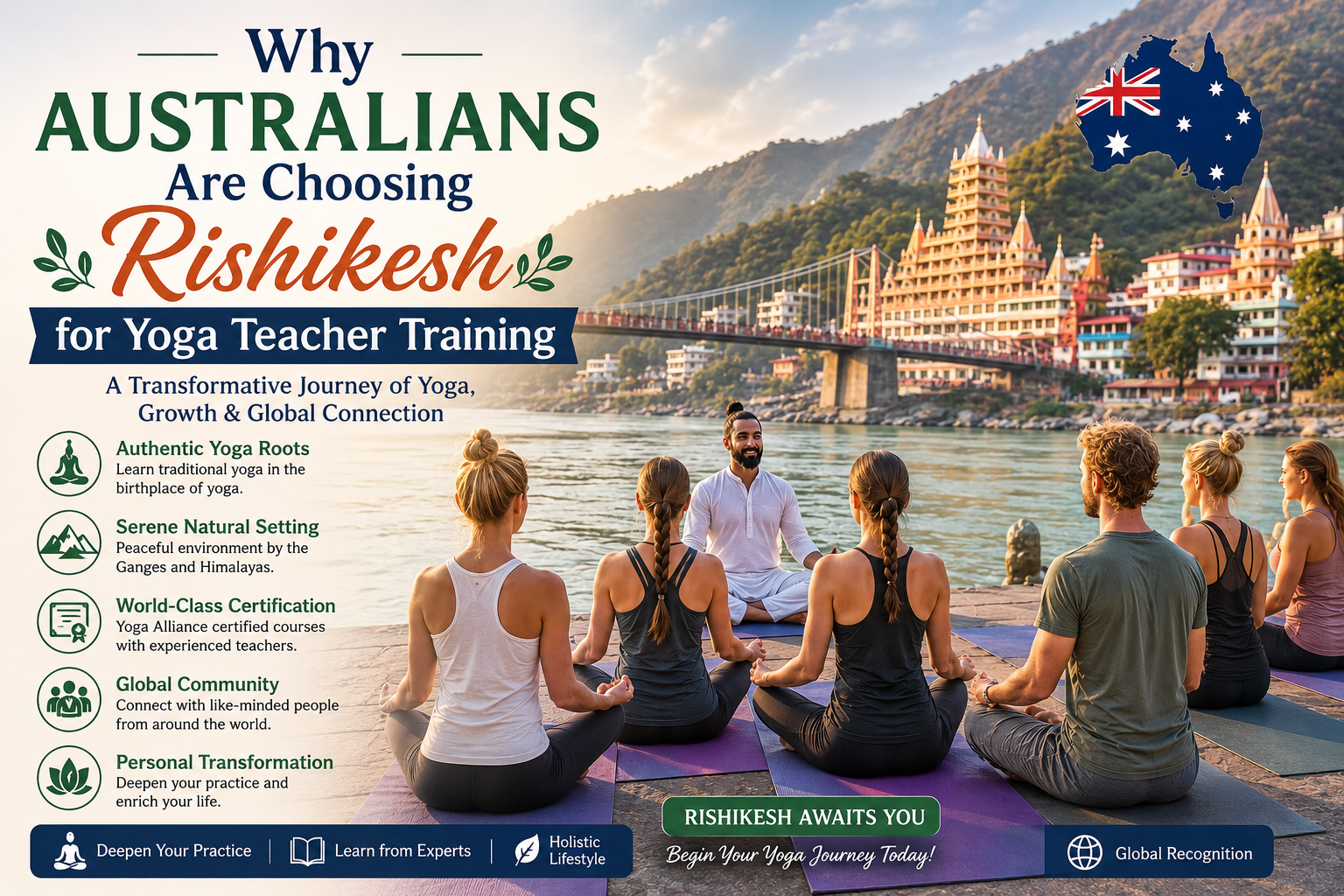
An informational guide to why a growing number of Australian yoga students are travelling to Rishikesh for teacher training, what the experience actually involves, and what to consider before enrolling.
Every year, a steady stream of Australian yoga students make the long journey to a small town on the banks of the Ganges to complete their teacher training. Rishikesh sits roughly a full day’s travel from most Australian cities, and yet it continues to draw students away from closer, more convenient options across South-East Asia and at home. Understanding why comes down to more than geography: it is about where yoga actually developed, the depth of teaching available, and an experience that is difficult to replicate elsewhere.
This guide looks at what specifically draws Australians to Rishikesh for yoga teacher training, what the training itself typically involves, and the practical considerations worth thinking through before booking a course.
It is written for Australian readers who are seriously considering a teacher training course, whether as a career step, a deepening of personal practice, or both, and who want a realistic picture of the experience rather than a purely promotional one. Choosing to train overseas is a significant decision, involving cost, time away from work or family, and a fair amount of research into which school and style will actually suit a particular student, so this guide aims to cover the practical questions alongside the more inspirational ones.
1. Why Rishikesh Has Become a Global Draw for Yoga Teacher Training
Rishikesh has been associated with yogic practice for centuries, long before yoga became a global wellness industry, and this history is a large part of its continued appeal. The town is home to a dense concentration of ashrams, schools, and experienced teachers, many trained in lineages that trace back generations, which is difficult to find concentrated anywhere else in the world. For students who want their training to feel rooted in something more than a certificate, this depth of tradition carries real weight.
Rishikesh’s reputation is also reinforced by its physical setting. The town sits where the Ganges emerges from the Himalayan foothills, and the combination of mountain air, river views, and a genuinely quiet, contemplative atmosphere gives students a setting that supports focus in a way that a busy home studio rarely can. For many, this environment is as much a part of the training as the curriculum itself.
2. What Draws Australians Specifically to Rishikesh
Australian yoga students often cite a similar set of reasons for choosing Rishikesh over more local or regional options: the authenticity of learning yoga in the country where it originated, the relatively affordable cost of training compared with equivalent courses in Australia, and a growing word-of-mouth reputation within Australia’s own yoga community, where returning graduates frequently recommend the experience to their own students. For many, the appeal is also personal, a genuine desire to step outside familiar surroundings and immerse fully in the practice without the usual distractions of home.
A growing number of Australian yoga studios now actively encourage their staff and senior students to train overseas, partly because graduates tend to return with a noticeably deeper understanding of the practice, and partly because it has become something of an expected step within Australia’s own teaching community. This shifting expectation has, in turn, made the decision to travel feel less unusual and more like a natural progression for serious students.
3. The Value of Learning Yoga at Its Source
There is a meaningful difference between learning yoga poses in a studio setting and learning the philosophy, breathwork, and teaching methodology behind them from instructors who grew up within that tradition. Training in Rishikesh typically includes far more philosophical and anatomical grounding than a standard studio-based course, alongside daily practice with teachers who often have decades of experience. For students planning to teach professionally, this depth of understanding tends to shape how they teach for years afterward.
This grounding also tends to make graduates more adaptable teachers once they return home. Rather than relying on a single memorised sequence, students who have engaged deeply with the underlying philosophy and anatomy are generally better equipped to adjust classes for different bodies, injuries, and skill levels, a skill that becomes increasingly valuable once teaching professionally in a studio environment.
4. Understanding the Range of Yoga Styles Taught in Rishikesh
One advantage of training in Rishikesh is the sheer range of styles available within a small area, allowing students to choose a course that genuinely matches their interests rather than settling for whatever happens to be offered locally. Dynamic, breath-linked styles such as Vinyasa Yoga in Rishikesh India appeal to students coming from a more fitness-oriented background, while other schools focus on gentler, more traditional approaches. This variety allows Australian students to select training that fits their existing practice rather than adapting to a single, generic curriculum.
5. Choosing Between a Course and a Retreat
Prospective students sometimes conflate a certification course with a shorter wellness break, but the two serve different purposes. A Yoga Retreat in Rishikesh is generally built around rest, reflection, and deepening personal practice over a shorter period, without the structured curriculum or assessment involved in certification. A teacher training course, by contrast, is a more intensive, credentialed program aimed at those who want to teach. Australians researching options should be clear on which outcome they are actually seeking before enrolling.
For students unsure which style fits them best, it is generally worth trialling a few different classes locally in Australia before committing to a specific school in Rishikesh, since the underlying teaching philosophy can vary considerably between a dynamic, movement-focused approach and a slower, more alignment-based one.
6. What a Typical Yoga Teacher Training Includes
Most reputable programs in Rishikesh follow a similar general structure, regardless of the specific style taught. A typical day includes:
- Early-morning meditation and pranayama practice, often before sunrise.
- A structured asana class covering alignment, sequencing, and adjustments.
- Philosophy and anatomy lectures covering the theoretical foundations of the practice.
- Teaching methodology sessions, where students practise leading portions of a class.
- A second, often more restorative practice session in the evening.
This structure is intentionally demanding, designed to build both practical teaching skill and personal discipline over the course of several weeks.
Rest days are typically built into the schedule roughly once a week, and most schools also include time for local excursions, such as visits to nearby temples or waterfalls, which gives the experience a broader cultural dimension beyond the classroom itself.
7. The Certification Process Explained
For Australians new to the process, understanding how certification actually works is an important first step before choosing a school. How to Get Yoga Certified in Rishikesh India walks through the pathway from beginner to internationally recognised certification, including how course hours are structured and what governing bodies typically require. Understanding this roadmap in advance helps avoid enrolling in a program that does not align with long-term teaching goals.
Most Australian students pursue what is internationally known as a 200-hour foundational certification as their first step, with many later returning for a more advanced 300-hour course once they have gained some teaching experience. Confirming exactly how a school’s hours map onto these recognised standards is one of the more important checks to make before enrolling.
8. Mental Health and Personal Growth Benefits
Beyond the certification itself, many Australian students describe the experience as personally transformative in ways they did not initially anticipate. Stepping away from work, technology, and familiar routines for several weeks, combined with daily meditation and structured practice, often has a noticeable effect on stress levels and general wellbeing. Yoga for Mental Health in Rishikesh India explores this connection in more depth, looking at how immersive practice environments like Rishikesh support mental clarity alongside physical training.
9. Cost Considerations for Australian Students
Cost is a genuine factor in why many Australians choose Rishikesh over local training. Course fees, accommodation, and meals are typically bundled together and are often considerably lower than equivalent hours of training within Australia, even after accounting for international flights. It is worth budgeting realistically for flights, visa fees, travel insurance, and any additional excursions, since these costs sit outside the course fee itself but are part of the overall trip.
10. Travel, Visas, and Practical Logistics from Australia
Most Australian travellers require a tourist e-visa for India, which can generally be arranged online in advance of departure, along with standard travel vaccinations recommended for the region. Direct flights from Australia to India are limited, so most itineraries involve a connection through a hub such as Singapore, Kuala Lumpur, or Dubai, followed by a domestic transfer or road journey to Rishikesh itself. Building in a day of buffer time around these connections is generally a sensible precaution, particularly for a first visit.
11. Common Mistakes Australian Students Make When Choosing a School
The most common mistake is choosing a school based solely on price without checking whether its certification is recognised by an internationally accepted governing body, which matters considerably for anyone planning to teach professionally back in Australia. Booking too close to the intended start date, without allowing time for visa processing, is another frequent issue. It is also worth being cautious of schools that heavily overstate class sizes or teacher availability in their marketing without any way to verify these claims in advance.
12. Building Confidence as a First-Time International Traveller
For Australian students who have not travelled extensively in India before, the prospect can feel more daunting than the training itself. In practice, most reputable schools are well accustomed to hosting international students and provide considerable support around airport transfers, accommodation, and general orientation in the first few days. Arriving with a flexible mindset, comfortable clothing suited to the climate, and a willingness to adjust to a different pace of life tends to make the transition considerably smoother.
13. Who This Training Suits Best
Rishikesh-based training tends to suit Australians who want a genuinely immersive experience rather than the most convenient or fastest available option, and who are comfortable with a more traditional, structured daily schedule. It is particularly well suited to those planning to teach professionally, given the depth of philosophy and methodology typically covered, though many students without any teaching ambitions also complete the training purely to deepen their own practice.
14. Making the Most of the Experience Long-Term
Students who get the most lasting value from training in Rishikesh tend to be those who treat it as the beginning of an ongoing practice rather than a single, self-contained trip. Staying connected with teachers, continuing daily practice after returning home, and gradually building toward further training, such as a Yoga Instructor Certification Guide in India, all help extend the benefits of the experience well beyond the weeks spent in Rishikesh itself.
Frequently Asked Questions (FAQs)
Q1. Why do Australians travel so far for yoga teacher training when options exist closer to home?
Many are drawn by the authenticity of training at yoga’s traditional source, the depth of teaching available, and generally lower costs compared with equivalent training in Australia.
Q2. How long does a typical yoga teacher training course in Rishikesh take?
Most foundational courses run around three to four weeks, though shorter retreats and longer, more advanced programs are also available.
Q3. Do Australians need a visa to attend yoga training in India?
Yes, a tourist e-visa is generally required and can usually be arranged online in advance, well before the intended travel date.
Q4. Is prior yoga experience required before starting a teacher training course?
Most foundational courses welcome students with a reasonably consistent personal practice, though extensive prior experience is not always required; it is worth checking a specific school’s prerequisites.
Q5. Is training in Rishikesh internationally recognised?
Reputable schools typically offer certification aligned with internationally recognised standards, though it is worth confirming this directly with a school before enrolling.
Q6. What should Australian students budget for beyond the course fee?
International flights, visa costs, travel insurance, and any personal excursions are typically separate from the course fee and should be budgeted for independently.
Q7. Is Rishikesh safe for solo Australian travellers?
Rishikesh is generally considered a safe and well-established destination for international yoga students, including solo travellers, though standard travel precautions are always worth following.
Final Thoughts
For Australians drawn to yoga as more than a passing interest, Rishikesh offers something genuinely difficult to replicate closer to home: depth of tradition, experienced teachers, and an immersive environment built specifically around the practice. Approached with realistic expectations and a bit of practical planning, it continues to be one of the more meaningful ways to complete a yoga teacher training course.
