 Skip to content
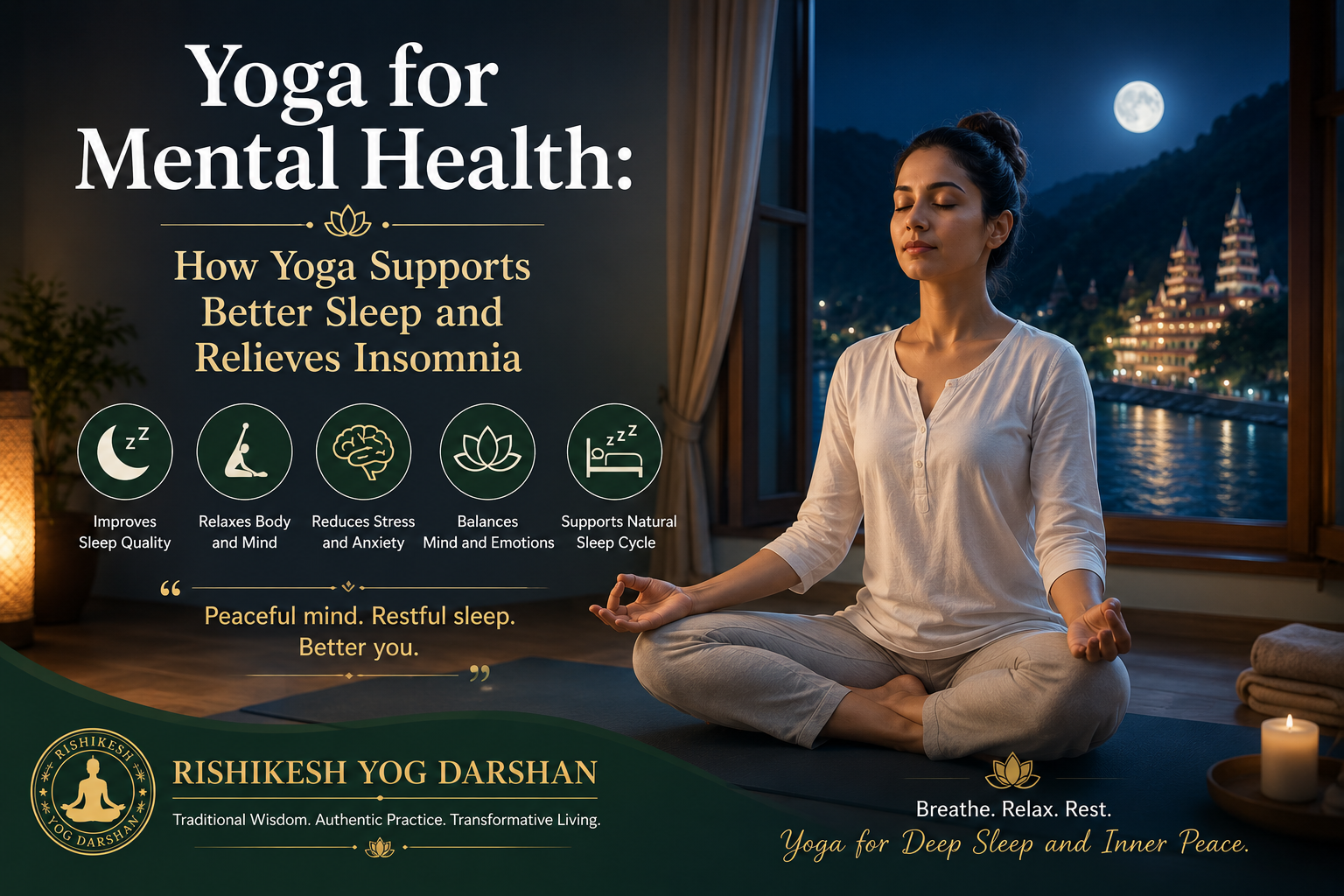
Important Note: This article is written for informational and educational purposes only. It is not a substitute for professional medical advice, diagnosis, or treatment. Chronic insomnia is a recognised medical condition. If sleep difficulties are significantly affecting your daily functioning, please consult a qualified healthcare professional. Yoga may serve as a meaningful complementary support — it is not a replacement for clinical evaluation or treatment.
Sleep is not a luxury. It is a biological necessity — as fundamental to health as food, water, and breath. During sleep, the brain clears metabolic waste products, consolidates memory, processes emotion, and restores the regulatory systems that govern everything from immune function to hormonal balance. Sleep deprivation — even mild and cumulative — impairs cognitive performance, destabilizes mood, increases inflammatory markers, and significantly elevates risk for a wide range of physical and mental health conditions.
Yet according to the World Health Organization, sleep disorders affect between 30 and 45 percent of adults in developed nations. Insomnia — defined clinically as difficulty initiating or maintaining sleep, or non-restorative sleep occurring at least three nights per week for at least three months — is the most prevalent, affecting approximately 10 to 15 percent of adults with diagnosable chronic insomnia disorder.
Against this backdrop, a substantial and growing body of evidence supports yoga as a meaningful complementary intervention for sleep difficulties — acting through multiple physiological and psychological mechanisms to address the conditions that make falling asleep, staying asleep, and achieving genuinely restorative rest so challenging for so many people. This article examines the science, the specific practices, the practical application, and how Yoga for Mental Health in Rishikesh India addresses sleep as one of the core dimensions of wellbeing that yoga is uniquely equipped to support.
1. Understanding Insomnia: What Is Actually Disrupting Sleep
Insomnia is not simply the inability to sleep. It is, in most cases, a failure of the sleep-wake regulatory system — specifically, an inability to sufficiently downregulate physiological and psychological arousal at the time sleep is needed.
The two primary biological systems governing sleep are the circadian rhythm (the approximately 24-hour internal clock governing alertness and sleepiness cycles) and sleep pressure (the progressive build-up of adenosine in the brain throughout waking hours that creates the drive to sleep). Insomnia disrupts both — but its most common underlying mechanism is hyperarousal: a state of excessive physiological and cognitive activation that prevents the nervous system from making the transition from waking alertness to the settled, low-arousal state that sleep requires.
This hyperarousal manifests physiologically as elevated cortisol and adrenaline levels, elevated body core temperature, increased heart rate variability disruption, and sympathetic nervous system dominance. It manifests psychologically as racing thoughts, worry about sleep itself (a pattern cognitive behavioural therapy for insomnia, CBT-I, calls ‘sleep-related cognitive arousal’), and the paradoxical effort to force sleep — which, of course, makes sleep less likely.
This profile is directly relevant to what yoga addresses. The autonomic nervous system rebalancing, cortisol regulation, body temperature modulation, and cognitive settling that specific yoga practices produce are precisely the physiological changes that the hyperarousal model of insomnia requires.
2. What the Research Shows: Yoga and Sleep Quality
The evidence base for yoga’s effects on sleep has grown substantially over the past fifteen years. While the research landscape is still developing — and individual studies vary in design quality — the pattern of findings is consistent and clinically meaningful.
Systematic reviews and meta-analyses have found that yoga interventions are associated with statistically significant improvements in sleep quality, sleep onset latency (the time taken to fall asleep), total sleep time, sleep efficiency (the proportion of time in bed actually spent asleep), and daytime functioning in people with insomnia. These effects have been observed across diverse populations including older adults, cancer survivors, pregnant women, people with chronic pain, students, and the general adult population.
The proposed physiological mechanisms include:
- Parasympathetic nervous system activation — yoga, particularly restorative and pranayama-focused practices, reliably increases parasympathetic (rest-and-digest) tone and reduces sympathetic (fight-or-flight) dominance, creating the physiological preconditions for sleep onset
- Cortisol reduction — yoga practice has been consistently associated with reduced evening cortisol levels; since cortisol is naturally elevated in chronic insomnia, this normalization directly addresses a core mechanism of sleep disruption
- Core body temperature modulation — certain yoga postures, particularly gentle inversions and forward folds, facilitate the mild core temperature drop that signals the brain to initiate sleep
- GABA elevation — as in depression research, yoga has been associated with increased GABA activity in brain regions governing relaxation and sleep initiation, providing a neurochemical substrate for its sleep-promoting effects
- Melatonin support — some evidence suggests that regular yoga practice, particularly practices that reduce sympathetic nervous system activity in the evening, supports more consistent melatonin secretion — the primary hormonal signal for sleep onset
Perhaps most significantly, yoga appears to address not just the physiological but also the cognitive dimension of insomnia — the ruminative, hypervigilant mental activity that keeps many people awake even when their bodies are exhausted. Mindfulness-based components of yoga practice directly train the disengagement from thought that is the cognitive prerequisite for sleep.
3. The Most Effective Yoga Practices for Insomnia and Sleep Support
Not all yoga practices are equally appropriate for sleep support — and timing matters as much as type. The following practices have the strongest evidence base and classical support for their sleep-promoting effects.
Yoga Nidra: The Practice Designed for the Sleep-Wake Threshold
Yoga Nidra — meaning ‘yogic sleep’ — is the single most directly relevant yoga practice for insomnia support. Developed as a systematic method for moving awareness to the hypnagogic state between waking and sleeping, Yoga Nidra guides practitioners through progressive body scanning, alternating awareness between sensation and stillness, visualization, and intention-setting in a state of deep physical relaxation combined with maintained conscious awareness.
Research on Yoga Nidra has found significant improvements in sleep quality, reductions in sleep onset latency, and improvements in sleep efficiency — alongside reductions in anxiety and cortisol. The practice requires no physical exertion, can be practiced lying down, and is accessible to virtually all practitioners regardless of physical capacity. Yoga Nidra in Rishikesh explores this practice in depth — including its classical foundations, its modern adaptations for therapeutic use, and how it is taught within comprehensive yoga programs.
Restorative Yoga: The Body’s Signal for Safety and Stillness
Restorative yoga — passive postures held for five to twenty minutes with full prop support — produces the physiological conditions for sleep through sustained, supported stillness. The long-held Supta Baddha Konasana (reclining bound angle pose), Viparita Karani (legs up the wall), supported child’s pose, and supine twists are among the most effective — facilitating mild core temperature reduction, abdominal organ massage that stimulates the vagus nerve, and a complete release of the muscular holding patterns that physical tension creates.
The Iyengar Yoga in Rishikesh India tradition is particularly well-developed in the therapeutic application of restorative postures — with specific sequences designed for nervous system support, fatigue recovery, and sleep preparation that draw on B.K.S. Iyengar’s extensive work with therapeutic yoga applications. This precision approach to supported postures provides a more systematically developed toolkit for sleep support than generic restorative classes typically offer.
Pranayama: Direct Regulation of the Sleep-Wake Nervous System
Evening pranayama practice is among the most evidence-supported sleep interventions available within the yoga toolkit. The most relevant practices for sleep support include:
- 4-7-8 breathing (or extended exhalation breathing) — inhaling for 4 counts, holding for 7, exhaling for 8 activates the parasympathetic nervous system through the exhalation-vagal reflex, directly reducing physiological arousal
- Nadi Shodhana (alternate nostril breathing) — balances the autonomic nervous system and is associated with cortisol reduction; ideal as an evening practice 30 to 60 minutes before sleep
- Bhramari (humming bee breath) — the vibration of humming directly stimulates the vagus nerve through the soft palate and nasopharynx, producing rapid parasympathetic activation and mental quieting
- Chandra Bhedana (left nostril breathing) — classical Hatha Yoga texts associate left nostril dominance with ida nadi activation, the cooling, receptive, rest-associated energetic channel; modern research on nasal cycle effects on autonomic tone provides plausible physiological support
Gentle Asana: Evening Movement as Sleep Preparation
A short sequence of gentle, floor-based asanas practiced 60 to 90 minutes before bed functions as a physiological transition signal — moving the body from the activity mode of the day toward the rest mode of night. Forward folds, gentle hip openers, supported inversions, and supine twists are the most appropriate choices. Dynamic or cardiovascularly stimulating practices — including vigorous Ashtanga Yoga in Rishikesh India or fast-paced Vinyasa Yoga in Rishikesh India — are better practiced in the morning or early afternoon; vigorous exercise within three hours of sleep onset can delay rather than support sleep onset by elevating core temperature and sympathetic tone.
Meditation and Mindfulness: Quieting the Cognitive Hyperarousal
The ruminative, hypervigilant cognitive activity that characterises insomnia — the mind rehearsing tomorrow’s challenges, reviewing today’s difficulties, or anxiously monitoring whether sleep is coming — is directly addressed by the mindful awareness cultivated through yoga’s meditative practices. Body scan meditation, open monitoring meditation, and mantra-based practices all train the disengagement from discursive thinking that is the cognitive prerequisite for sleep onset.
4. A Practical Sleep-Support Yoga Routine
The following evidence-informed daily structure integrates yoga’s most effective sleep-support tools into a practical routine that addresses both the physiological and cognitive dimensions of insomnia.
| Time | Practice | Duration | Sleep Benefit |
| Morning | Nadi Shodhana pranayama + light Surya Namaskar | 15–20 min | Regulates daily cortisol rhythm |
| Afternoon | Moderate asana practice if desired (Hatha/Vinyasa) | 30–60 min | Builds sleep pressure via physical activity |
| Early evening (2hr before bed) | Gentle floor asana: forward folds, hip openers, twists | 20–30 min | Initiates temperature drop and parasympathetic shift |
| Pre-sleep (30–60 min before bed) | Bhramari, 4-7-8 breathing, or Chandra Bhedana | 10–15 min | Direct ANS regulation and cortisol reduction |
| In bed | Yoga Nidra (audio-guided or self-directed) | 20–45 min | Sleep onset facilitation and deep restoration |
Consistency matters more than duration. Practicing this structure nightly — even in abbreviated form on difficult days — begins to establish new associative cues that signal the nervous system that rest is appropriate. Over two to four weeks, many practitioners report significant improvements in sleep onset, sleep quality, and morning restoration.
5. The Philosophical Dimension: What Yoga Teaches About Rest
The classical yoga tradition offers a perspective on sleep and rest that goes beyond the physiological — and that many practitioners find both clarifying and genuinely helpful in addressing the mindset patterns that perpetuate insomnia.
The Yoga Sutras describe the state of sleep (nidra) as one of the five modifications of the mind (vrittis) — neither something to be suppressed nor forced, but a natural movement of consciousness that arises when the conditions for it are present. The tradition’s insight is that the attempt to control or force sleep — the anxious monitoring and effortful willing that characterizes much insomnia — is itself the obstacle. The practice is not to try to sleep but to create the conditions in which sleep arises naturally.
The path of Jnana & Karma Yoga in Rishikesh — the yoga of wisdom and right action — offers relevant guidance here: the principle of non-attachment (vairagya) applied to sleep means releasing the anxious grasping at rest and the distressed identification with wakefulness, and resting instead in present awareness without agenda. This is not passive resignation but active, skillful disengagement from the effortful mental activity that prevents sleep.
The Values of Yoga in Life India — particularly santosha (contentment) and ahimsa (non-violence toward oneself) — are directly applicable to the self-critical patterns that insomnia so often generates: the frustration with oneself for not sleeping, the catastrophizing of sleepless nights, the shame about exhaustion. Cultivating self-compassion in relation to sleep difficulty is not incidental to recovery — for many people, it is central to it.
6. Sleep, Lifestyle, and the Holistic Yoga Approach
Yoga’s approach to sleep is not limited to evening practices. The classical tradition understands sleep quality as a product of how one lives — the quality of food, the management of energy and attention throughout the day, the regularity of daily rhythms, and the cultivation of mental clarity that reduces the cognitive load that the sleeping brain must process.
The sattvic diet — the yogic dietary framework emphasizing fresh, light, plant-based foods that support mental clarity rather than heaviness or stimulation — is directly relevant to sleep quality. Heavy, processed, or stimulating foods (including caffeine and alcohol) disrupt sleep architecture in well-documented ways. The sattvic diet, as practiced in Rishikesh training environments, naturally supports the stable blood sugar levels, reduced digestive load, and neurochemical balance that better sleep requires. Food and Lifestyle During Yoga Teacher Training in Rishikesh explores how this dietary approach integrates with the full lifestyle of yoga immersion — and why students consistently report dramatic improvements in sleep quality within the first week of arrival in Rishikesh.
Ayurveda’s complementary approach to sleep is also worth noting. The Ayurvedic Massage Course in Rishikesh India introduces practitioners to Abhyanga (warm oil self-massage) — a practice with its own evidence base for nervous system calming and sleep support, and one that integrates naturally with an evening yoga routine. The combination of gentle asana, pranayama, Abhyanga, and Yoga Nidra as a pre-sleep sequence represents one of the most comprehensive non-pharmacological sleep interventions available.
7. For Yoga Teachers: Supporting Students With Sleep Difficulties
Yoga teachers increasingly encounter students who come to class specifically hoping to improve their sleep — or who disclose sleep difficulties when discussing their health and goals. Understanding how to serve these students effectively is an important dimension of professional competence.
Key considerations for teachers include:
- Class timing: avoid scheduling highly dynamic or cardiovascularly stimulating classes in the evening for students with insomnia; offer the gentler, more restorative options discussed above
- Savasana quality: invest in Savasana — extending it, providing guided relaxation, offering eye pillows and blankets; for students with insomnia, a high-quality Savasana may be the most therapeutic component of a class
- Pranayama instruction: introduce evidence-based evening pranayama practices explicitly — many students have never learned extended exhalation breathing or Bhramari and do not know these tools are available to them
- Yoga Nidra classes: consider offering dedicated Yoga Nidra sessions, which have the strongest evidence base for insomnia and can be attended regardless of physical capacity or practice experience
- Referring appropriately: yoga cannot address all cases of insomnia; teachers should know when to encourage students to seek medical evaluation, particularly for insomnia comorbid with depression, anxiety, sleep apnea, or other conditions requiring clinical assessment
Teachers who want to develop formal competence in yoga’s therapeutic applications for sleep and mental health will find that comprehensive Yoga Teacher Training in Rishikesh programs address these dimensions systematically. The Best Yoga School in Rishikesh integrates therapeutic yoga applications — including sleep support — into its curricula at foundational and advanced levels, equipping graduates to serve the full spectrum of student needs.
Frequently Asked Questions
Q1. Can yoga cure chronic insomnia?
Yoga is not a cure for chronic insomnia — which is a medical condition that may require clinical evaluation and treatment, including cognitive behavioural therapy for insomnia (CBT-I), which is the current first-line evidence-based treatment. However, yoga can be a highly effective complementary intervention — addressing the physiological hyperarousal, autonomic dysregulation, and cognitive patterns that perpetuate insomnia in ways that enhance the effects of clinical treatment and, in mild to moderate cases, may produce significant improvement as a standalone practice.
Q2. Which is more effective for insomnia — Yoga Nidra or restorative yoga?
Both are highly effective and are best combined. Yoga Nidra, practiced in bed or on a mat with an audio guide, most directly targets the sleep-wake threshold and has the strongest research evidence for reducing sleep onset latency. Restorative yoga is most effective as a pre-sleep practice one to two hours before bed, facilitating the physiological transition toward sleep. Together, they form a comprehensive sleep preparation sequence that addresses both the body and the mind.
Q3. How quickly can yoga improve sleep?
Many practitioners report noticeable improvements in sleep quality within one to two weeks of establishing a consistent evening yoga routine. Research studies have found statistically significant improvements over intervention periods of four to eight weeks. The key is consistency: practicing nightly — even briefly on difficult days — creates the cumulative neurobiological and associative effects that produce lasting improvement.
Q4. Is it safe to practice Yoga Nidra if I fall asleep during it?
Yes. Falling asleep during Yoga Nidra is not a failure of the practice — for people with insomnia, it may be the most useful thing the practice can facilitate. The classical tradition distinguishes the intended state of Yoga Nidra (conscious awareness at the sleep-wake threshold) from unconscious sleep, but for therapeutic sleep support purposes, practitioners should not be concerned about or try to prevent sleep onset during the practice.
Q5. Can a yoga retreat help reset disrupted sleep patterns?
Many practitioners report that an extended period in a structured yoga environment — such as a Yoga Retreat in Rishikesh — produces significant improvements in sleep patterns that persist well beyond the retreat itself. The combination of regular daily practice schedule, sattvic diet, natural light exposure, reduced digital stimulation, evening satsang, and the restorative environment of Rishikesh appears to facilitate a circadian rhythm reset alongside the neurobiological effects of the practice itself. For people with chronic sleep disruption, this immersive reset can provide a new baseline from which daily home practice then builds.
Q6. What should yoga teachers know about recommending practices to students with insomnia?
Teachers should understand the contraindications discussed above — particularly the importance of avoiding stimulating practice too close to bedtime. They should be able to offer specific evidence-based recommendations (Yoga Nidra, restorative practice, Bhramari, Nadi Shodhana) rather than generic suggestions to ‘try yoga for sleep’. They should also recognise when a student’s insomnia presentation suggests co-occurring conditions that require medical evaluation. The Yoga Instructor Certification Guide in India and How to Get Yoga Certified in Rishikesh India provide guidance on the depth of therapeutic training that equips teachers to work confidently in this area.
Final Thoughts
Insomnia is one of the most pervasive and underestimated health challenges of modern life. Its effects ripple through every dimension of wellbeing — cognitive, emotional, physical, and relational — and its root causes are deeply embedded in the hyperaroused, chronically stimulated state that contemporary urban life so readily produces.
Yoga’s approach to sleep is both ancient and urgently relevant: it addresses not just the symptom of sleeplessness but the physiological and psychological conditions from which it arises. Through pranayama, Yoga Nidra, restorative practice, mindful movement, dietary support, and the philosophical reorientation toward non-striving and self-compassion, yoga provides a complete toolkit for sleep restoration that no single pharmacological or clinical intervention can match in breadth.
For practitioners, the invitation is to begin — consistently, patiently, and with genuine curiosity rather than anxious goal-setting. For teachers, the invitation is to deepen understanding of yoga’s therapeutic applications so that the many students who come to class carrying the burden of poor sleep receive the best possible guidance. And for all of us: to remember that rest is not weakness, that sleep is not lost productivity, and that the capacity to let go at the end of the day — to genuinely, completely rest — is one of the most important skills a human being can develop.
The tradition of Yoga for Mental Health in Rishikesh India holds sleep in exactly this regard — not as a passive absence of wakefulness, but as an active, sacred restoration without which the fullness of life is not available. In Rishikesh, where the natural rhythm of sunrise and sunset still governs daily life, where the sound of the river replaces the sound of traffic, and where the tradition of yoga has always understood rest as foundational to practice — the path back to genuine sleep feels, for many students, like coming home.
May every practitioner who seeks rest find the stillness within that makes genuine rest possible.
