 Skip to content
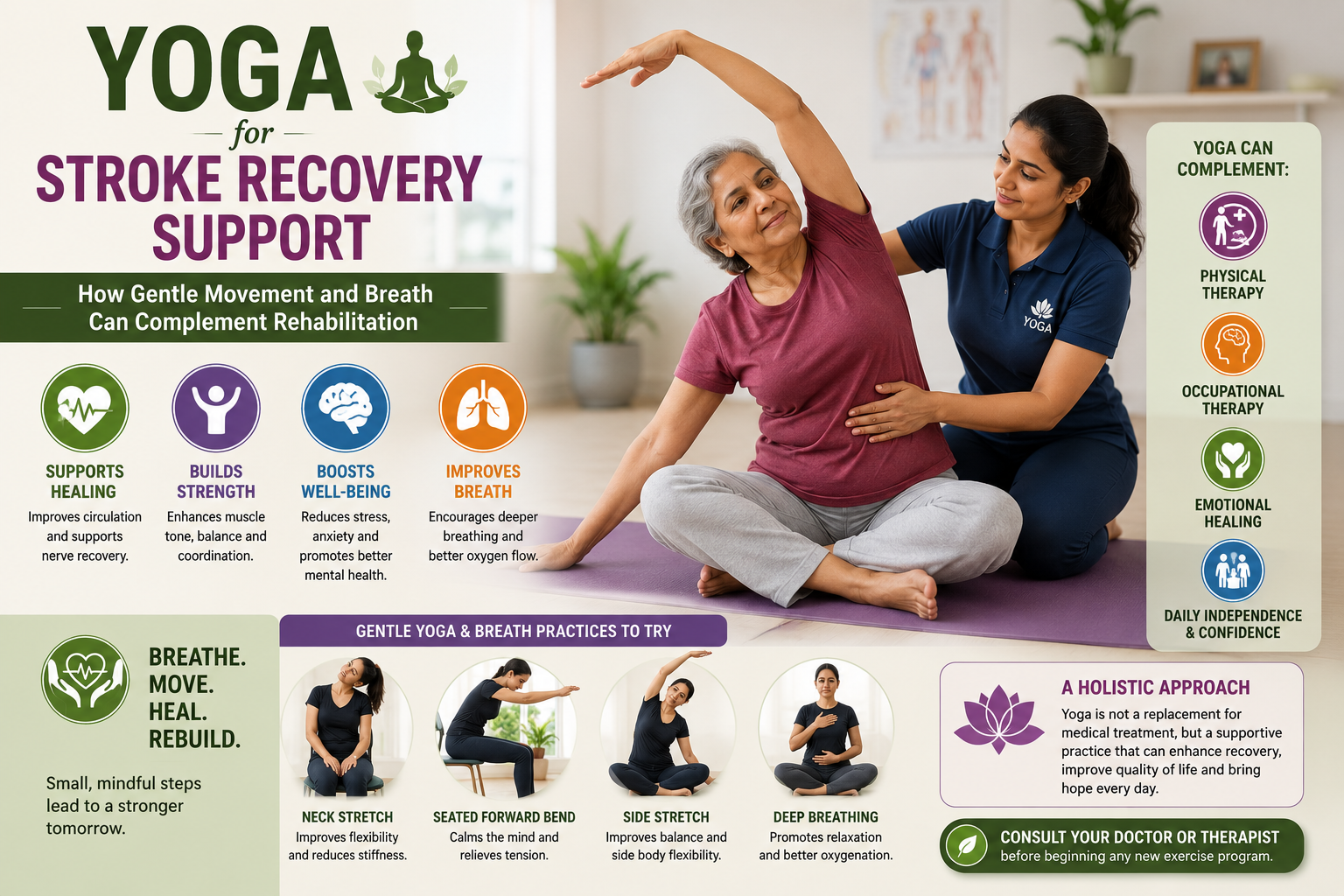
Recovering from a stroke is rarely a straight line. Physical rehabilitation, speech therapy, and medical management form the foundation of recovery, and progress often unfolds gradually across months or years rather than weeks. Within that longer arc, a growing number of rehabilitation programs have begun incorporating adapted yoga as a supportive practice, one that works alongside physiotherapy rather than replacing it, to help survivors rebuild strength, balance, and a sense of steadiness in both body and mind. This article is written with real caution given the seriousness of stroke as a medical condition, and it should be read as background education rather than a program to follow independently.
Below, we look at how adapted yoga is being used to support stroke recovery, what the research says about its role alongside standard rehabilitation, and the safety considerations that make medical clearance and professional supervision non-negotiable for this population. For those interested in the therapeutic and adaptive side of yoga more broadly, a Yoga TTC India program often includes training in gentle, accessible sequencing designed for people recovering from illness or injury.
Why Yoga Is Being Explored Alongside Stroke Rehabilitation
A stroke can affect movement, balance, coordination, speech, and emotional regulation depending on which part of the brain was affected and how severely. Standard rehabilitation, including physical therapy, occupational therapy, and speech-language therapy, focuses on rebuilding specific functions through repetitive, targeted exercises. Adapted yoga is increasingly used as a complementary layer within this process, offering slow, mindful movement that can support balance retraining, gentle strengthening, and body awareness in a low-impact format.
Beyond the physical component, stroke survivors frequently experience anxiety, depression, and a disrupted sense of connection to their own body, particularly when a stroke has caused lasting weakness or altered sensation on one side. Breathwork and mindfulness elements common to yoga are sometimes incorporated into rehabilitation settings specifically to address this emotional dimension, which is now recognized as a meaningful factor in overall recovery and quality of life.
What the Research Says About Yoga and Stroke Recovery
A growing number of small clinical studies have examined adapted yoga, often chair-based or otherwise modified, as an addition to standard stroke rehabilitation, with some showing improvements in balance, mobility, and quality of life among stroke survivors who participated alongside conventional therapy. Several studies have also reported reductions in self-reported anxiety and depressive symptoms among participants in supervised, therapist-guided yoga programs.
It is important to state clearly that this research remains at an early stage compared with the extensive evidence base behind conventional stroke rehabilitation, and study sizes are often small. Adapted yoga should be understood as a potential complement explored under professional guidance, never as a replacement for physical therapy, occupational therapy, or the medical management of stroke risk factors such as blood pressure, cholesterol, and blood clotting.
What Adapted Yoga for Stroke Recovery Typically Involves
Programs designed for stroke survivors look very different from a general yoga class, and the modifications are not optional extras but essential safety features built around each person’s specific level of function.
Chair-Based and Supported Movement
Many stroke recovery programs use chair-based or wall-supported sequences rather than floor work, since balance and one-sided weakness make standing or transitional movements genuinely risky without support. These sessions typically focus on small, controlled range-of-motion movements for the arms, shoulders, and legs, gentle stretching, and simple seated postures that can be adapted to each person’s specific limitations.
Slow, Guided Breathwork
Simple, slow breathing exercises are often included to support relaxation and reduce the anxiety that frequently accompanies stroke recovery, though any breathing technique involving breath holding or forceful effort is generally avoided given the cardiovascular sensitivity involved in stroke recovery. The focus stays on gentle, natural breath rather than advanced pranayama techniques.
Restorative and Mind-Body Practice
Deep relaxation practices can offer meaningful support for the emotional toll of stroke recovery, which is often underestimated compared with the physical rehabilitation process. Guided practices similar to Yoga Nidra in Rishikesh illustrate the kind of deeply restful, low-exertion practice that some rehabilitation settings draw on, adapted for a seated or fully supported position rather than the traditional floor-based format.
Practices That Should Be Avoided During Stroke Recovery
Given the cardiovascular and neurological factors involved in stroke, several common yoga practices carry meaningful risk for this population and should not be attempted outside a carefully supervised clinical setting, if at all.
- Any inversion, including headstand, shoulder stand, or even simple forward folds with the head below the heart, due to sudden shifts in blood pressure and blood flow to the brain.
- Unsupported standing balance poses, given the fall risk associated with one-sided weakness, altered sensation, or impaired coordination.
- Breath retention or forceful breathing techniques, which can affect blood pressure and are considered inappropriate for anyone with a history of stroke or significant cardiovascular risk.
- Fast-paced or vigorous sequences of any kind, which do not align with the slow, controlled, closely supervised approach that stroke recovery requires.
- Any independent floor-to-standing transition without a therapist, caregiver, or stable support present.
These are not areas where general yoga guidance should be adapted casually. Every element of a stroke recovery yoga practice needs to be designed and supervised by a qualified professional, typically a physical therapist, occupational therapist, or a yoga therapist working directly within a medical rehabilitation team.
The Emotional Dimension of Stroke Recovery
The emotional impact of stroke is significant and sometimes overlooked in a recovery process that understandably prioritizes physical function first. Grief over lost abilities, frustration with slow progress, anxiety about future health, and depression are all common, and they can, in turn, slow physical recovery if left unaddressed.
Gentle, mindfulness-based approaches are sometimes incorporated into rehabilitation psychology for exactly this reason. Resources on Yoga for Emotional Balance explore how breath and mindful movement can support emotional regulation more broadly, and while stroke survivors need care tailored specifically to their neurological and physical status, the underlying principle, that calming the nervous system supports emotional steadiness, applies across many recovery contexts.
Addressing Stroke Risk Factors Alongside Recovery
For many stroke survivors, recovery also means working to reduce the risk of a second event, which typically involves managing blood pressure, cholesterol, blood sugar, and other cardiovascular risk factors under medical supervision. Once a treating physician has confirmed it is safe to do so, some of the same gentle, breath-centered practices used in emotional and physical recovery may also support these broader risk factors over time, though any such practice must be approved and monitored by the medical team managing the person’s stroke recovery specifically, not adopted from general wellness content.
Building a Supervised Recovery-Focused Routine
There is no generic daily routine that applies safely to stroke recovery, since the right approach depends entirely on the type and severity of the stroke, the specific functions affected, and clearance from the treating medical team. In general, however, well-supervised programs tend to share a few structural principles:
- Sessions led directly by a physical therapist, occupational therapist, or a yoga therapist trained in neurological rehabilitation, not a general studio class.
- Short, low-intensity sessions rather than long or demanding ones, especially in the earlier stages of recovery.
- A stable base, whether a chair, wall, or bed, used consistently rather than progressing to unsupported positions prematurely.
- Clear communication with the rehabilitation team about how each session affects mobility, fatigue, mood, and any new symptoms.
Progress in this context is measured in small, steady gains rather than rapid change, and the same paced, patient approach to consistency that appears throughout structured yoga training environments applies here in a much more carefully supervised form.
Working Within a Multidisciplinary Care Team
Stroke recovery is rarely managed by a single provider, and any exploration of adapted yoga works best when it is coordinated with the full care team rather than pursued as a separate, independent activity. Neurologists oversee medical stability and risk factor management, physical and occupational therapists guide functional rehabilitation, and speech-language pathologists address communication and swallowing where needed.
When a yoga therapist or specially trained instructor is involved, the most effective programs treat that person as one additional member of this team, with direct communication about the survivor’s current abilities, precautions, and goals, rather than operating in isolation from the broader medical picture. This coordinated approach is part of why hospital-affiliated or rehabilitation-center-based programs are generally considered safer starting points than independent studio classes for this population.
Safety Guidelines for Stroke Survivors Considering Yoga
Yoga should never be introduced into a stroke recovery plan without explicit approval from the treating neurologist or rehabilitation team, and any practice that is approved should be delivered or directly supervised by a qualified professional familiar with the person’s specific medical history and current level of function.
New weakness, sudden changes in speech or vision, severe headache, dizziness, chest pain, or any symptom resembling the original stroke should be treated as a medical emergency requiring immediate attention, not something to monitor through continued practice.
Frequently Asked Questions (FAQs)
1. Can yoga help with stroke recovery?
Some research suggests that adapted, supervised yoga may support balance, mobility, and emotional wellbeing when used alongside standard rehabilitation, though the evidence base is still developing and any practice must be approved by the treating medical team.
2. Is regular yoga safe for stroke survivors?
General yoga classes are generally not appropriate for stroke survivors, particularly in the earlier stages of recovery, due to balance risk, blood pressure sensitivity, and the need for individualized modification. Any yoga practice should be specifically adapted and supervised by a qualified rehabilitation professional.
3. How soon after a stroke can someone begin adapted yoga?
This varies significantly based on the severity of the stroke, ongoing medical stability, and clearance from the treating physician, and there is no general timeline that applies safely to everyone. This decision should be made entirely by the person’s medical and rehabilitation team.
4. Can breathing exercises help with stroke-related anxiety?
Gentle, guided breathing may support relaxation and anxiety reduction for some stroke survivors, but any technique involving breath holding or forceful effort should be avoided unless specifically approved by a physician, given the cardiovascular considerations involved in stroke recovery.
5. Note for Readers
This article is intended for general informational purposes only and does not constitute medical advice. Stroke is a serious medical condition, and any exercise, movement, or breathing practice introduced during recovery should be approved and supervised by a qualified physician, neurologist, or rehabilitation therapist familiar with the individual’s specific medical history.
Final Thoughts: Steady, Supervised Progress Over Time
Stroke recovery asks a great deal of patience from survivors and their families, and the physical, emotional, and cognitive dimensions of that recovery are deeply intertwined. Adapted, professionally supervised yoga is one tool among many that some rehabilitation programs are exploring to support this whole-person recovery, always as a careful complement to medical care rather than a substitute for it. For readers supporting a loved one through this process, or exploring the therapeutic side of yoga more broadly once cleared by a medical team, learning about the structure of a guided Yoga Retreat in Rishikesh can offer a sense of how breath, gentle movement, and rest are woven together in a fully supported setting, the same underlying principles that inform adapted, medically supervised recovery work.
