 Skip to content
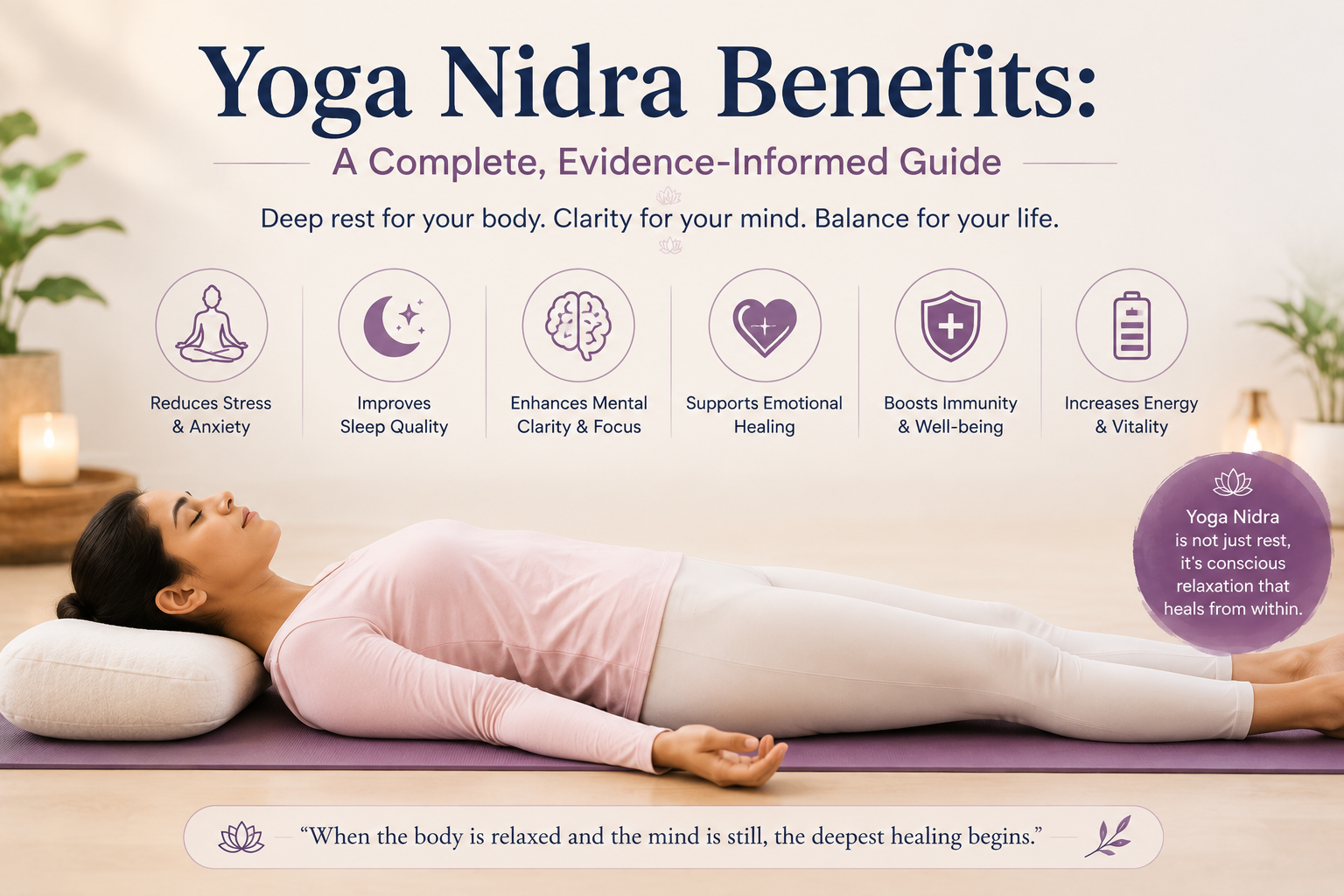
An informational guide to yoga nidra’s real, evidence-aligned benefits — covering what actually happens in the body and brain during this guided practice, where the research genuinely supports its use for relaxation and rest, and where popular claims about “deep healing” and instant transformation outpace what the evidence supports.
Yoga nidra, often translated as “yogic sleep,” is frequently marketed with sweeping promises: that a single session can heal trauma, guarantee deep sleep, or reset the nervous system in twenty minutes. The more accurate picture is more modest. Yoga nidra is a structured, guided relaxation practice that reliably supports a shift toward rest and lowered physiological arousal, but it is not a substitute for sleep itself, nor a quick fix for deeper psychological or medical conditions. What it genuinely offers is a well-supported tool for down-regulating stress and building a repeatable habit of rest, a real role that falls short of the more dramatic claims attached to it online.
This guide walks through what yoga nidra actually is, what happens in the body and mind during a session, and where popular claims go further than the evidence allows. Yoga nidra is not a substitute for medical or psychological care, and anyone managing a diagnosed condition, including a sleep disorder or a trauma-related condition, should treat it as a complement to, not a replacement for, appropriate professional guidance.
1. What Yoga Nidra Actually Is
Yoga nidra is a guided relaxation practice performed lying down in a supported, comfortable position, in which a teacher’s voice leads the practitioner through a structured sequence: settling the body, rotating attention through different parts of it, noticing breath, and working with visualisation or a personal intention. Unlike seated meditation, it asks for no active concentration effort and very little movement, which is why it is often described as accessible to people who find stillness or seated practice difficult. The name is somewhat misleading, since the aim is not to fall asleep but to rest in a state of relaxed, receptive awareness between waking and sleep.
2. Why Some Claims About Yoga Nidra Go Too Far
It is easy to find wellness content suggesting that a single yoga nidra session can dissolve deep trauma, cure chronic insomnia outright, or produce the restorative equivalent of several hours of sleep. These claims are not well supported. Yoga nidra can meaningfully lower perceived stress, but complex conditions such as clinical insomnia, post-traumatic stress, or chronic anxiety are shaped by many factors and generally require dedicated treatment beyond a relaxation practice alone. The fair summary is that yoga nidra offers real, modest, cumulative benefits rather than a single dramatic reset.
3. What the Research Actually Shows
Research on yoga nidra and closely related guided-relaxation protocols, sometimes studied under the label “non-sleep deep rest,” shows reasonably consistent short-term reductions in self-reported stress and anxiety, alongside measurable shifts toward a more parasympathetic, rest-oriented state during and after a session. Evidence on longer-term outcomes, such as sustained improvement in chronic insomnia, is more limited and often comes from smaller studies, so it is fair to describe yoga nidra as a well-supported short-term relaxation tool with promising but still-developing evidence for longer-term use. Much of what circulates online as proof of dramatic healing effects is anecdotal rather than drawn from controlled research.
4. What Happens in the Body and Brain During Practice
During a typical session, heart rate and breathing rate tend to slow and muscle tension eases as attention shifts inward. Practitioners often describe passing through a hypnagogic state, the drowsy, image-rich threshold between waking and sleep, without fully losing awareness of the guiding voice. This state is thought to allow a kind of rest distinct from ordinary waking relaxation, since the mind stays lightly aware even as the body settles toward something closer to early sleep.
5. The Traditional Framework: Koshas and Pratyahara
Classical yoga nidra draws on the concept of the koshas, layered dimensions of the person ranging from the physical body to breath, mind, and deeper awareness, and the practice is traditionally understood as a form of pratyahara, or withdrawal of the senses. Modern secular versions keep the structure, body awareness, breath, visualisation, while setting aside the wider philosophical framework, though understanding the traditional context can deepen the practice for anyone exploring it as part of broader yogic study.
6. How a Typical Session Is Structured
Most sessions follow a recognisable arc: settling into a comfortable resting position, setting a brief personal intention, a rotation of awareness through the body, attention to the natural breath, a period of visualisation, and a gradual return to full waking awareness. Sessions commonly run twenty to forty-five minutes, though shorter guided versions of ten to fifteen minutes are widely used and can still offer meaningful benefit.
7. Documented Benefits: Stress, Sleep, and Beyond
The most consistently documented benefit is a reduction in perceived stress and anxiety around a session, along with improved subjective ease of relaxing and, for many practitioners, an easier transition into sleep afterward. Some research also points to modest improvements in mood and self-reported fatigue with regular practice over several weeks. Benefits related to blood pressure or broader physical health markers appear in some smaller studies but are less consistently replicated, so these are best treated as areas of ongoing research rather than settled outcomes.
8. Who Yoga Nidra May Help Most
Yoga nidra tends to suit people who find seated meditation physically uncomfortable or mentally frustrating, since it requires little active effort and can be practised lying down. It is commonly used by people managing everyday stress, occasional sleep difficulty, or general nervous-system overstimulation. It is also frequently included in Yoga Teacher Training in Rishikesh programmes as a foundational relaxation tool, since teachers who understand it well are better equipped to guide it safely for a wide range of students.
9. How Long and How Often to Practise
There is no fixed schedule that suits everyone, but much of the available research uses sessions in the ten- to forty-five-minute range, practised from a few times a week to daily. Consistency appears to matter more than length; a shorter practice done regularly tends to be more beneficial over time than an occasional long session. Many find an evening session, close to bedtime but not necessarily in bed itself, a natural fit, though yoga nidra can also serve as a mid-afternoon reset.
10. Common Mistakes People Make with Yoga Nidra
A few patterns tend to undermine an otherwise beneficial practice: expecting a single session to resolve deep or long-standing psychological difficulty, judging a session as a failure if sleep is reached rather than the intended state of relaxed awareness, and skipping the settling or intention-setting stage. Practising in a position that is not genuinely comfortable, or in an environment with frequent interruptions, also tends to blunt the benefit, since depth of relaxation depends heavily on feeling physically settled.
11. Adapting Yoga Nidra to Real Life
A yoga nidra practice that genuinely supports wellbeing looks adaptable, fitting available time and energy rather than following a rigid, idealised format.
- Start with a shorter guided session of ten to fifteen minutes rather than an ambitious full-length practice that is easy to abandon.
- Choose a resting position that feels genuinely comfortable, using props such as a pillow under the knees if lying flat is uncomfortable.
- Set a brief, realistic personal intention rather than an elaborate one, since the intention is meant to be simple and repeatable.
- Treat falling asleep during a session as a natural response rather than a failure, and simply continue the habit the next time.
- Consider a guided Yoga Retreat in Rishikesh for a more immersive introduction if self-guided practice at home feels difficult to sustain.
12. Red Flags in Yoga Nidra Claims
A few common red flags tend to signal claims about yoga nidra that outpace the evidence.
- Promises that a single session can heal deep trauma or replace psychological treatment entirely.
- Claims that one twenty-minute session is physiologically equivalent to several hours of sleep, stated as settled fact.
- Suggestions that yoga nidra can diagnose or cure a specific medical condition without any supporting mechanism.
- Vague language about “quantum healing” or “instant nervous system resets” offered without explanation or evidence.
13. Learning Yoga Nidra Properly
Because guiding a genuinely restful yoga nidra session well, rather than simply reading a script aloud, involves understanding pacing, voice, body awareness, and how to hold a safe space for people who may become emotional or fall asleep, learning from a properly trained teacher makes a meaningful difference. A structured Yoga Teacher Training in Rishikesh programme typically includes dedicated training in guiding restorative practices such as yoga nidra alongside broader relaxation and breath-based methods, offering a grounded foundation for anyone who wants to teach or deepen the practice beyond a self-taught, app-based version.
For people specifically drawn to the practice as a way to support emotional wellbeing and manage everyday stress, a dedicated look at Yoga for Mental Health in Rishikesh India can offer a useful, evidence-aligned starting point for understanding how a practice such as yoga nidra fits alongside, rather than replaces, appropriate mental health support.
A structured, deeply guided version of the practice, such as the Yoga Nidra in Rishikesh approach, illustrates how the technique is traditionally taught in depth, guiding students through the full body-scan, breath, and visualisation sequence under experienced supervision rather than through a shortened online recording.
Safety Notes and When to See a Doctor
Yoga nidra can genuinely support relaxation and an easier transition toward rest, but it should never replace appropriate medical or psychological diagnosis and treatment for a specific condition.
- Anyone managing a diagnosed trauma-related condition should approach yoga nidra alongside, not instead of, appropriate professional mental health support.
- Persistent difficulty falling or staying asleep that does not improve with a consistent relaxation practice should be evaluated by a doctor.
- Unusual distress, dissociation, or overwhelming emotion during or after a session is a signal to pause and speak with a qualified professional.
- Anyone with a diagnosed cardiovascular or respiratory condition should confirm which breath-based elements of the practice are appropriate for them.
Frequently Asked Questions (FAQs)
Q1. How long should a yoga nidra session be?
There is no fixed minimum that suits everyone. Sessions of ten to twenty minutes practised consistently tend to offer meaningful short-term benefits for relaxation and stress, and a shorter, realistic session is generally more sustainable than an ambitious longer one that often gets skipped.
Q2. Is it a problem if I fall asleep during yoga nidra?
Falling asleep occasionally is a normal response, particularly if the body is genuinely fatigued, and it does not mean the practice failed. Over time, many practitioners find they can rest in the aware, drowsy state between waking and sleep without fully losing awareness of the guidance.
Q3. Does yoga nidra really replace a full night’s sleep?
Not on its own. Yoga nidra can offer a genuinely restful state and may ease sleep debt in the short term, but it is not a physiological substitute for the distinct stages and functions of overnight sleep, and claims equating a short session to hours of sleep outpace the current evidence.
Q4. Can yoga nidra help with anxiety?
Yoga nidra shows reasonably consistent short-term benefit for perceived anxiety and stress, and many people find it a useful part of an everyday self-care routine. For a diagnosed anxiety disorder, it is best used alongside, rather than instead of, appropriate professional treatment.
Q5. What is the best time of day to practise yoga nidra?
There is no single correct time; an evening session close to, but not necessarily in, bed suits many people aiming to ease into sleep, while a midday session can serve as a brief reset during a demanding day. Consistency at a chosen time tends to matter more than the specific hour.
Q6. Do I need any experience with yoga to try yoga nidra?
No prior yoga experience is required, since the practice involves lying still and following spoken guidance rather than performing postures. This accessibility is part of why it is often recommended to complete beginners as an entry point into a broader relaxation or meditation practice.
Q7. What is the most evidence-based way to think about yoga nidra?
The most accurate framing is that yoga nidra offers genuine, well-supported short-term relaxation and stress relief, with promising but still-developing evidence for longer-term benefits, rather than a guaranteed cure for sleep problems or deep psychological difficulty on its own.
Final Thoughts
Yoga nidra is not a shortcut to instant healing so much as a genuinely restful, well-supported practice for easing stress and supporting the transition toward rest. The most honest, evidence-aligned view of its role is a modest one: a structured way to down-regulate an overactive nervous system, build a repeatable habit of rest, and offer a few minutes of guided calm in an otherwise demanding day. This is a more realistic picture than some wellness marketing suggests, but it is also a far more sustainable one.
Approached consistently, adapted to real time and energy, and paired with appropriate medical or psychological guidance when needed, yoga nidra can offer many people a genuinely useful, low-risk way to rest more deeply within an ordinary day.
