 Skip to content
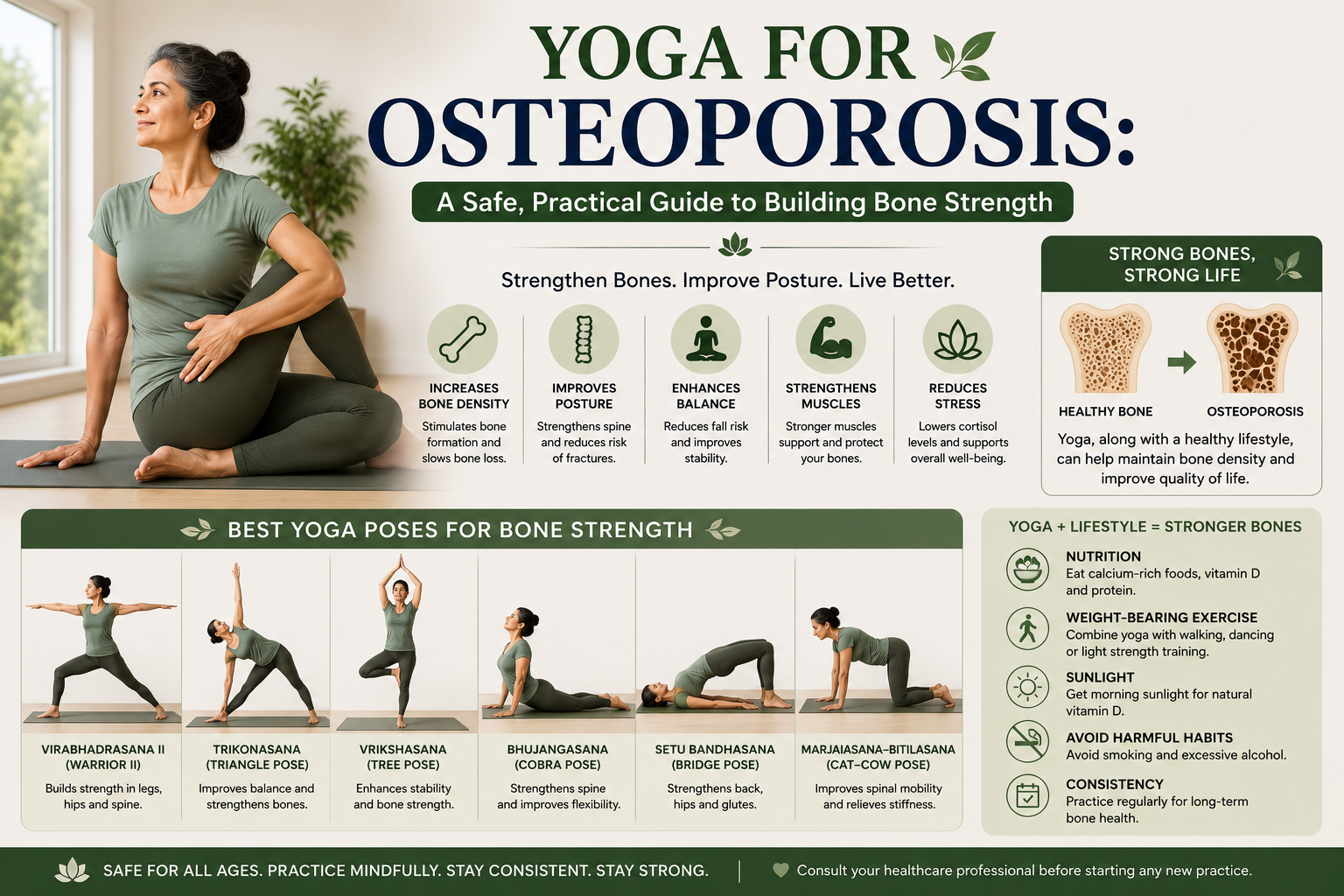
This guide offers a general overview of how yoga can support bone health for people living with, or at risk of, osteoporosis. It is not medical advice. Anyone with diagnosed osteoporosis, osteopenia, or a history of fractures should consult their doctor or a qualified yoga therapist before beginning any new movement practice.
Osteoporosis is often described as a silent condition, one that quietly weakens bone density over years before a fracture or a routine scan reveals how much strength has been lost. For the millions of people navigating this diagnosis, especially women in the years around and after menopause, the natural instinct is sometimes to move less out of fear of injury. Yet a growing body of research suggests the opposite approach tends to serve bone health far better: safe, weight-bearing, alignment-focused movement, practiced consistently and with the right guidance.
Yoga, when adapted thoughtfully, is one of the more accessible ways to build that kind of movement into daily life. It combines gentle resistance, balance training, postural awareness, and stress reduction in a single practice, all of which play a meaningful role in maintaining bone density and preventing falls. This guide walks through how yoga supports bone health, which poses to approach with caution, and how to build a routine that is both safe and genuinely effective.
1. Understanding Osteoporosis and Why Movement Matters
Osteoporosis develops when bone tissue breaks down faster than the body can rebuild it, leaving bones more porous and prone to fracture. It is especially common after menopause, when declining estrogen levels accelerate bone loss, which is why practices designed for Yoga for Menopause so often overlap with those recommended for bone health.
Bone is living tissue that responds to load. Weight-bearing activity signals bone cells to rebuild and strengthen, while prolonged inactivity has the opposite effect, accelerating loss. This is why complete rest is rarely the right response to an osteoporosis diagnosis. The goal instead is to find movement that loads the bones safely, improves balance to reduce fall risk, and supports posture, since spinal fractures related to osteoporosis are frequently linked to compressed or rounded posture over time.
2. How Yoga Supports Bone Health
Yoga contributes to bone health through several distinct mechanisms rather than a single effect. Weight-bearing poses, where the body supports its own weight through the arms, legs, or spine, place gentle mechanical stress on bone that can help maintain density. Balance-focused poses train the stabilizing muscles and reflexes that prevent falls, which matter enormously for anyone with fragile bones, since a fall is often the event that leads to a fracture rather than the bone loss itself. Because so much of this benefit is tied to overall wellbeing, many of the same practices also feature prominently in guidance around Yoga for Women’s Health, where bone density is one of several interconnected concerns.
Yoga also supports the hormonal and metabolic environment in which bone remodeling happens. Practices that reduce cortisol and support steadier hormonal rhythms, an area covered in more depth in resources on Yoga for Hormonal Balance, can indirectly support the body’s ability to maintain bone density, since chronic stress and elevated cortisol are both associated with accelerated bone loss.
Finally, posture-focused practice strengthens the muscles that support the spine, shoulders, and hips, which helps counteract the forward-leaning, compressed posture that often develops with age and low bone density. Better posture reduces strain on vulnerable vertebrae and can meaningfully lower the risk of compression fractures over time.
3. Is Yoga Safe for Osteoporosis? What the Research Suggests
This is the question most people ask first, and rightly so. The honest answer is that yoga can be very safe and beneficial for people with osteoporosis, but only when it is adapted to avoid movements that place excessive flexion or twisting stress on the spine. Research into yoga and bone density, including studies following practitioners over multiple years, has generally found improvements or stabilization in bone density among consistent practitioners using a carefully selected sequence of poses, along with improved balance and reduced fall risk.
The caveat that matters most is technique. Poses performed with poor alignment, excessive force, or without regard to individual limitations can increase fracture risk rather than reduce it. This is precisely why guidance from a teacher trained in adapting yoga for bone health, rather than a generic class, makes such a meaningful difference for this population.
4. Yoga Poses to Approach With Caution or Avoid
For anyone with diagnosed osteoporosis or significant bone density loss, certain categories of movement carry a higher risk of vertebral compression fractures and should generally be avoided or heavily modified, ideally under the guidance of a qualified instructor:
- Deep forward folds that round the spine, such as a full seated forward bend, which place compressive flexion stress on the vertebrae.
- Aggressive spinal twists, particularly deep seated twists that combine rotation with flexion.
- Full wheel pose or other deep backbends that place significant load on the spine without adequate preparation and strength.
- Fast, uncontrolled transitions between poses, especially in a heated or fast-paced class setting, where balance can be compromised.
- Any inversion or pose that carries a meaningful fall risk without proper support, props, or supervision.
None of this means these movement patterns are permanently off-limits. It means they need to be approached gradually, with modification, and ideally under supervision, rather than avoided through fear or attempted without guidance.
5. Safe and Effective Yoga Poses for Osteoporosis
A well-designed practice for bone health emphasizes weight-bearing standing poses, gentle extension rather than flexion of the spine, and balance work, often performed with the support of props. This alignment-first approach is central to Iyengar Yoga in Rishikesh, a style built around precise positioning and the use of blocks, straps, and walls, which makes it particularly well suited to practitioners managing low bone density.
- Mountain Pose (Tadasana), practiced with attention to weight distribution through the feet, to build postural awareness and gentle leg strength.
- Warrior II and Extended Side Angle, which load the legs and hips through the body’s own weight while building strength around the hip joint.
- Tree Pose, practiced near a wall for support, to develop the balance reflexes that reduce fall risk.
- Gentle backward extension poses such as Locust or supported Cobra, which strengthen the muscles along the spine without the compressive risk of deep forward folding.
- Bridge Pose, performed with control, to strengthen the glutes, hamstrings, and lower back.
- Seated or standing gentle twists that rotate from the upper back rather than the lower spine, kept well within a comfortable range.
6. Building a Weekly Yoga Routine for Bone Health
Consistency tends to matter more than intensity for bone health, since bone remodeling happens gradually. A sustainable weekly structure, built around three to five sessions, generally works better than occasional long or intense sessions:
| Session Focus | Best Suited For | Key Elements to Include |
| Weight-Bearing Standing Poses | Building and maintaining bone density in the hips and legs | Mountain, Warrior II, Extended Side Angle, held with steady breath |
| Balance and Fall Prevention | Reducing fracture risk from falls | Tree Pose, single-leg standing work, near a wall or chair for support |
| Gentle Strength and Extension | Supporting the spine and correcting posture | Locust, supported Cobra, Bridge, performed with control |
| Restorative and Breath-Focused Practice | Lowering cortisol and supporting recovery | Slow breathing, supported restorative poses, brief relaxation |
7. The Role of Breath, Alignment, and Props
Breath and alignment are not secondary details in a bone-health-focused practice; they are central to its safety. Slow, steady breathing keeps movements controlled rather than rushed, which matters enormously when the goal is to avoid sudden, forceful loading of a vertebra or joint. Many practitioners find that restorative, breath-led sessions, such as those built around Yoga Nidra in Rishikesh, pair well with a more active bone-strengthening routine, offering a way to lower stress hormones while the body recovers between sessions.
Props deserve particular mention. A block under the hand in a standing pose, a strap to extend reach without rounding the spine, or a wall for balance support are not signs of a modified or lesser practice, they are the tools that make a pose genuinely safe for someone with fragile bones. Anyone practicing at home should prioritize a few sturdy props over attempting a pose in its full, unsupported expression.
8. Combining Yoga With Diet, Sunlight, and Lifestyle
Yoga works best as part of a broader approach to bone health rather than as a standalone solution. Adequate calcium and vitamin D intake, regular sunlight exposure, and avoiding smoking and excessive alcohol all remain foundational. Because chronic stress accelerates bone loss through sustained cortisol elevation, the stress-reduction benefits highlighted in guidance on Yoga for Stress Management are directly relevant here, not simply a pleasant side effect.
Complementary bodywork can also play a supporting role. Many practitioners managing osteoporosis pair their yoga practice with gentle, therapeutic touch, and some go on to study approaches like an Ayurvedic Massage Course in Rishikesh to better understand how circulation, muscle tension, and joint mobility interact with long-term bone and joint health.
9. Common Mistakes to Avoid, and Practicing Safely Long-Term
- Attempting a generic, fast-paced class without disclosing an osteoporosis diagnosis to the instructor beforehand.
- Pushing into deep forward folds or twists to match a class’s pace rather than modifying to a safe range.
- Skipping props out of habit or self-consciousness, when a block or wall would make a pose meaningfully safer.
- Treating yoga as a replacement for medical monitoring, rather than a complementary practice alongside regular bone density scans and medical guidance.
- Learning primarily from unverified online sources rather than a qualified teacher; those planning to teach or deepen their own practice seriously often choose structured, in-person training such as a 200 Hour Yoga Teacher Training in Rishikesh, where alignment principles are taught in depth rather than picked up informally.
Once a safe routine is established, most of these risks are manageable with a bit of ongoing attention: periodic check-ins with a doctor or physiotherapist, honest communication with any instructor about limitations, and a willingness to modify a pose rather than push through discomfort.
Frequently Asked Questions (FAQs)
Q1. Can yoga actually reverse osteoporosis?
Yoga is unlikely to reverse significant bone loss on its own, but consistent, well-adapted practice has been associated with maintained or improved bone density in several studies, alongside meaningful improvements in balance and fall prevention, which matter just as much for fracture risk.
Q2. Is it safe to start yoga after an osteoporosis diagnosis if I have never practiced before?
Yes, in most cases, provided the practice is introduced gradually and under qualified guidance. Starting with gentle, weight-bearing and balance-focused poses, rather than a general or advanced class, is the safer path for beginners with low bone density.
Q3. Which yoga poses are considered highest risk for someone with osteoporosis?
Deep forward folds, aggressive twists, and unsupported backbends carry the greatest risk of vertebral compression fractures and are generally avoided or heavily modified for this population.
Q4. How many times a week should I practice yoga for bone health?
Most guidance suggests three to five shorter sessions a week tends to work better for bone health than occasional long sessions, since bone remodeling responds to consistent, moderate loading over time.
Q5. Do I need special props to practice yoga safely with osteoporosis?
Props such as blocks, straps, and a wall for balance support are strongly recommended. They allow poses to be performed with correct alignment and reduced risk, rather than forcing a full expression of a pose that may not be appropriate.
Q6. Should I tell my yoga instructor about my osteoporosis diagnosis?
Yes, always. A qualified instructor needs this information to modify poses appropriately and to guide you away from movements that carry unnecessary risk.
Q7. Can yoga help with the anxiety that sometimes comes with an osteoporosis diagnosis?
Many practitioners find that the breath-focused and restorative elements of yoga help manage the anxiety that can accompany a new diagnosis, alongside the physical benefits, though this should complement rather than replace professional support if anxiety becomes significant.
Q8. Where can I learn to practice or teach yoga specifically adapted for bone health?
Final Thoughts
Living with osteoporosis does not mean choosing between staying active and staying safe. With the right adaptations, thoughtful pacing, and guidance from a qualified teacher, yoga can offer a genuinely supportive path toward stronger bones, better balance, and greater confidence in daily movement. For those wanting to go deeper into a bone-conscious practice in a setting built around exactly this kind of careful, alignment-focused teaching, a Yoga Retreat in Rishikesh offers the time, environment, and expert guidance that a home practice alone often cannot.
Every individual’s bone health, medical history, and physical capacity are different, so this guidance should always be paired with advice from a doctor, physiotherapist, or qualified yoga therapist before beginning or modifying any yoga practice for osteoporosis.
