
By the Rishikesh Yog Darshan editorial team | Written from first-hand teaching experience in Rishikesh, India
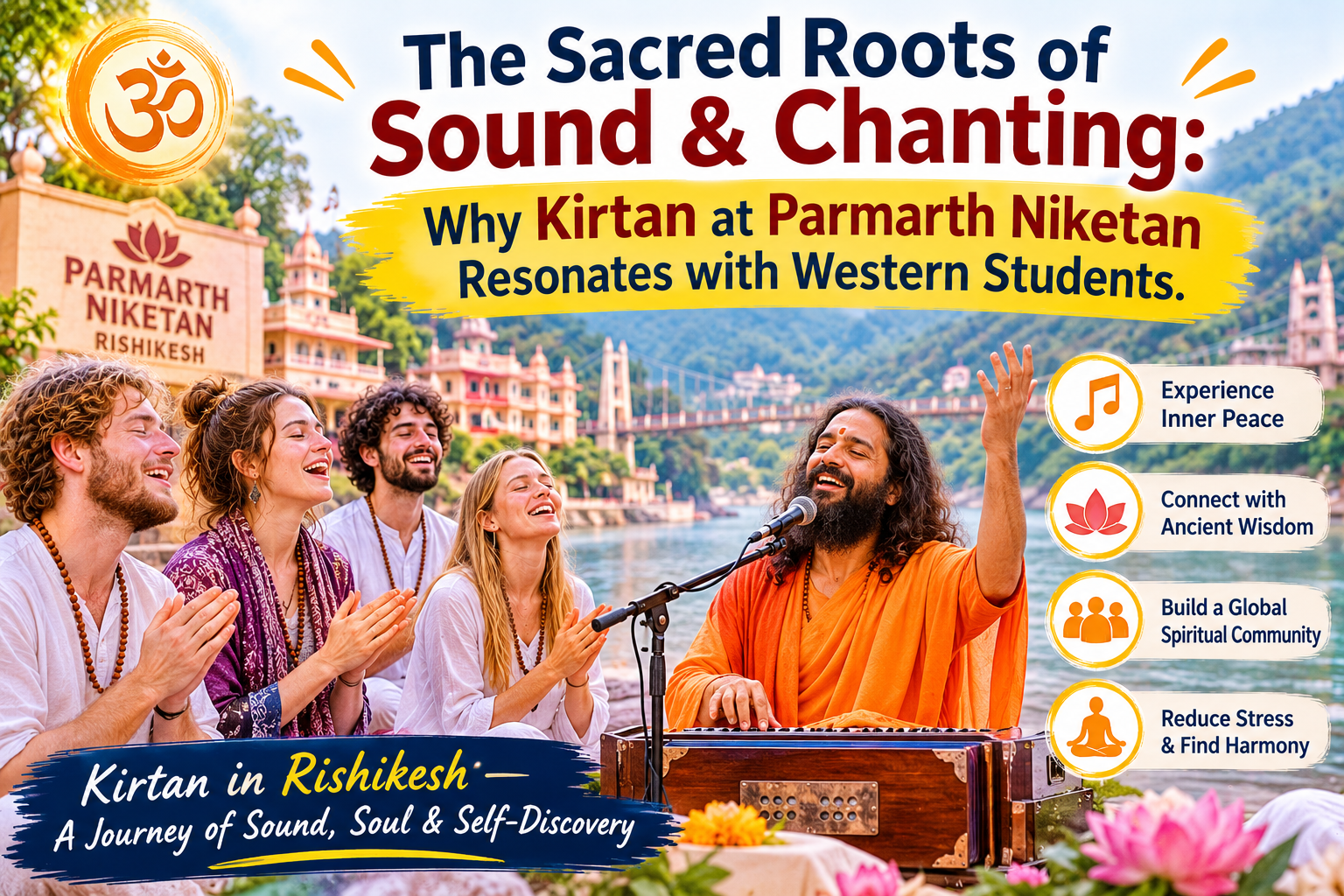
As the sun sets over the Ganges in Rishikesh, a harmonium begins to breathe, hand drums join in, and a few hundred voices rise together. For many Western visitors, that first evening kirtan at Parmarth Niketan is the moment yoga stops being a workout and becomes something felt in the chest. No one asks you to be flexible, fluent in Sanskrit or even “good at singing.” You simply listen, repeat and let the sound do its work.
This guide explains where chanting comes from, what makes kirtan different from other forms of sound practice, why the experience at Parmarth Niketan connects so strongly with students from the West, and how to bring that practice into a yoga teacher training or a daily routine. It is written for readers who want accurate, practical information rather than a romanticised picture.
The Sacred Roots of Sound in Yoga
In the Indian tradition, sound is not treated as background. The concept of nada (primordial sound) sits at the heart of classical yoga, and the syllable Om is described in texts such as the Mandukya Upanishad as the sound that contains all others. The Yoga Sutras of Patanjali link Om with devotion and recommend its repetition as a path to steadiness of mind. Later Hatha yoga texts describe nada anusandhana, the practice of listening to inner sound, as an advanced meditation.
Three related terms are often confused, so it helps to separate them:
- Mantra: a sacred word or phrase repeated silently or aloud, either for concentration or devotion.
- Japa: the repetition of a mantra, often counted on a mala of 108 beads.
- Kirtan: group devotional singing in call-and-response form, usually accompanied by harmonium, drums and cymbals.
Kirtan belongs to the bhakti (devotional) stream of yoga, which developed across India through poets and saints who set the names of the divine to music so that ordinary people, not only scholars, could take part. This is the same tradition that sits beside Jnana (knowledge) and Karma (action) in the classical map of the yogic paths. If you want to see how these paths complement each other, our introduction to Jnana & Karma Yoga in Rishikesh is a useful companion read.
What Is Kirtan, and How Does It Work?
A kirtan leader sings a short line, often a name or a verse in Sanskrit or Hindi, and the group sings it back. The melody is simple, repeated and gradually builds in tempo and volume. Because the phrases repeat, nobody needs to read lyrics or memorise anything. Participation is the point, not performance.
Three features make kirtan especially accessible:
- Call and response removes the pressure to perform, because you follow rather than lead.
- Repetition gives the thinking mind something to hold, which many people describe as a form of moving meditation.
- Shared voice creates a sense of belonging that solo practice rarely offers.
Outside India, kirtan became widely known through artists such as Krishna Das and teachers like Ram Dass, who shared the practice with Western audiences from the late 20th century onwards. Many of today’s kirtan communities in Europe, North America and Australia trace their roots to that exchange. Experiencing it where it is practised daily, however, is a different matter.
Why Parmarth Niketan Is Special
Parmarth Niketan is one of the largest and most visited ashrams in Rishikesh, located on the banks of the Ganges in the Swarg Ashram area. It was established in 1942 and is led today by Pujya Swami Chidanand Saraswati. The ashram is known for its evening Ganga Aarti, a fire ceremony with hymns and kirtan held at sunset on the riverbank, as well as for hosting the annual International Yoga Festival, which brings teachers and practitioners from many countries.
The setting matters. You sit on stone steps beside a fast-moving river with the foothills of the Himalayas behind you. Children, monks, pilgrims and travellers sit side by side. The singing is led warmly and without performance pressure, and visitors are invited to join. If you are curious about why this small Himalayan town has such a pull, our article on What Makes Rishikesh the Yoga Capital of the World? explains its history and traditions in detail.
A practical note: ceremony times shift with sunset, and schedules can change during festivals or the monsoon. Check the current timings locally before you plan your evening, and dress modestly, with shoulders and knees covered.
Why Kirtan Resonates with Western Students
We have welcomed students from many countries, and the reasons they give for connecting with kirtan are remarkably consistent.
It offers an alternative to performance culture
Many Western yoga classes emphasise posture, fitness and appearance. Kirtan asks for none of that. There is no “advanced” level, no mirror and no comparison. Students who arrive tired of self-judgement often find this a relief.
It engages the body and breath together
Singing lengthens the exhale and regulates breathing naturally. Many practitioners report feeling calmer after chanting, and early research on group singing and mantra repetition suggests possible benefits for mood and stress. The evidence is still developing and results vary, so it is best viewed as a supportive practice rather than a treatment. If you are interested in the broader connection between yogic practice and emotional wellbeing, you can read more about Yoga for Mental Health in Rishikesh India. Anyone living with a diagnosed condition should keep working with a qualified health professional.
It creates community without pressure
Many travellers are far from home and looking for connection. Singing together builds quick, wordless familiarity. You do not need to share a language, a religion or a background to sing the same line.
It connects yoga to its devotional heart
Students who begin with physical practice often discover that the tradition has an emotional and spiritual dimension they were never taught. Kirtan opens that door gently, and it fits naturally with reflections on the Values of Yoga in Life India, such as compassion, humility and service.
It does not require belief
Some Westerners hesitate because kirtan uses names of deities. A respectful approach is to treat the practice as you would any cultural or devotional tradition: participate sincerely at your own comfort level, or simply listen. No one will question your beliefs. Many teachers encourage students to see the sound itself, rather than any particular doctrine, as the entry point.
How Chanting Fits Into Yoga Teacher Training
Traditional teacher training treats sound as part of the curriculum, not an extra. A well-designed programme introduces mantra, Om chanting and sometimes kirtan alongside asana, pranayama, meditation and philosophy. When you search for a Yoga Teacher Training in Rishikesh, ask whether chanting is taught as a skill, including pronunciation, meaning and how to lead respectfully.
That matters if you plan to teach, because students often ask about Sanskrit and mantra, and an informed answer builds trust. Choosing the Best Yoga School in Rishikesh is partly about finding teachers who can explain the roots of these practices without exaggerating or diluting them.
If you are unsure how to begin, our Yoga Instructor Certification Guide in India and the step-by-step roadmap on How to Get Yoga Certified in Rishikesh India explain how courses are structured and what to check before enrolling. A recognised Yoga TTC India programme, registered with Yoga Alliance, is generally accepted by studios abroad.
Which course level suits you?
- 100 Hours YTTC Rishikesh India: a shorter introduction for beginners and those with limited time.
- 200 Hours YTTC Rishikesh India: the standard foundation for becoming a certified teacher.
- 300 Hours YTTC Rishikesh India: deeper study for those who already hold a 200-hour certificate.
- 500 Hours YTTC Rishikesh India: the advanced, combined pathway for committed teachers.
You can also see the full range of programmes at Yoga Teacher Training in Rishikesh India.
Sound Alongside Other Yoga Styles
Chanting does not replace physical practice; it complements it. Many schools open or close sessions with Om or a short mantra, whatever the style being taught.
- In dynamic classes such as Vinyasa Yoga in Rishikesh India, chanting at the start helps students settle and link breath to movement.
- In Ashtanga Yoga in Rishikesh India, a traditional invocation is chanted before practice, which many students find grounding.
- Iyengar Yoga in Rishikesh India emphasises precision and often includes reflective, quiet pauses where sound and silence meet.
- Kundalini Yoga in Rishikesh India uses mantra, breath and rhythm extensively, making it a natural next step if you love chanting.
- After an evening of kirtan, the stillness of Yoga Nidra in Rishikesh offers a gentle way to rest and integrate the experience.
- Experienced students who want to refine breath, meditation and subtle practices can explore Advanced Yoga Practices in Rishikesh India.
- Those interested in complementary traditional wellbeing therapies may also look at an Ayurvedic Massage Course in Rishikesh India.
If you prefer a shorter immersion before committing to a full course, a Yoga Retreat in Rishikesh lets you experience daily practice, including chanting, in a lower-commitment format.
How to Experience Kirtan Respectfully
Good etiquette helps you enjoy the practice and honours the community that keeps it alive.
- Arrive early so you can find a seat without disturbing others.
- Dress modestly, and remove your shoes where indicated.
- Listen first. Follow the leader’s pronunciation before joining in.
- Join at your comfort level. It is fine to listen, clap or hum.
- Avoid filming intrusively. Be mindful of people who are praying.
- Learn the meaning of what you chant when you can. Ask a teacher if you are unsure.
- Offer thanks. A small donation or a word of appreciation is welcome.
If you are planning a longer stay, it helps to know what daily life looks like. These articles cover Daily Routine During Yoga Teacher Training in Rishikesh, Food and Lifestyle During Yoga Teacher Training in Rishikesh, What to Pack for Yoga Teacher Training in Rishikesh and Things to Know Before Doing Yoga Teacher Training in India. For sightseeing beyond the ghats, see Spiritual Places to Visit in Rishikesh During Yoga TTC.
Bringing Kirtan Home
You do not need a harmonium to begin. Try this simple routine:
- Sit comfortably for five minutes and chant Om slowly three to nine times.
- Repeat a short mantra you have learned from a teacher, using a mala if you like.
- Play a recorded kirtan and sing along softly.
- Join a local kirtan group, which many cities now host.
- Return to a quiet minute of listening after you stop.
Consistency matters more than duration. A few minutes a day often does more than one long session a month.
Frequently Asked Questions
Do I need to be religious to join kirtan? No. Many participants come as curious visitors. You can listen, clap or sing at your own comfort level.
Is kirtan the same as meditation? Not exactly. Kirtan is devotional singing, but many people find the repetition and focus meditative.
Can I attend the evening aarti as a tourist? Yes. Visitors are generally welcome at Parmarth Niketan. Confirm timings locally and follow the ashram’s guidance on dress and behaviour.
Will chanting be part of my teacher training? It depends on the school. Ask for the syllabus and check whether mantra and chanting are included.
Can chanting replace medical or psychological care? No. It can support wellbeing, but it is not a substitute for professional treatment.
Final Thoughts
Kirtan resonates because it asks very little and offers a great deal: a simple melody, a shared voice and a few minutes when the thinking mind loosens its grip. At Parmarth Niketan, with the Ganges moving beside you and the Himalayas behind, that experience is especially vivid, which is why so many Western students remember it long after they return home.
If you are considering a longer immersion, start with an honest look at the syllabus, the teachers and the tradition behind the course. Sound may begin as a curiosity, but for many students it becomes the doorway to the deeper practice of yoga.
Disclaimer: Ceremony timings, course details and fees change. Please verify current information locally or with your chosen school. This article is for general information and is not medical advice.