 Skip to content
Note: This article offers a traditional and practical understanding of stretching and yoga as a supportive practice for joint health and mobility. It does not replace personalized advice from a qualified doctor, physiotherapist, or orthopedic specialist. Joint health needs vary widely by age, condition, and activity level, and results of any stretching practice depend on individual anatomy, consistency, and guidance received.
Joints rarely announce their decline all at once. It happens gradually, a knee that takes a moment longer to straighten after sitting, a hip that feels tighter climbing stairs than it used to, shoulders that no longer reach as far overhead as they once did without complaint. Stretching is one of the simplest, most accessible tools available for keeping joints functioning well, not because it changes the structure of the joint itself, but because it directly addresses the surrounding muscle tightness, restricted range of motion, and postural compensation that so often turn a normal, aging joint into a genuinely uncomfortable one.
Modern daily life does joints very few favors. Long hours seated at a desk, repetitive movement patterns, and general underuse of a joint’s full range all contribute to stiffness that compounds quietly over months and years. Stretching offers a structured way to counteract this pattern, not through forceful correction, but through patient, consistent movement that gradually restores mobility and eases the muscular guarding that builds up around joints that aren’t moved through their full range often enough.
This guide explores why joints stiffen in the first place, which stretching approaches genuinely support long-term joint health, and how to build a sustainable, safe routine around it. It is worth noting from the outset that stretching does not reverse arthritis or structural joint damage. What it can meaningfully influence is the surrounding muscular tension, circulation, and range of motion that often determine whether a joint feels functional and comfortable or stiff and limited.
1. Why Joints Stiffen Over Time
Joints rely on regular movement through their full range to stay lubricated and supple. Synovial fluid, which cushions and nourishes the cartilage inside a joint, circulates more effectively when a joint is moved regularly, and tends to stagnate when a joint is held in the same limited position for long stretches of time. Combine this with the natural muscle shortening that occurs from prolonged sitting or repetitive movement, and the result is a joint that feels progressively tighter even without any underlying disease process.
This connection between physical stagnation and how the body eventually compensates is explored further in our broader guide to Yoga for Mental Health in Rishikesh India, which looks at how chronic stress and physical stagnation are often deeply intertwined, each reinforcing the other.
2. How Stretching Actually Supports Joint Function
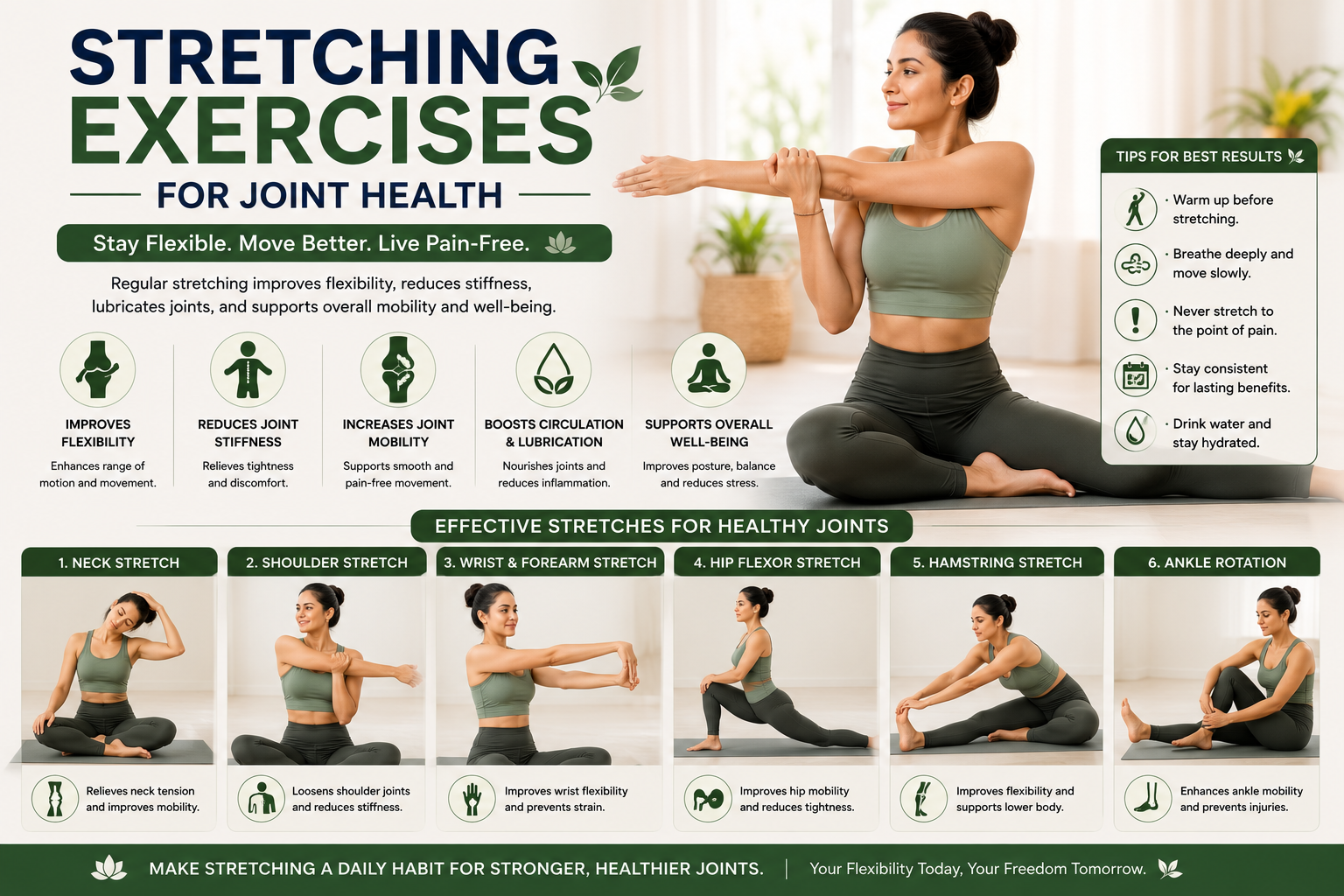
Stretching works on joint health through several overlapping mechanisms. It lengthens muscles and connective tissue that have shortened from disuse, which reduces the pulling tension placed on the joint itself. It also encourages blood flow and synovial fluid circulation around the joint, supporting the tissues that keep cartilage healthy. Perhaps most importantly, regular stretching maintains a joint’s available range of motion, since range that isn’t used regularly tends to be gradually lost.
Because muscles around a joint often compensate for one another, tightness in one area can quietly transfer strain elsewhere. Tight hip flexors, for example, can alter pelvic positioning in ways that place additional load on the lower back and knees. A well-rounded stretching routine considers this interconnected chain rather than isolating a single stiff joint.
3. Stretching and Yoga Practices That Support Joint Health
Gentle Flow-Based Movement: Linking slow, breath-paced movement through a joint’s available range helps maintain mobility gradually, without the jarring impact of more forceful or fast-paced stretching methods.
Static Holds With Patience: Gentle, sustained stretches held for twenty to sixty seconds allow muscle fibers to genuinely lengthen, rather than the shorter, bouncing stretches that can sometimes trigger a protective muscle contraction instead.
Supported Restorative Stretching: Using bolsters, blankets, or blocks to hold a gentle stretch passively, a principle central to Yoga Nidra in Rishikesh, allows chronically tight tissue around a joint to release without any active muscular effort working against it.
Joint Circling and Mobilization: Slow, controlled circular movements through a joint’s full available range, such as gentle ankle, wrist, or shoulder circles, help maintain lubrication and awareness of the joint’s true range before deeper stretching begins.
Strength Paired With Flexibility: Building strength in the muscles surrounding a joint alongside flexibility work helps that joint stay stable through its full range, rather than gaining mobility it cannot adequately support.
4. Static Stretching vs Ballistic Stretching vs Yoga-Based Mobility Work: Key Differences at a Glance
| Approach | What It Looks Like | Long-Term Effect |
| Static Stretching | Holding a gentle stretch steadily for a sustained period | Gradual, reliable increases in flexibility |
| Ballistic Stretching | Bouncing or forcing a joint quickly into its end range | Higher injury risk, potential joint irritation |
| Yoga-Based Mobility Work | Breath-paced movement combined with sustained holds | Balanced strength, flexibility, and joint awareness |
5. Working With Specific Joints
Not every joint responds the same way to stretching, and a routine should be matched to how each area is actually used. Knees, which bear significant load with every step, generally respond best to stretching the muscles above and below the joint, such as the quadriceps, hamstrings, and calves, rather than attempting to stretch the knee joint directly.
Hips, which move through an unusually wide range in daily life, benefit from consistent, varied stretching across flexion, extension, and rotation, an approach well supported by traditions such as Ashtanga Yoga in Rishikesh India, which moves the body through a wide range of hip-opening postures in a structured sequence.
Shoulders, given their unusual mobility and dependence on surrounding muscle support, benefit particularly from alignment-focused practice. Traditions such as Iyengar Yoga in Rishikesh India place particular emphasis on precise positioning and generous use of props, reducing the risk of a poorly aligned stretch aggravating an already sensitive joint.
6. Physical, Mental, and Functional Benefits Compared
- Physical: Improved joint mobility, reduced surrounding muscular tension, and better circulation of nourishing synovial fluid.
- Mental: Lower stress reactivity, which reduces the muscular guarding that often intensifies chronic joint stiffness.
- Functional: Greater ease with everyday movements such as climbing stairs, bending down, and reaching overhead without escalating discomfort.
7. The Alignment Principles Behind Lasting Relief
Technique alone rarely produces lasting joint relief without attention to how a stretch is actually performed. A poorly aligned stretch can place strain on the joint itself rather than the intended muscle, which is why prop-supported, precisely guided movement tends to outperform enthusiastic but imprecise stretching.
This attention to alignment carries a lesson beyond the mat: many postural habits that quietly stiffen joints, such as locking the knees while standing or rounding the lower back while seated, are unconscious patterns carried through daily life, not just formal practice. Learning to recognize and correct this alignment on the mat gradually builds the awareness needed to correct it through an ordinary day as well, a theme also touched on in our guide to Yoga for Stress Management, where similar body-awareness practices help release chronically held tension.
8. Common Mistakes to Avoid When Stretching for Joint Health
- Bouncing aggressively into a stretch in pursuit of quicker flexibility gains.
- Stretching a joint cold, without any gentle warm-up movement beforehand.
- Ignoring sharp or pinching pain and continuing to push through a stretch regardless.
- Stretching only the obviously tight area while ignoring the surrounding muscle chain contributing to the imbalance.
- Neglecting strength work entirely, which leaves a newly flexible joint without adequate support through its range.
9. A Simple Framework for Building a Safe Stretching Routine
If you are building your own approach, ask yourself these three questions honestly:
- Which joints feel consistently stiff during ordinary daily movement?
- What daily habits, such as long periods of sitting or repetitive motion, am I realistically able to adjust?
- Am I pairing stretching with any strength work, or only lengthening muscles without supporting them?
There are no universally right answers here, only the honest starting point of where your joints currently sit. A short, consistent daily practice of gentle mobilization, sustained stretching, and postural awareness tends to shift chronic stiffness more effectively than occasional, intense stretching sessions.
10. Deepening Practice Through Structured Training
While a personal stretching routine can meaningfully support joint health, many practitioners eventually seek more structured guidance to deepen and sustain these habits safely. This is one reason so many people travel for Yoga Teacher Training in Rishikesh, immersing themselves in daily practice, anatomy, and alignment principles in a way that’s difficult to replicate through occasional classes at home.
Programs at the Best Yoga School in Rishikesh typically combine asana, breathwork, and hands-on alignment instruction into one cohesive curriculum, giving students both the technique and the anatomical understanding needed to build a joint-friendly stretching practice that lasts well beyond training.
For those curious how this training is structured, our Yoga Instructor Certification Guide in India outlines the different levels of Yoga TTC India programs available, and a 200 Hours YTTC Rishikesh India course remains one of the most complete starting points for building both a personal practice and a deeper understanding of safe joint care through stretching and yoga.
Many students also extend their stay into a dedicated Yoga Retreat in Rishikesh, using the slower pace to focus on restorative stretching and individualized attention that ongoing joint stiffness often benefits from.
Frequently Asked Questions (FAQs)
Q1. Why is stretching important for joint health, in simple terms?
Stretching lengthens the muscles and connective tissue surrounding a joint, reducing tension pulling on the joint itself and helping maintain the joint’s full range of motion, which tends to shrink without regular use.
Q2. Can stretching really prevent joint problems like arthritis?
Stretching doesn’t prevent structural conditions like arthritis, but consistent practice is widely reported to ease surrounding muscular tension, improve circulation, and reduce how much discomfort a stiff or aging joint actually produces day to day.
Q3. How long does it take to notice results from stretching for joint stiffness?
Some relief, such as looser muscles immediately after a session, can be felt right away, while lasting improvements in overall joint mobility typically develop over several weeks of consistent practice.
Q4. Is it better to stretch before or after exercise?
Gentle, dynamic movement is generally more appropriate before exercise to warm up the joints, while longer, sustained static stretches are usually better suited to after exercise or as a separate, standalone practice.
Q5. Which stretches should be avoided with an existing joint injury?
Any stretch that reproduces sharp, pinching, or radiating pain should be stopped immediately, and deep or forceful stretching around a recently injured joint should only be approached with individualized medical or physiotherapy guidance.
Q6. How often should I stretch for joint health?
A short daily practice, even ten to fifteen minutes of gentle mobilization and sustained stretching, tends to be more effective for joint health than longer, infrequent sessions once or twice a week.
Q7. Does stretching alone keep joints healthy, or is strength training also needed?
Flexibility and strength work best together. Stretching improves range of motion, but the muscles surrounding a joint also need adequate strength to support that range safely and prevent instability.
Q8. Can beginners with stiff joints start a stretching routine safely?
Yes. A joint-focused stretching routine generally starts with very gentle, accessible movement, making it approachable even for complete beginners, ideally under the guidance of a qualified teacher or physiotherapist. For those wanting a deeper foundation, exploring How to Get Yoga Certified in Rishikesh India can offer a sense of how a beginner’s practice can gradually deepen into a more complete understanding of movement and anatomy.
Q9. Does stretching replace medical treatment for joint pain?
No. Stretching can be a valuable complementary practice for maintaining mobility, but it isn’t a substitute for medical evaluation, physiotherapy, or other treatment recommended by a qualified doctor, particularly when pain is persistent or worsening.
