 Skip to content
Most people encounter the word “karma” long before they encounter Karma Yoga, usually as a vague shorthand for cosmic payback, the idea that good or bad actions eventually circle back to the person who performed them. That popular meaning isn’t entirely wrong, but it misses what Karma Yoga actually teaches. Rather than a system for accumulating good outcomes, Karma Yoga is one of the four classical paths of yoga, a discipline built around how action itself is performed, not what a person hopes to get from it.
At Rishikesh Yog Darshan, Karma Yoga is taught as a living, practical discipline rather than a purely philosophical idea, one that shapes how a person works, serves, and relates to daily responsibilities. This guide looks at what Karma Yoga actually means, where the concept comes from, how it differs from other yogic paths, and why its central teaching, acting without attachment to results, remains genuinely useful in a modern context far removed from the world in which it was first taught.
What Is Karma Yoga?
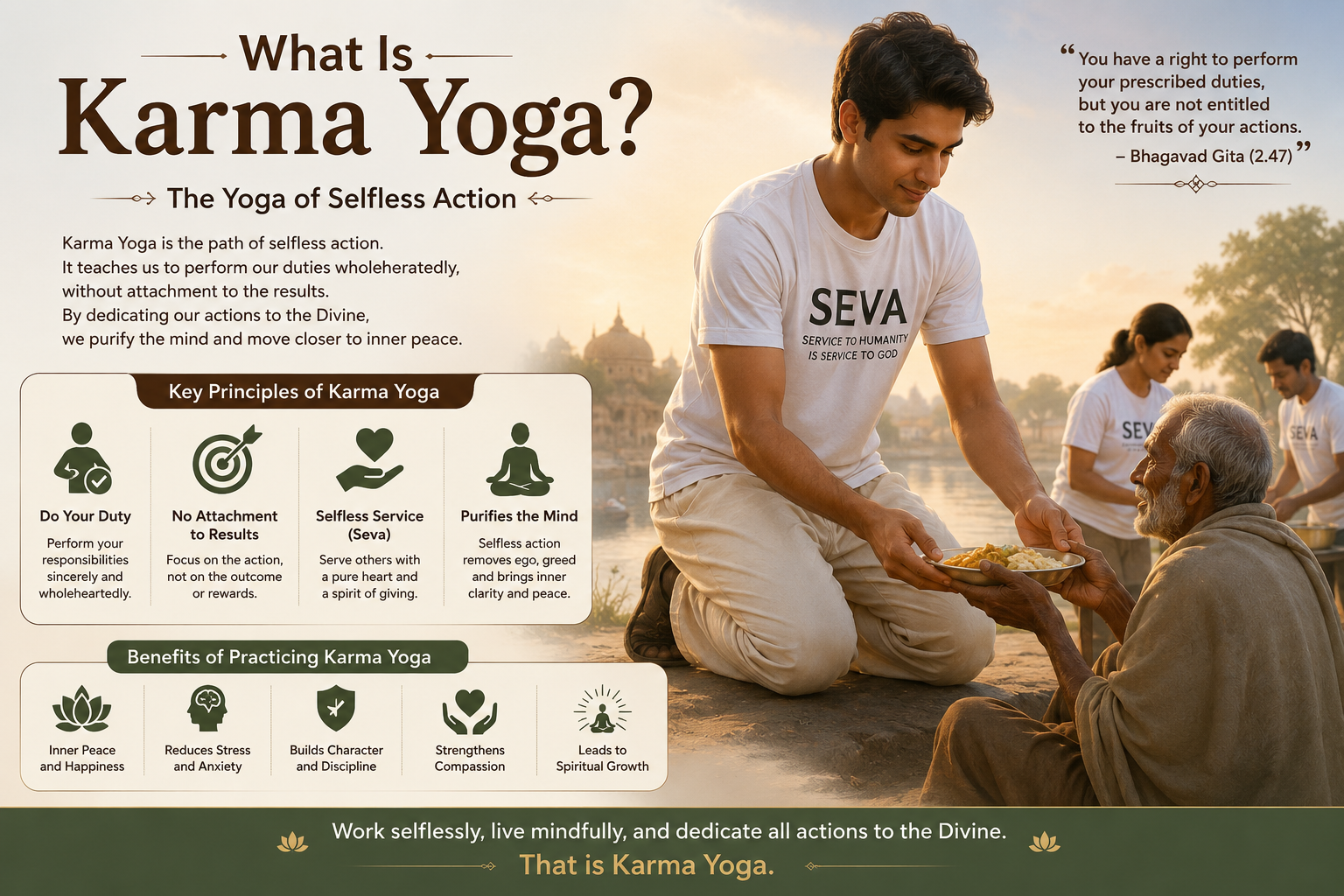
Karma Yoga translates roughly to “the yoga of action,” and it describes a path toward liberation through selfless, disciplined engagement with everyday duties and responsibilities. Unlike practices centered on posture, breath, or meditation, Karma Yoga doesn’t require withdrawing from daily life; it transforms daily life itself into the practice. Work, service, and ordinary obligations become the very material through which spiritual growth happens.
The defining principle of Karma Yoga is action performed without attachment to its results, often summarized by the phrase “you have a right to your actions, but never to the fruits of those actions.” This doesn’t mean indifference to outcomes or a lack of effort; it means directing full attention and care into the action itself, while releasing the anxious grip on whether a specific outcome is achieved. The distinction is subtle but significant, since it separates genuine effort from the exhausting cycle of striving, worrying, and measuring self-worth against results.
The Philosophical Roots of Karma Yoga
Karma Yoga’s clearest and most influential articulation appears in the Bhagavad Gita, where the teacher Krishna instructs the warrior Arjuna on how to act rightly amid conflict and uncertainty. Arjuna’s central struggle, wanting to withdraw from difficult duty rather than face it, becomes the occasion for one of yoga’s most enduring teachings: that liberation is found not by escaping responsibility, but by fulfilling it with the right internal attitude.
This context matters, because it shows Karma Yoga was never designed as a retreat from the world. It was designed for people fully embedded in complex responsibilities, family, work, conflict, and uncertainty, offering a way to engage with all of it without being consumed by anxiety over results. That framing is part of why Karma Yoga has remained so relevant across very different historical and cultural contexts, including the demands of modern working life.
What makes this teaching distinct from a simple call to “do your best and let go” is the depth of psychological insight behind it. The Gita repeatedly links suffering not to action itself, but to the restless craving for particular outcomes, along with the fear of failure that inevitably accompanies that craving. Karma Yoga’s proposed solution isn’t detachment from life, but a re-orientation of where a person places their sense of security, moving it away from uncertain external results and toward the quality and sincerity of the effort itself.
Karma Yoga and the Other Classical Paths
Traditional yogic philosophy describes four major paths, each suited to different temperaments, and understanding how they relate clarifies what makes Karma Yoga distinct.
- Karma Yoga (the path of action) – Growth through selfless service and disciplined, non-attached action in daily responsibilities.
- Jnana Yoga (the path of knowledge) – Growth through self-inquiry, discernment, and direct investigation into the nature of the self.
- Bhakti Yoga (the path of devotion) – Growth through love, surrender, and devotion directed toward the divine or a chosen ideal.
- Raja Yoga (the path of meditation and mental discipline) – Growth through systematic control of the mind, closely aligned with the eight-limbed framework of concentration and meditation.
These paths were never meant to be mutually exclusive, and most traditional teaching presents them as complementary rather than competing, with many practitioners naturally drawing on more than one depending on temperament and circumstance.
Core Principles of Karma Yoga
A few interlocking principles define how Karma Yoga is actually practiced, beyond the general idea of selfless action.
- Nishkama Karma (action without selfish desire) – Performing an action fully and skillfully while releasing personal attachment to a specific reward or recognition.
- Seva (selfless service) – Acting for the benefit of others or a larger purpose, rather than primarily for personal gain, often expressed through community, family, or charitable work.
- Equanimity in success and failure – Meeting both favorable and unfavorable outcomes with the same steady, undisturbed attitude, rather than measuring self-worth by results.
- Dharma (duty aligned with one’s role) – Fulfilling responsibilities appropriate to one’s position and circumstances, rather than avoiding difficult obligations or imitating someone else’s path.
- Present-focused engagement – Bringing full attention to the action happening now, rather than being consumed by anxious anticipation of a future outcome.
Why Karma Yoga Is Often Misunderstood
A few recurring misconceptions tend to distort how Karma Yoga is understood outside careful study of the tradition.
- Assuming Karma Yoga means being indifferent to outcomes, when it actually calls for full effort and care, just without anxious attachment to a specific result.
- Treating Karma Yoga as identical to general volunteering or charity, when it specifically describes an internal orientation toward any action, paid work included, not only unpaid service.
- Believing Karma Yoga requires passivity or the suppression of ambition, when the tradition explicitly encourages skillful, committed action.
- Confusing “karma” as popularly used, referring to cosmic reward and punishment, with Karma Yoga’s more precise teaching about the psychological freedom found in non-attached action.
How Karma Yoga Applies to Modern Life
Karma Yoga’s original context, ancient duty and dharma, can feel distant from contemporary work and family life, but its core principle translates surprisingly directly into modern circumstances.
- Approach daily work tasks with full attention and care, while consciously loosening the grip on how they’ll be judged or rewarded.
- Look for opportunities to serve a purpose larger than personal gain, whether through community involvement, mentorship, or simply supporting colleagues or family members.
- Notice when anxiety about outcomes, rather than the task itself, is driving stress, and practice redirecting attention back to the action at hand.
- Treat setbacks and successes with a similarly steady response, rather than allowing either to dictate a sense of personal worth.
- Recognize ordinary responsibilities, work, caregiving, everyday obligations, as legitimate spiritual practice rather than distractions from a “real” practice reserved for the meditation cushion.
None of this requires a dramatic lifestyle change. For most people, the shift happens gradually, through small, repeated moments of noticing where attention has drifted toward outcome-anxiety, and consciously redirecting it back to the task at hand. Over time, this practice tends to feel less like a rule to follow and more like a genuine change in how effort itself is experienced.
Karma Yoga and the Life of a Yoga Practitioner
For many practitioners, especially those drawn to teaching, Karma Yoga takes on a very direct, practical form. Teaching itself, when approached with the right attitude, becomes an expression of Karma Yoga: skillful, attentive service offered without an anxious focus on how it will be received or rewarded. This is part of why so many people who complete a structured Residential Yoga Teacher Training in Rishikesh describe teaching as a practice in its own right, not simply a skill acquired to deliver classes.
This connection between Karma Yoga and teaching also shows up clearly for those exploring what comes after certification. Guidance on Career Opportunities After Yoga Teacher Training often highlights service-oriented paths, community classes, therapeutic work, volunteer teaching, that reflect Karma Yoga’s emphasis on offering skill and attention for the benefit of others rather than personal gain alone.
Why Learn This From Rishikesh Yog Darshan
Rishikesh has been a center of study for the Bhagavad Gita and the broader yogic tradition for generations, and Karma Yoga is exactly the kind of teaching that benefits from careful, contextual instruction rather than a surface-level summary. Taught properly, Karma Yoga reshapes how a person relates to everyday responsibility. Taught poorly, or reduced to a slogan about “good karma,” it loses nearly all of its practical depth.
Resources such as Why Rishikesh is Called the Yoga Capital of the World explain why this region has remained central to serious study of texts like the Bhagavad Gita, while guidance on How to Start Your Career as a Yoga Teacher shows how principles like Karma Yoga move directly from philosophical study into a genuinely service-oriented teaching career.
Frequently Asked Questions
1. What does Karma Yoga actually mean?
Karma Yoga means “the yoga of action,” describing a spiritual path toward growth through selfless, disciplined action performed without attachment to specific results or personal reward.
2. Is Karma Yoga the same thing as good karma?
No. Popular use of “karma” refers to cosmic cause and effect, while Karma Yoga specifically describes an internal attitude toward action, acting fully while releasing attachment to outcomes, regardless of whether “good karma” results.
3. Do I need to volunteer or do charity work to practice Karma Yoga?
Not necessarily. Karma Yoga can be practiced through any action, including paid work and ordinary daily responsibilities, since its focus is on the internal attitude behind the action rather than the specific type of task performed.
4. Where does the concept of Karma Yoga come from?
Karma Yoga’s clearest classical source is the Bhagavad Gita, where the teaching is presented through a dialogue about fulfilling duty and responsibility without being paralyzed or consumed by attachment to outcomes.
5. How is Karma Yoga different from Bhakti or Jnana Yoga?
Karma Yoga emphasizes growth through selfless action, Bhakti Yoga emphasizes growth through devotion, and Jnana Yoga emphasizes growth through self-inquiry and discernment; the paths are considered complementary rather than competing.
6. Can Karma Yoga help with work-related stress?
Many practitioners find that Karma Yoga’s emphasis on full engagement without anxious attachment to results directly addresses common sources of work stress, though it works best as a gradual shift in attitude rather than an instant fix.
7. Is Karma Yoga relevant for someone who isn’t religious?
Yes. While Karma Yoga has religious and philosophical roots, its core principle, acting with full effort while releasing attachment to outcomes, functions as a practical psychological approach that doesn’t require adopting any particular belief system.
Final Thoughts
Karma Yoga offers something distinct from postures, breath work, or meditation: a way of transforming ordinary responsibility itself into a genuine spiritual practice. Its central teaching, that meaningful effort and psychological freedom come not from controlling outcomes but from releasing anxious attachment to them, remains just as relevant to modern work and daily life as it was to the ancient context in which it was first taught.
Approached seriously, Karma Yoga doesn’t ask anyone to withdraw from responsibility or ambition. It asks for a shift in how that responsibility is carried, with full attention, sustained effort, and a steadier relationship with whatever results eventually follow.
