
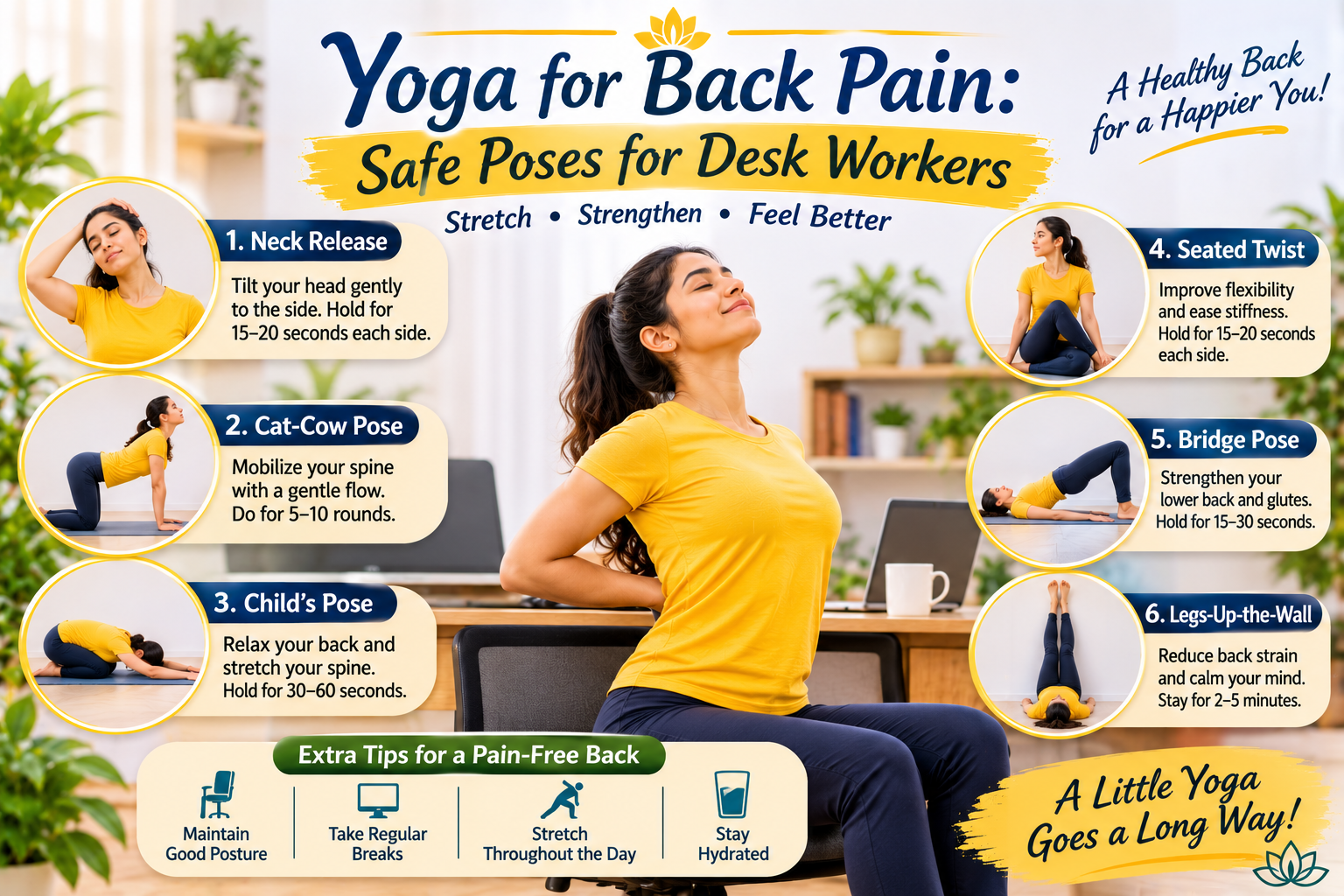
You sit down at 9 a.m. intending to stand up every hour. By 1 p.m., you realise you have barely moved. Your shoulders have crept toward your ears, your lower back feels stiff, and your hips seem locked. For millions of desk workers, this is a normal day, and a major reason that back discomfort is so common in office jobs.
Gentle yoga is one of the most accessible ways to ease that stiffness and build better movement habits. This guide explains why desk work affects your back, what research suggests about yoga, and how to practise nine safe, beginner-friendly poses. It also includes a short routine you can fit into a workday and clear guidance on when to seek medical advice.
Why Desk Work Often Leads to Back Pain
Your spine is designed for movement, not for hours in a single position. Several common factors contribute to discomfort among desk workers:
- Prolonged sitting. Staying in one posture for long periods can strain muscles and joints and reduce circulation.
- Slouching or forward head posture. Leaning toward a screen increases the load on the neck and upper back.
- Tight hip flexors. Sitting keeps the front of the hips shortened, which can pull on the lower back.
- Weak core and glute muscles. When the muscles that support the spine are underused, other areas compensate.
- Stress. Mental tension often shows up as raised shoulders and a clenched jaw.
- Poor workstation setup. A low screen, unsupported chair, or awkward keyboard height all add up.
Back pain has many possible causes, and not all of them are posture-related. That is why it is important to treat general guidance as a starting point, not a diagnosis.
What Does the Research Say About Yoga and Back Pain?
Studies on yoga for chronic low back pain suggest it may modestly improve pain and function for some people, and several clinical guidelines list yoga among the non-drug options worth considering. At the same time, research quality varies, effects differ between individuals, and yoga is not a cure for every type of back pain.
The most realistic way to think about it: gentle, regular yoga can help you build mobility, strength, and body awareness, which may reduce stiffness and make everyday movement more comfortable. It works best as part of a broader approach that includes movement breaks, a supportive workstation, and professional care when needed.
Before You Begin: Safety First
Please read this section before trying the poses.
- Get medical advice if you have a diagnosed spinal condition, such as a herniated disc, sciatica, spondylolisthesis, osteoporosis, or recent surgery, or if you are pregnant.
- See a doctor promptly if you experience warning signs, including numbness or tingling in the legs, weakness, loss of bladder or bowel control, unexplained weight loss, fever, severe pain after an injury, or pain that wakes you at night and keeps worsening.
- Move gently. Mild stretching is normal; sharp, shooting, or radiating pain is a signal to stop.
- Do not force the range of motion. Smaller movements done consistently are better than aggressive stretches.
- Breathe steadily. Holding your breath often means you are pushing too hard.
- Warm up first. A few minutes of walking or gentle movement helps.
9 Safe Yoga Poses for Desk Workers
1. Seated Cat-Cow
Sit toward the front of your chair with feet flat. Place your hands on your knees. Inhale, gently arch your back and lift your chest. Exhale, round your spine and draw your chin toward your chest. Repeat for 8 to 10 slow breaths.
Why it helps: Introduces gentle spinal movement without leaving your desk.
2. Seated Spinal Twist
Sit tall with feet flat. Inhale to lengthen your spine, then exhale and rotate to the right, placing your left hand on your right knee and your right hand on the chair back. Hold for 5 breaths, then switch sides.
Why it helps: Eases stiffness in the mid-back. Twist from the upper back and avoid cranking the spine.
3. Cat-Cow on Hands and Knees
On a mat, come onto hands and knees. Inhale as you lower the belly and lift the chest, exhale as you round the spine. Move slowly, about 8 to 10 rounds.
Why it helps: Gently mobilises the whole spine and links movement with breath.
4. Child’s Pose
From hands and knees, sit your hips back toward your heels and fold forward, forehead resting on the mat or a cushion. Hold for 5 to 8 breaths.
Why it helps: A restful stretch for the back and hips. Place a cushion between your calves and thighs if it feels tight.
5. Supine Knee-to-Chest
Lie on your back and draw one knee toward your chest, holding behind the thigh. Keep the other leg bent or extended. Hold for 5 breaths, then switch. Finish by hugging both knees gently.
Why it helps: Soothes the lower back and releases the hips. Avoid pulling hard.
6. Supine Figure-Four Stretch
Lie on your back with knees bent. Cross your right ankle over your left thigh. Gently draw your left thigh toward you until you feel a stretch in the right hip. Hold for 5 to 8 breaths, then switch sides.
Why it helps: Tight hips are common in desk workers, and releasing them may reduce strain on the lower back.
7. Low Lunge (Hip Flexor Stretch)
From hands and knees, step your right foot forward between your hands, keeping the left knee on the mat (use a folded blanket for comfort). Lengthen your spine and gently shift your hips forward. Hold for 5 breaths, then switch.
Why it helps: Opens the front of the hips that become shortened during sitting. Keep your lower back relaxed instead of arching.
8. Sphinx Pose
Lie on your stomach and prop yourself on your forearms, elbows under shoulders. Lengthen your chest forward and keep your neck long. Hold for 5 to 8 breaths.
Why it helps: Offers a mild backbend that counteracts forward slouching. Skip it, or check with your doctor first, if backbends aggravate your symptoms.
9. Bridge Pose
Lie on your back with knees bent and feet hip-width apart. Press into your feet and lift your hips a few inches, keeping your neck relaxed. Hold for 3 to 5 breaths, then lower slowly.
Why it helps: Strengthens glutes and hamstrings, which support the lower back. Lift only as high as is comfortable.
A 10-Minute Desk-Worker Routine
| Time | Practice |
|---|---|
| 0 to 1 min | Standing or seated breathing |
| 1 to 2 min | Seated cat-cow |
| 2 to 3 min | Seated spinal twist (both sides) |
| 3 to 5 min | Cat-cow on hands and knees, then Child’s Pose |
| 5 to 6 min | Supine knee-to-chest |
| 6 to 7 min | Figure-four stretch (both sides) |
| 7 to 8 min | Low lunge (both sides) |
| 8 to 9 min | Sphinx pose or bridge pose |
| 9 to 10 min | Relaxation on your back |
Practise four to five days a week. If you cannot get to a mat, the seated poses can be done at your desk in about three minutes.
Small Changes That Make a Big Difference at Work
Yoga is more effective when paired with better daily habits.
- Stand and move every 30 to 60 minutes. Even a short walk helps.
- Adjust your screen so the top is roughly at eye level.
- Support your lower back with a chair that fits you or a small cushion.
- Keep feet flat on the floor or a footrest.
- Position your keyboard and mouse close, with elbows near your sides.
- Alternate tasks so you are not locked into one position.
- Stay hydrated and breathe fully. Shallow chest breathing can increase tension.
Managing Stress, Sleep, and Back Pain Together
Back discomfort rarely exists in isolation. Stress can heighten muscle tension, and poor sleep can make pain feel worse. Many people find it helpful to treat all three together. If you are interested in how yoga relates to rest, you may find it useful to read about how yoga supports better sleep and relieves insomnia, and a related look at how yoga may help you relieve insomnia offers further perspective.
Mind-based practices can also help you notice tension earlier. This overview of meditation as a tool for psychological wellbeing explains how attention training supports emotional balance. If long-term low mood is affecting your energy and pain levels, the article on how yoga supports recovery from depression offers context, though professional mental health care should always come first in such cases.
Common Mistakes to Avoid
- Stretching too aggressively. More is not better, especially with sore muscles.
- Ignoring your core and glutes. Strength matters as much as flexibility.
- Rounding deeply into forward folds if bending forward aggravates your pain. Bend your knees and keep the movement small.
- Skipping movement breaks and expecting a single session to fix a full day of sitting.
- Practising through pain. Discomfort that increases during or after a pose is a reason to stop.
- Comparing yourself with others. Your range of motion is individual.
When to See a Professional
Gentle yoga is appropriate for many people, but it is not a replacement for medical evaluation. Please consult a doctor or physiotherapist if:
- Your pain lasts more than a few weeks or keeps getting worse.
- You experience pain that radiates down a leg, numbness, tingling, or weakness.
- Pain follows an injury or fall.
- You have other health conditions that may affect your spine.
- You are unsure which poses are safe for you.
A qualified yoga teacher with experience in therapeutic or beginner classes can also help you adapt poses to your body.
Frequently Asked Questions
Is yoga good for lower back pain from sitting? Many people find gentle yoga helpful for stiffness and mobility, and it may support pain management for some. It works best alongside movement breaks and professional guidance when needed.
How often should I practise? Short sessions four to five days a week are a sensible starting point.
Which pose is best for desk workers? There is no single best pose. A mix of spinal mobility, hip opening, and gentle strengthening tends to work well.
Can I do yoga with a herniated disc or sciatica? Possibly, but only with medical advice and often with modifications. Avoid deep forward folds or strong twists unless a professional approves.
Should I practise when my back is in acute pain? If pain is severe or sudden, rest and seek medical advice. Gentle walking and easy movement are usually preferred over deep stretching in the acute phase, but follow your clinician’s guidance.
Do I need a mat? It helps, but a folded blanket or carpet also works.
Final Thoughts
You may not be able to change your job, but you can change how you move through it. A few minutes of mindful stretching, steady breathing, and regular movement breaks can ease stiffness and build resilience over time. Start gently, stay consistent, respect your body’s signals, and involve a healthcare professional whenever pain is persistent or unusual. Small, repeated efforts are what make a back feel better over months, not heroic stretches on a single afternoon.