 Skip to content
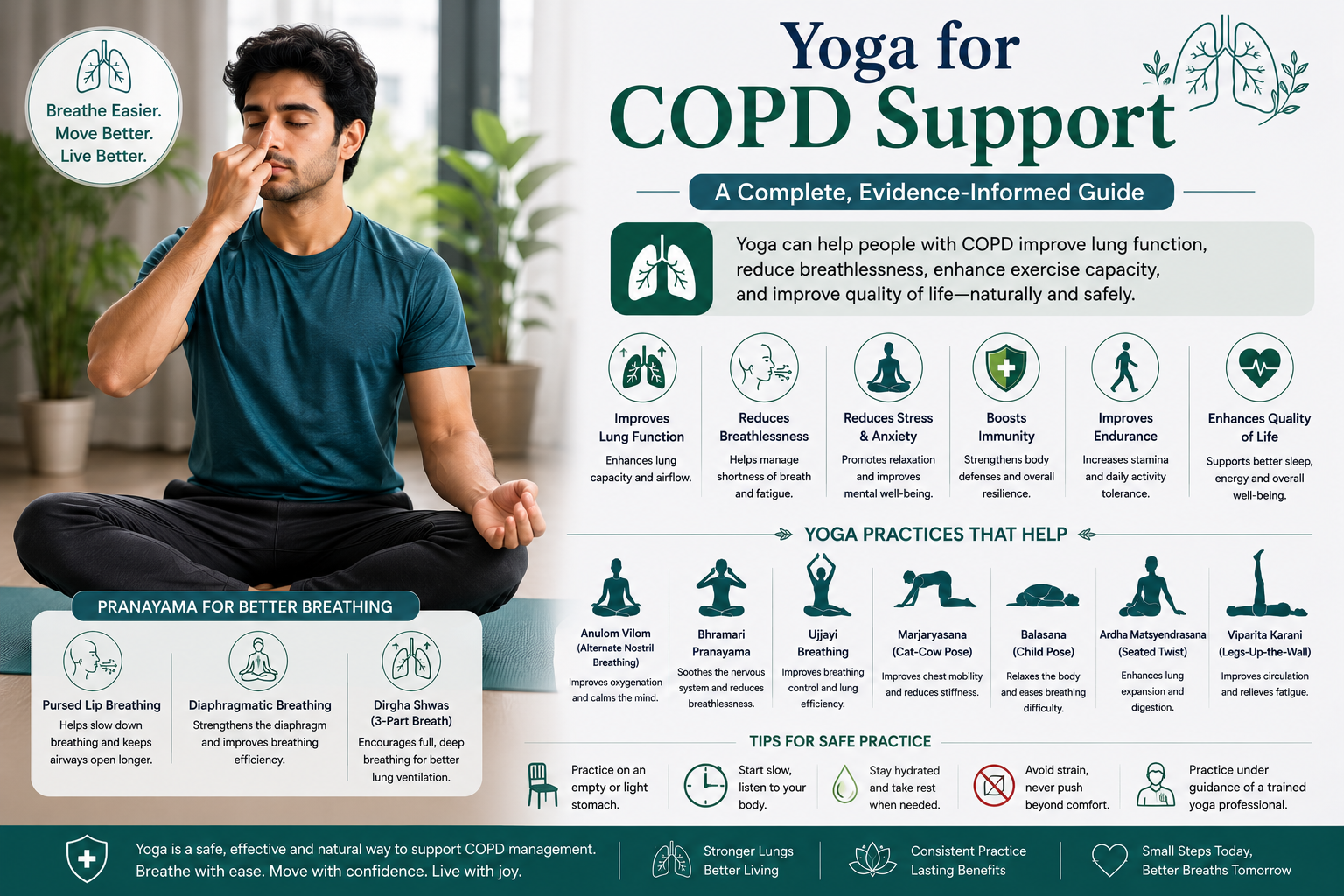
An informational guide to what yoga can and cannot do for chronic obstructive pulmonary disease (COPD) — covering how the condition actually affects the lungs, where breath, posture, and pacing-focused practices genuinely help, and where popular claims about yoga “curing” or “reversing” COPD outpace the evidence.
Living with COPD often means living with breathlessness as a daily companion, and that search for relief understandably leads many people toward yoga, sometimes marketed with claims that a particular breathing sequence or posture can reverse lung damage or eliminate the need for medication. The more accurate picture is more modest: COPD involves permanent structural changes to the airways and lung tissue, most often from long-term exposure to irritants such as cigarette smoke, and no yoga practice repairs that damage or restores lost lung capacity.
What yoga can genuinely offer is support for breathing efficiency, exercise tolerance, energy pacing, and the anxiety that so often accompanies breathlessness, a real and useful role that falls well short of a cure. This guide walks through how COPD actually affects the lungs, where yoga has an evidence-aligned role in supporting people who live with it, and where popular claims about yoga curing COPD go further than the science supports. Yoga is not a substitute for medical care, and anyone with diagnosed COPD should treat it as a complement to, not a replacement for, appropriate diagnosis, medication, and pulmonary rehabilitation.
1. What Is Actually Happening in the Lungs With COPD
Chronic obstructive pulmonary disease is an umbrella term that generally includes emphysema and chronic bronchitis, both of which involve long-term, largely irreversible changes to the airways and air sacs of the lungs. In emphysema, the walls of the air sacs break down, reducing the surface area available for gas exchange and making the lungs less elastic, which traps air and makes it harder to fully exhale. In chronic bronchitis, the airway linings stay inflamed and produce excess mucus, narrowing the passages air needs to move through. Together these changes make breathing more effortful, particularly during exertion, and explain why people with COPD often describe a persistent sense of breathlessness even when resting. Understanding this clarifies what yoga can realistically do: support how efficiently the remaining lung capacity is used, not restore capacity that has been lost.
2. Why Claims That Yoga “Cures” or “Reverses” COPD Go Too Far
It is easy to find wellness content suggesting a particular pranayama technique or yoga sequence can reverse COPD or repair damaged lung tissue. These claims are not well supported. The structural changes underlying COPD, destroyed air sacs and narrowed, inflamed airways, are not tissue that a breathing exercise can rebuild. The more accurate picture is that yoga, particularly breath-focused and pacing-focused practice, can be a genuinely helpful complementary approach for easing the day-to-day experience of breathlessness and supporting exercise tolerance, offering modest, real benefits without replacing appropriate medical treatment or reversing the underlying disease.
3. What the Research Actually Shows
Research on structured breathing and gentle movement practice in COPD is more developed than in many other conditions, largely because these elements already form part of standard pulmonary rehabilitation. Pursed-lip breathing has documented evidence for reducing the sensation of breathlessness and improving oxygen saturation during activity for many people with COPD. Diaphragmatic breathing shows more mixed results in COPD specifically, since some studies suggest it can occasionally increase breathlessness in people with significant hyperinflation, which is part of why individualised guidance matters. Yoga-specific studies, including gentle asana and pranayama programmes, have shown modest improvements in quality of life, exercise capacity, and anxiety in some trials, generally as an adjunct to standard pulmonary rehabilitation rather than a replacement for it. The fair summary: certain breathing techniques have genuine, evidence-aligned benefit for COPD when appropriately tailored, while broader claims about yoga curing or reversing the disease outpace what has actually been studied.
4. Breathing Techniques Commonly Used in COPD Support
Pursed-lip breathing is one of the most consistently recommended techniques for people with COPD, since exhaling slowly through slightly pursed lips helps keep airways open a little longer and can ease the sensation of air trapping. Diaphragmatic breathing is sometimes recommended too, though it needs to be introduced carefully and individually, since it does not suit everyone with significant hyperinflation. Slow, paced breathing during activity, sometimes coordinated with movement such as timing exhalation to an exertion like standing up, is widely taught in pulmonary rehabilitation settings to reduce the breathlessness associated with everyday tasks.
A gradual, structured approach to this kind of breath training, of the sort covered in Pranayama for Stress Relief, offers a sensible starting point for building calm, controlled breathing habits, though anyone with COPD should adapt the pace and intensity with guidance from a clinician or pulmonary rehabilitation therapist familiar with their condition.
5. Postures and Positioning for Easier Breathing
Body position meaningfully affects how much room the diaphragm has to move, which is part of why certain postures are widely taught to people with COPD. Sitting upright and leaning slightly forward with the arms supported on a table or the knees, sometimes called the tripod position, is one of the most commonly recommended positions for easing acute breathlessness. Restorative, supported postures that avoid compressing the chest or abdomen tend to be more comfortable than deep forward folds or postures that require holding the breath. Evidence for any single yoga posture directly improving lung function in COPD is limited, and the right choice varies by individual and by how advanced the disease is, so working with guidance rather than following a generic sequence is safer.
6. Gentle Movement, Pacing, and Exercise Tolerance
Of all the ways yoga-adjacent practice supports people with COPD, gentle, paced movement combined with coordinated breathing has some of the most consistent evidence, since maintaining physical activity and muscle strength is a core part of standard pulmonary rehabilitation and is associated with improved exercise tolerance and quality of life. This is not about intensity; it is about consistency, appropriate pacing, and coordinating breath with movement rather than holding the breath during exertion. Anyone with COPD starting a movement practice should be guided by a pulmonary rehabilitation programme or a clinician familiar with their specific lung function and any supplemental oxygen needs.
7. Anxiety, Breathlessness, and the Role of Calming Practice
Breathlessness and anxiety often feed each other in COPD: the sensation of not getting enough air can trigger anxiety, and anxiety can in turn make breathing feel more effortful and rapid. Slow, paced breathing and relaxation-focused practice do not treat the underlying lung disease, but they can help interrupt this cycle for some people by supporting a calmer physiological state during moments of breathlessness.
This overlap between breath, calm, and rest is explored further in Yoga Nidra in Rishikesh, which looks at how deep restorative practice supports the kind of rest the body’s regulatory systems depend on, something that matters for people managing the fatigue that often comes with chronic breathlessness.
For people whose COPD symptoms are compounded by ongoing exhaustion, Yoga for Burnout Recovery looks specifically at how restorative practice can support recovery from prolonged fatigue and depleted energy.
8. Practices and Situations to Approach With Caution
Not every yoga practice suits someone with COPD. Forceful, rapid, or vigorous breathing techniques can increase breathlessness and are generally best avoided, particularly during an active flare-up or exacerbation. Deep forward folds, tight abdominal binding, or postures that compress the chest can make breathing feel more restricted for some people with significant hyperinflation. Anyone using supplemental oxygen should practise only with guidance that accounts for their oxygen needs during exertion. Increased breathlessness, chest pain, confusion, or a significant change in mucus colour or amount are signals to seek medical evaluation rather than pushing through a practice.
9. Building a Safe, Realistic Practice
A yoga-related practice that genuinely supports COPD looks gentle, paced, and closely aligned with any existing pulmonary rehabilitation programme rather than positioned as a separate or competing approach.
- Learn pursed-lip breathing and practise it consistently, especially before and during activities that typically cause breathlessness.
- Use the tripod or a similar supported forward-leaning position during moments of acute breathlessness.
- Coordinate breath with movement, exhaling during exertion rather than holding the breath.
- Avoid vigorous, forceful, or breath-holding techniques, particularly during a flare-up or exacerbation.
- Work with a pulmonary rehabilitation team or a teacher trained through a structured Yoga Teacher Training in Rishikesh programme who understands how to adapt practice for a chronic respiratory condition.
10. Traditional Pranayama Perspectives Alongside Modern Pulmonary Care
Traditional yogic approaches to breath have long emphasised slow, controlled, diaphragm-aware breathing as a foundation of practice, developed centuries before modern respiratory medicine described the mechanics involved. While these traditions use different language and were not developed with COPD specifically in mind, the underlying emphasis on unforced, paced, attentive breathing aligns reasonably well with the evidence-based, comfort-focused approach used in modern pulmonary rehabilitation.
A structured Best Yoga School in Rishikesh typically teaches this traditional breath work alongside the physiological grounding needed to adapt it safely for people managing a chronic respiratory condition, rather than presenting a single generic sequence for everyone.
11. Red Flags in Yoga-for-COPD Claims
A few common red flags tend to signal claims about yoga and COPD that outpace the evidence.
- Suggestions that a breathing technique or sequence can reverse COPD or repair damaged lung tissue.
- Encouragement to stop using prescribed inhalers, oxygen, or other treatment in favour of a yoga-based programme.
- Vigorous or forceful breathing techniques taught without any caution for people with significant hyperinflation or active exacerbations.
- Vague claims that a practice “detoxifies” or “rebuilds” the lungs without any explanation of the underlying mechanism.
12. Learning These Practices Properly
Because adapting yoga safely for COPD requires understanding both breath technique and the specific physiology of obstructive lung disease, learning from a properly trained teacher, ideally in coordination with a pulmonary rehabilitation team, makes a real difference.
Programmes with a strong grounding in physiology, such as a Yoga TTC India that covers respiratory anatomy alongside traditional pranayama, offer a more grounded understanding of what these techniques can genuinely offer people managing a chronic respiratory condition.
Safety Notes and When to See a Doctor
Yoga and related breath and pacing-focused practices can genuinely support comfort and function in COPD, but they should never replace appropriate medical diagnosis or treatment.
- Sudden worsening of breathlessness, chest pain, confusion, or blue-tinged lips or fingertips requires urgent medical attention.
- A change in mucus colour, amount, or thickness, or a new fever, should be evaluated by a doctor, since these can signal an exacerbation.
- Anyone with COPD starting a new movement or breathing practice should coordinate with their pulmonary rehabilitation team or physician.
- Supplemental oxygen needs should be assessed by a clinician before beginning any new exercise or breathing routine.
Frequently Asked Questions (FAQs)
Q1. Can yoga cure or reverse COPD?
No. COPD involves permanent structural changes to the airways and lung tissue that a yoga practice does not repair. Yoga can support breathing efficiency, exercise tolerance, and anxiety around breathlessness, but it does not replace medical diagnosis or treatment.
Q2. What is the most useful breathing technique for someone with COPD?
Pursed-lip breathing has the most consistent evidence specifically for COPD, since it helps keep airways open longer during exhalation and can ease the sensation of breathlessness during activity.
Q3. Is diaphragmatic breathing always recommended for COPD?
Not universally. It can be genuinely helpful for some people, but research shows mixed results, and it may increase breathlessness for people with significant hyperinflation, so it should be introduced with individual clinical guidance.
Q4. Can yoga replace pulmonary rehabilitation?
No. Pulmonary rehabilitation is a structured, evidence-based programme combining exercise, education, and breathing training, and yoga is best used alongside it rather than as a substitute.
Q5. Are yoga postures safe for someone with COPD?
Many gentle, supported postures are generally well tolerated, but deep forward folds, tight abdominal compression, and breath-holding postures can feel more restrictive for some people and should be approached with individual guidance.
Q6. Can breathing exercises replace inhalers or oxygen therapy?
No. COPD requires appropriate medical treatment, and breathing techniques should never be used as a substitute for inhalers, oxygen therapy, or other prescribed care when a doctor determines they are needed.
Q7. What is the most evidence-based way to think about yoga’s role in COPD?
The most accurate framing is that yoga, particularly pursed-lip breathing, paced movement, and relaxation practice, can support comfort, exercise tolerance, and anxiety management, working alongside, not instead of, standard pulmonary rehabilitation and medical care.
Final Thoughts
COPD is a genuine, largely irreversible change in lung structure and function, and the most honest, evidence-aligned view of yoga’s role is a supportive one: helping with breathing efficiency, pacing, exercise tolerance, and the anxiety that often accompanies breathlessness, rather than reversing the underlying disease itself. This is a more modest picture than some wellness marketing suggests, but it is also a safer and more realistic one.
Approached gradually, in coordination with a pulmonary rehabilitation team and appropriate medical guidance, yoga and related breath-focused practices can offer many people living with COPD a genuinely useful, low-risk way to support daily comfort and function.
