 Skip to content
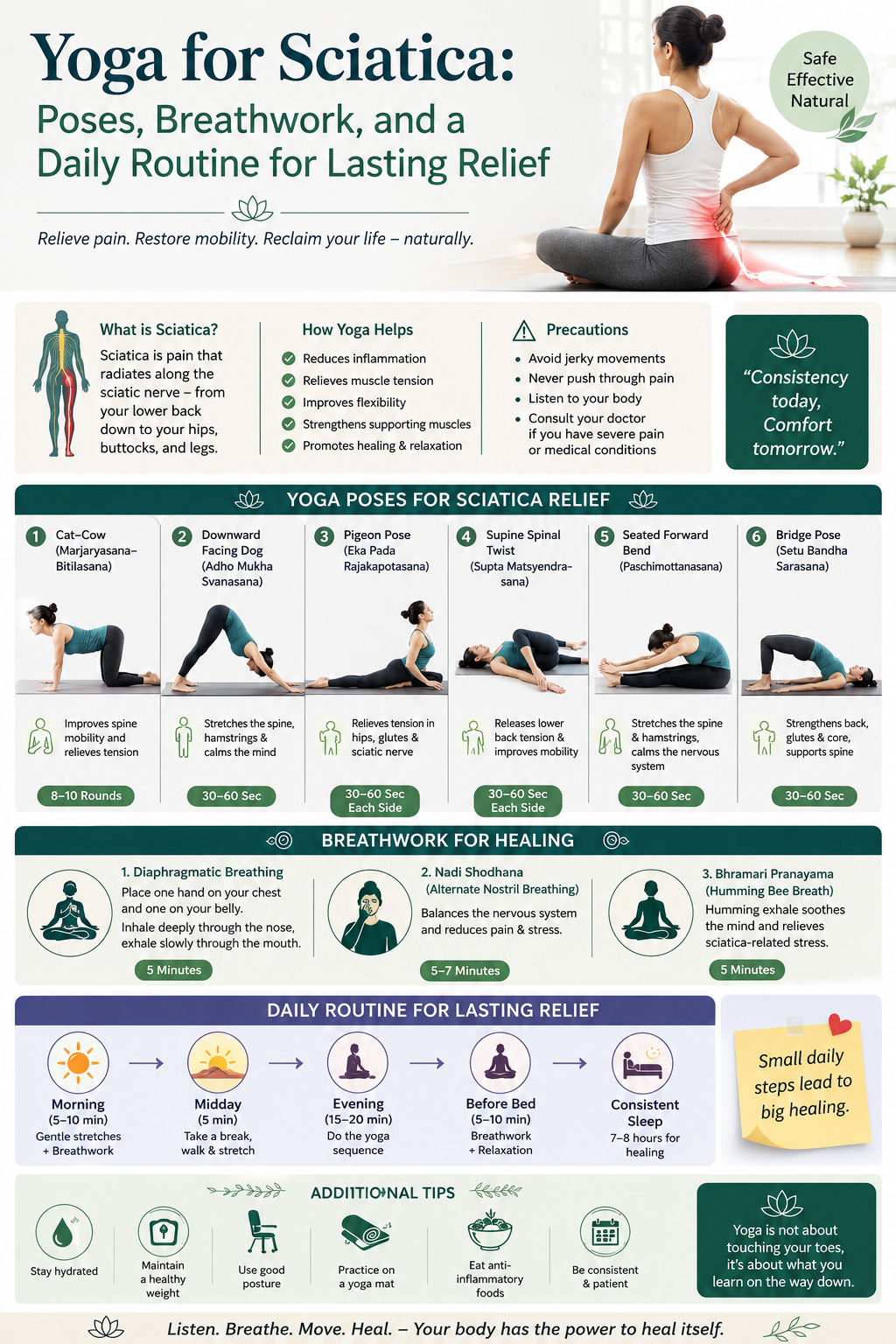
That sharp, burning line that runs from your lower back, through the hip, and down the back of one leg is one of the most disruptive kinds of pain a body can experience. It can turn sitting, standing, and even sleeping into a daily negotiation. If you’ve been searching for a way to manage sciatica without relying purely on painkillers, yoga offers a gentle, well-researched path back to comfortable movement — provided it’s practiced correctly.
This guide walks through what sciatica actually is, why yoga helps, which poses to use (and which to avoid), and how to build a simple daily routine around it.
What Is Sciatica, Really?
Sciatica isn’t a disease in itself — it’s a symptom. It occurs when the sciatic nerve, the longest and thickest nerve in the body, gets compressed or irritated somewhere along its path from the lower spine through the buttock and down the leg. The most common triggers are a herniated or bulging disc, spinal stenosis, piriformis syndrome (where a small hip muscle presses on the nerve), or simple prolonged sitting with poor posture.
The pain usually shows up on one side of the body and can range from a dull ache to a sharp, electric jolt, often paired with numbness, tingling, or muscle weakness in the leg or foot. Because the sciatic nerve is so long, the exact sensation and location can vary widely from person to person — which is also why a single “one-pose-fixes-all” approach rarely works, and why any serious yoga practice for sciatica has to be adapted to the individual.
Why Yoga Helps With Sciatica
Yoga addresses sciatica from several angles at once, which is part of why it’s recommended by physiotherapists alongside conventional treatment:
- Releases the piriformis and hip rotators. A tight piriformis muscle is one of the most common causes of nerve compression, and gentle hip-opening stretches can relieve pressure directly at the source.
- Improves spinal alignment. Many sciatica cases trace back to poor posture or disc issues; yoga rebuilds core strength and spinal awareness so the lower back isn’t compensating for weak abdominal or gluteal muscles.
- Increases blood flow and reduces inflammation. Slow, mindful movement paired with breath encourages circulation to compressed tissue, which can speed up the body’s natural healing process.
- Calms the nervous system. Chronic pain keeps the nervous system on high alert, which can amplify pain signals. Breathwork and restorative poses shift the body out of that fight-or-flight state.
The important caveat: yoga for sciatica is therapeutic, not universal. Poses that involve deep forward folds or aggressive twisting can worsen disc-related sciatica, so the sequence matters as much as the individual postures.
It’s also worth acknowledging the mind-body loop that chronic pain creates. Living with ongoing sciatic pain often brings frustration, disrupted sleep, and low-grade anxiety, all of which tend to increase muscle guarding and, in turn, worsen the pain itself. This is why practices built around yoga for mental health in Rishikesh so often overlap with pain-recovery programs — and why a broader yoga for stress management routine can be just as important to sciatica recovery as the physical stretches themselves.
Best Yoga Poses for Sciatica Relief
These poses are widely used in therapeutic and Iyengar Yoga in Rishikesh-style classes, where props like blocks, bolsters, and straps are used to keep the spine safe while still releasing the tight areas around the nerve.
1. Supta Padangusthasana (Reclining Hand-to-Big-Toe Pose)
Lying on your back, loop a strap around the ball of one foot and slowly straighten that leg toward the ceiling while the other leg stays grounded. This gently stretches the hamstring and the sciatic nerve pathway itself without any spinal loading, making it one of the safest starting points.
2. Pigeon Pose (Eka Pada Rajakapotasana)
A classic hip-opener that directly targets the piriformis and outer hip. Keep a folded blanket under the hip of the bent leg for support, and only fold forward as far as feels like a stretch, never a strain.
3. Cat-Cow Stretch (Marjaryasana-Bitilasana)
This rhythmic spinal flow warms up the entire back, mobilizes the vertebrae, and is safe for almost every stage of sciatica because it avoids any static loading of the lower spine.
4. Sphinx Pose (Salamba Bhujangasana)
A gentle backbend that decompresses the lower spine and can relieve pressure from a bulging disc — useful for people whose sciatica is disc-related rather than muscular.
5. Reclining Pigeon Pose (Supta Kapotasana)
A supported, floor-based variation of pigeon pose that achieves a similar piriformis release with far less strain on the knee and hip joint, making it ideal for beginners or anyone in acute pain.
6. Locust Pose (Salabhasana)
Strengthens the lower back and glutes, which helps the spine bear weight more evenly and reduces the repetitive strain that often triggers sciatic flare-ups.
7. Downward-Facing Dog (Adho Mukha Svanasana)
A gentle inversion that lengthens the entire back body and hamstrings. Bending the knees slightly here keeps the stretch comfortable rather than forceful.
8. Legs-Up-the-Wall Pose (Viparita Karani)
A restorative finishing pose that reduces lower-back compression and calms the nervous system. It’s often taught in restorative yoga and Yoga Nidra in Rishikesh sessions for exactly this reason — it asks nothing of the body while still promoting recovery.
Pranayama and Breathwork for Sciatica
Pain and breath are closely linked: shallow, guarded breathing tightens the muscles around an already irritated nerve, while slow, diaphragmatic breathing helps those same muscles release. A few minutes of Nadi Shodhana (alternate nostril breathing) or simple belly breathing before and after your pose sequence can meaningfully lower the perceived intensity of pain. This is also where pranayama for stress relief becomes directly relevant to sciatica — since ongoing stress keeps the surrounding muscles guarded and less willing to release, calming the breath is often the missing piece in a physical-only approach to pain relief.
Precautions: What to Avoid When You Have Sciatica
Not every yoga pose is sciatica-friendly, and pushing through pain is never the goal. A few guidelines worth following:
- Avoid deep forward folds (like Paschimottanasana) during acute flare-ups, as they can increase pressure on a herniated disc.
- Skip intense twists early in your practice; introduce them only once the acute pain has settled and always move slowly.
- Never stretch into sharp, shooting, or numbing sensations — mild stretching discomfort is fine, nerve pain is a stop signal.
- Use props generously. A block under the hip, a bolster under the knees, or a strap around the foot all reduce strain while preserving the benefit of the pose.
- If pain radiates below the knee, worsens progressively, or comes with loss of bladder or bowel control, seek medical attention immediately — this goes beyond what yoga alone should treat.
Building a Simple Daily Routine
Consistency matters more than intensity when it comes to nerve-related pain. A workable daily sequence might look like this:
1. 5 minutes of Cat-Cow and gentle spinal warm-up
2. 10 minutes rotating through Sphinx Pose, Reclining Pigeon, and Supta Padangusthasana
3. 5 minutes of Locust Pose and light core activation
4. 5 minutes of alternate nostril breathing
5. Finish with 5–10 minutes in Legs-Up-the-Wall Pose
Practiced daily, even in short 20–30 minute sessions, this kind of routine tends to outperform sporadic, longer practices — the nervous system responds better to gentle, repeated signals than to occasional intense ones.
When Yoga Becomes a Deeper Practice
Many people who come to yoga initially for pain relief end up going much further with it. If therapeutic yoga interests you beyond home practice, studying under experienced teachers changes what’s possible — sequencing, prop use, and modification become second nature rather than guesswork. This is part of why so many people eventually consider a proper Yoga Teacher Training in Rishikesh: it’s not only about becoming a teacher, but about understanding the body’s mechanics well enough to work safely with conditions like sciatica, rather than around them.
Rishikesh, sitting at the foot of the Himalayas along the Ganges, has earned its reputation as a hub for exactly this kind of serious, body-aware study. Courses at a best yoga school in Rishikesh typically combine anatomy, therapeutic sequencing, and traditional philosophy, which is a very different foundation than a general fitness class. For anyone drawn to a structured, internationally recognized Yoga TTC in India, options range from a foundational 200-hour YTTC in Rishikesh to a more advanced 500-hour YTTC in Rishikesh for those who want to specialize in therapeutic and alignment-based teaching.
Styles like Iyengar Yoga in Rishikesh, which relies heavily on props and precise alignment, are particularly well-suited to students dealing with sciatica or other joint and nerve conditions, since the method is built around adapting poses to the body rather than forcing the body into a pose. Alongside asana, many schools also offer an Ayurvedic massage course in Rishikesh, which pairs well with therapeutic yoga since Ayurvedic bodywork techniques can further loosen the muscles surrounding a compressed nerve.
For those who’d rather ease into the practice before committing to a full teacher training, a short yoga retreat in Rishikesh is a low-pressure way to experience guided, therapeutic sequencing, restorative practices like Yoga Nidra in Rishikesh, and the kind of daily rhythm that makes consistent practice easier to sustain once you’re back home.
It also helps to understand why this particular town, and not somewhere else, has become the reference point for this kind of study. The reasons Rishikesh is considered the yoga capital of the world go beyond scenery — it’s the density of experienced teachers, the lineage of therapeutic and classical knowledge passed down through generations of practitioners, and an entire town built around daily, disciplined practice.
Frequently Asked Questions
Can yoga completely cure sciatica?
Yoga can significantly reduce pain and improve mobility, especially when the cause is muscular (like piriformis syndrome), but it isn’t a guaranteed cure for structural issues like a severe disc herniation. It works best as part of a broader approach that may include physiotherapy or medical guidance.
How soon can I expect relief?
Many people notice reduced tightness and improved range of motion within two to three weeks of consistent daily practice, though disc-related sciatica can take longer and needs a more cautious approach.
Is it safe to do yoga during an acute sciatica flare-up?
Gentle, supported poses like Legs-Up-the-Wall and Reclining Pigeon are generally safe even during a flare-up. Avoid deep folds, twists, or anything that increases the sharp, radiating pain.
Should beginners join a group yoga class or practice alone?
If you’re new to yoga or dealing with a diagnosed condition, a class with a qualified instructor — ideally one trained in therapeutic sequencing — is safer than following videos alone, at least until you’re confident with the modifications your body needs.
Final Thoughts
Sciatica can feel relentless, but it responds remarkably well to patient, consistent, well-informed movement. The poses and routine above are a solid starting point, but yoga’s real strength for pain-related conditions comes from working with someone who can watch your body and adjust in real time. Whether that means a local therapeutic yoga class or a deeper immersion like a Rishikesh-based training, the goal is the same: understanding your body well enough to move it, not around the pain, but through it.
