 Skip to content
Wellness guide by Rishikesh Yog Darshan: how a slower, cooling style of yoga practice can help calm an overactive thyroid, ease the racing, anxious symptoms it causes, and support the nervous system alongside your medical treatment.
Hyperthyroidism gets far less everyday attention than its opposite, hypothyroidism, yet living with it often feels more distressing moment to moment. Instead of fatigue and slowness, an overactive thyroid produces a racing heart, restlessness, unintended weight loss, heat intolerance, tremor, and a wired, anxious energy that can feel indistinguishable from a panic disorder. Medication or other medical treatment is essential and non-negotiable, but the day-to-day nervous system overdrive that comes with conditions like Graves’ disease is exactly the kind of thing a carefully chosen yoga practice can help settle. This guide explains why hyperthyroidism calls for a very different style of yoga than hypothyroidism, which practices help, and which ones to actively avoid.
Hyperthyroidism is significantly more common in women, often appearing between the ages of twenty and forty, and the majority of cases trace back to Graves’ disease, an autoimmune condition in which the immune system stimulates the thyroid to overproduce hormone. Because the resulting symptoms mimic anxiety so closely — palpitations, sweating, trouble sleeping, irritability — many people spend months attributing them to stress alone before a blood test reveals the actual cause. Once diagnosed, the instinct to “do more” yoga to feel calmer can backfire if the wrong style is chosen, which is why understanding the difference matters as much as the practice itself.
1. Why Hyperthyroidism Needs a Different Yoga Approach Than Hypothyroidism
An underactive thyroid benefits from stimulating, energising practice. An overactive thyroid needs almost the opposite. The nervous system in hyperthyroidism is already running in a heightened, sympathetic “fight or flight” state, driven by excess circulating hormone. Vigorous, heating, or highly stimulating yoga styles — fast vinyasa flows, intense backbends, forceful breathwork, or long deep inversions — can add fuel to a system that is already overstimulated, sometimes worsening palpitations, tremor, or anxiety rather than easing them.
The goal with hyperthyroidism is to work with the parasympathetic nervous system rather than push against an already elevated sympathetic state. That means slower pacing, longer holds in gentle postures, cooling breathwork, and a much greater emphasis on restorative practice than on strength or heat-building sequences. This single distinction is the most important thing to understand before starting any thyroid-focused yoga routine.
2. The Physiology Behind a Calming Yoga Practice for Hyperthyroidism
Three mechanisms explain why a slow, cooling approach genuinely helps.
Nervous system down-regulation: Extended exhales and slow, gentle movement activate the vagus nerve, shifting the body out of the sympathetic overdrive that excess thyroid hormone produces, which can ease heart rate and the sense of internal restlessness.
Reduced core body heat: Hyperthyroidism raises metabolic rate and body temperature, so heat intolerance is common. Cooling pranayama and shaded, unheated practice avoid adding further thermal stress that hot yoga or vigorous flow would create.
Better sleep and reduced tremor: Restorative postures and supported relaxation lower cortisol and adrenaline, both of which are already elevated in hyperthyroid states, and this combination frequently improves the disrupted sleep and fine tremor many people report.
As with any thyroid condition, yoga does not change hormone output on its own, and no asana or breathing practice replaces antithyroid medication, beta-blockers, or the medical monitoring a doctor prescribes. What a calming practice reliably improves is the perceived intensity of day-to-day symptoms — anxiety, sleep, heart-rate awareness, and general overstimulation — which is often the hardest part of living with the condition.
3. Yoga Postures That Help — and Ones to Approach with Caution
Because an overactive thyroid does not need extra glandular stimulation, the poses recommended here focus on grounding, forward-folding, and gentle support rather than the throat-opening backbends and inversions typically suggested for an underactive thyroid.
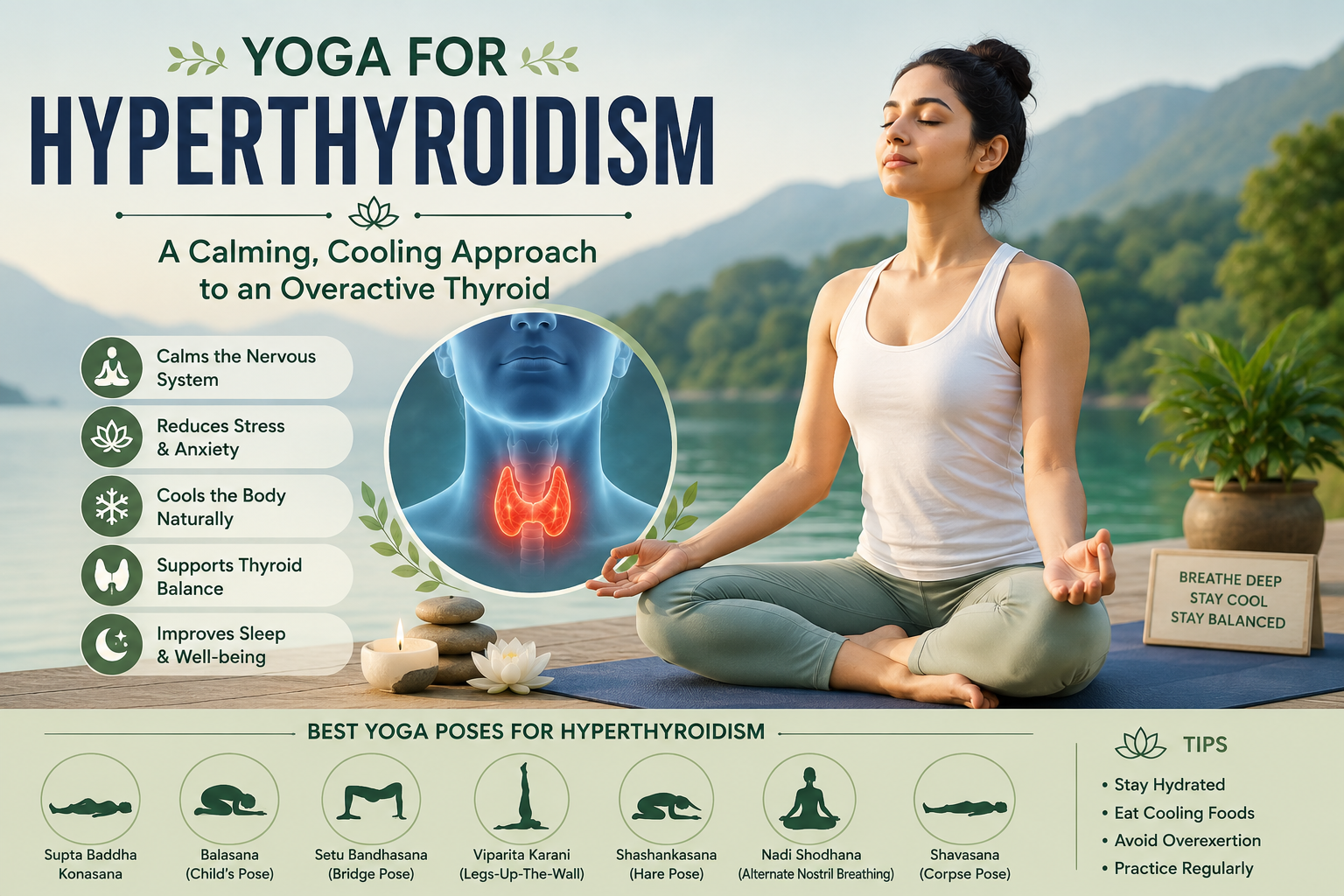
| Asana | Primary Action | Why It Suits Hyperthyroidism |
| Balasana (Child’s Pose) | Gentle forward fold, forehead grounded | Calms the nervous system and lowers heart rate without any throat stimulation |
| Paschimottanasana (Seated Forward Bend) | Passive forward fold | Soothing and introspective; avoids the chest and throat opening of backbends |
| Viparita Karani (Legs-Up-the-Wall) | Gentle, well-supported inversion | A safe, restful alternative to shoulder stand; eases palpitations without over-stimulating the neck |
| Supta Baddha Konasana (Reclined Bound Angle) | Reclined, supported hip opener | Deeply restorative; encourages long, slow breathing and reduces overall arousal |
| Marjaryasana-Bitilasana (Cat-Cow) | Slow, rhythmic spinal movement | Releases tension gently without the intensity of deep backbends like camel or fish pose |
| Savasana (Corpse Pose) | Complete stillness | Essential closing posture; allows the parasympathetic response built during practice to consolidate |
Postures traditionally recommended for hypothyroidism — Sarvangasana (shoulder stand), Halasana (plough pose), Matsyasana (fish pose), and Ustrasana (camel pose) — directly stimulate and stretch the thyroid region and are generally best avoided or only practiced under close supervision when hyperthyroidism is active, since added glandular stimulation is the opposite of what the condition needs. Fast-paced sun salutations, forceful backbends, and long, deep inversions held for extended periods fall into the same caution category.
Because so much of this comes down to individual sensitivity and correct modification, a supervised, props-based approach such as Iyengar Yoga in Rishikesh India is particularly useful, since bolsters, blankets, and walls can turn even a gentle inversion like legs-up-the-wall into a fully supported, low-effort posture rather than one that risks overstimulation.
4. Cooling Pranayama and Deep Rest for an Overactive Thyroid
Breathwork matters even more here than in hypothyroidism, because the wrong style of pranayama can genuinely aggravate symptoms.
Sheetali and Sheetkari (cooling breath): Breathing in through a curled tongue or clenched teeth cools the body and calms the nervous system, directly countering the heat intolerance common in hyperthyroidism.
Nadi Shodhana (alternate nostril breathing), slow pace: Balances the nervous system without the intensity of forceful techniques, and is well tolerated even on days when palpitations feel prominent.
Extended exhale breathing: Simply lengthening the exhale relative to the inhale (for example, a four-count inhale against an eight-count exhale) activates the vagus nerve and is one of the fastest ways to lower a racing heart rate naturally.
Vigorous techniques such as Kapalabhati (skull-shining breath) or Bhastrika (bellows breath) are generally best avoided during active hyperthyroidism, since their rapid, forceful pace can increase heart rate and heighten the wired, anxious feeling the condition already produces.
A full session of guided Yoga Nidra in Rishikesh is one of the single most useful tools available here, since it lowers arousal without requiring any physical effort at all, which matters on days when even gentle asana feels like too much.
Because the racing heartbeat, restlessness, and sense of dread that come with an overactive thyroid so often mirror the symptoms covered in resources on Yoga for Panic Attacks, many of the same grounding techniques — slow exhale-focused breathing, supported forward folds, and a calm, unhurried pace — apply directly here as well, even though the underlying cause is hormonal rather than purely psychological.
5. Building a Calming Daily Practice for Hyperthyroidism
A realistic routine for hyperthyroidism should feel closer to wind-down time than a workout. A simple structure to follow:
- Begin seated or reclined with five minutes of extended-exhale breathing to settle the heart rate before any movement.
- Move slowly through cat-cow and gentle seated stretches, keeping the pace unhurried and avoiding any sense of pushing toward a deeper stretch.
- Hold two or three grounding postures from the table above — child’s pose, seated forward bend, and legs-up-the-wall are a reliable core sequence — for one to three minutes each.
- Add five minutes of Sheetali or Sheetkari cooling breath, particularly useful in the evening or during warmer months.
- Close with 15 to 20 minutes of Savasana or full Yoga Nidra, since this is where most of the nervous-system benefit consolidates.
- Practice in a cool, quiet room rather than a heated studio, and avoid scheduling practice immediately after caffeine or a stressful part of the day.
A session built this way rarely needs to exceed 30 to 40 minutes. The point is not to build strength or stamina but to give an overstimulated system a genuine, repeatable chance to downshift each day.
6. Lifestyle Habits That Support the Practice
Yoga works best alongside a daily rhythm that avoids adding further stimulation to an already overactive system:
- Reduce or eliminate caffeine, since it compounds the palpitations and jitteriness hyperthyroidism already produces.
- Prioritise a consistent, unhurried bedtime routine, since poor sleep further elevates the stress hormones that aggravate symptoms.
- Choose cooling, hydrating foods and stay mindful of the unintended weight loss that often accompanies untreated or under-treated hyperthyroidism.
- Limit intense cardio or heat-based exercise during active flare periods, and reintroduce it gradually once hormone levels are better controlled under medical guidance.
- Build in short pauses through the day — even two minutes of extended-exhale breathing between tasks can prevent stress from compounding by evening.
None of these changes need to happen at once. Most people find it easier to remove one stimulating habit at a time — caffeine first, then late nights, then overly vigorous exercise — while adding the calming yoga elements described above in parallel.
For those who want to understand the emotional side of this more deeply, resources on Yoga for Emotional Balance and Pranayama for Stress Relief both offer practices that pair naturally with a hyperthyroidism-focused routine, since irritability and emotional volatility are as much a part of the condition as the physical symptoms.
Frequently Asked Questions (FAQs)
Q1. Can yoga replace medication for hyperthyroidism?
No. Hyperthyroidism, especially from Graves’ disease, requires medical treatment such as antithyroid medication, beta-blockers, radioactive iodine, or surgery depending on severity. Yoga supports the nervous system and eases symptoms alongside treatment; it does not correct excess hormone output on its own.
Q2. Why are inversions like shoulder stand discouraged for hyperthyroidism when they’re recommended for hypothyroidism?
Deep inversions and throat-focused backbends physically stimulate the thyroid gland and increase blood flow to it, which is helpful when the gland is underactive but unhelpful, and potentially aggravating, when it is already overproducing hormone.
Q3. Is any form of vigorous exercise safe during hyperthyroidism?
This varies significantly by severity and should be discussed with your doctor. Many people reduce high-intensity exercise during an active flare and reintroduce it gradually as hormone levels normalise with treatment, since an already elevated heart rate and metabolism leave less physiological buffer for intense exertion.
Q4. How quickly does a calming yoga practice help with symptoms like anxiety and racing heart?
Many people notice some easing of anxiety and a steadier heart rate within the first few sessions, since slow breathing has a fairly immediate effect on the nervous system. Sleep quality and overall symptom load typically take several weeks of consistent practice to shift more durably.
Q5. Can hot yoga or heated studio classes be used for hyperthyroidism?
It’s best to avoid heated classes during active hyperthyroidism, since heat intolerance is already a common symptom and added external heat can increase discomfort, heart rate, and the risk of dehydration.
Q6. Does stress management genuinely affect thyroid hormone levels, or only how symptoms feel?
Stress does not directly cause Graves’ disease or hyperthyroidism, but chronic stress can worsen the autoimmune activity behind it in some people and consistently intensifies how symptoms are experienced day to day, which is where a calming practice makes the most measurable difference.
Q7. Is it worth learning this style of practice properly rather than following generic videos online?
Yes, particularly for a condition where the wrong style of practice can worsen symptoms rather than help them. A structured Yoga Teacher Training in Rishikesh program gives individual, supervised correction, which matters far more here than in a general fitness class where instructors rarely account for thyroid-specific contraindications.
Final Thoughts
Hyperthyroidism asks for the opposite instinct that most people bring to yoga: less heat, less intensity, and less stimulation, not more. A slow, cooling, restorative practice — built around grounding postures, gentle inversions like legs-up-the-wall, and calming pranayama — works with an already overstimulated nervous system rather than against it, and can meaningfully ease the anxious, racing, overheated feeling that comes with an overactive thyroid.
Whether you build this into a short home routine or choose to deepen it through a dedicated Yoga Retreat in Rishikesh, the underlying principle stays constant: calm, consistent, correctly guided practice, paired with the medical treatment your condition requires, is what actually moves the needle over time.
